

450
10 The Statistical Basis of Bioenergetics
For ortho-hydrogen, the two proton spins are parallel, so they add to give a total
spin of I = 1, with a degeneracy of 2 I + 1 = 3 possible orientations along a
measurement axis. Since the spin one state is symmetric under the exchange of
the two protons, a rotation of 180 ◦ that carries one proton into the prior position
of the other must make the orbital part of the hydrogen molecule wave function
antisymmetric under such a rotation, since the protons are fermions. These orbital
parts with a total orbital angular momentum quantum number L will change by a
factor (−1) L by the 180 ◦ rotation, so L must be odd: L = 1, 3, 5, · · · .
For para-hydrogen, when the proton spins are anti-parallel, the nuclear spin state
give a total spin of I = 0, with just one possible such state, and therefore a
degeneracy of 2 I + 1 = 1. This state is antisymmetric on exchange of the two
protons, so the orbital parts of the total wave function must have only even L:
0, 2, 4, · · · .
Because the protons have only a very weak (magnetic) interaction with the
orbiting electrons, their spin states do not often change when the hydrogen
molecule gets bounced around by thermal motion at room temperature. Under these
conditions, the rotational energy states are dominated by the orbital motion of the
two protons revolving around an axis perpendicular to the line joining the protons.
Thus,
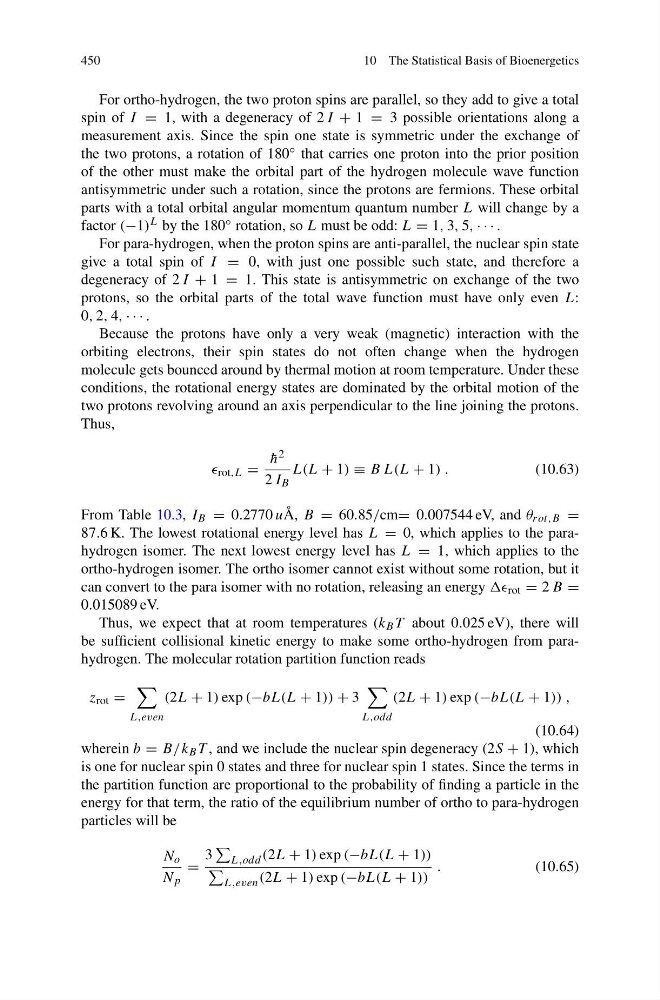
rot,L =
¯
h 2
2 I B
L(L + 1) ≡ B L(L + 1) .
(10.63)
From Table 10.3, I B = 0.2770 uÅ, B = 60.85/cm= 0.007544 eV, and θ rot,B =
87.6 K. The lowest rotational energy level has L = 0, which applies to the parahydrogen isomer. The next lowest energy level has L = 1, which applies to the
ortho-hydrogen isomer. The ortho isomer cannot exist without some rotation, but it
can convert to the para isomer with no rotation, releasing an energy rot = 2 B =
0.015089 eV.
Thus, we expect that at room temperatures (k B T about 0.025 eV), there will
be sufficient collisional kinetic energy to make some ortho-hydrogen from parahydrogen. The molecular rotation partition function reads
z rot =
L,even
(2L + 1) exp (−bL(L + 1)) + 3
L,odd
(2L + 1) exp (−bL(L + 1)) ,
(10.64)
wherein b = B/k B T , and we include the nuclear spin degeneracy (2S + 1), which
is one for nuclear spin 0 states and three for nuclear spin 1 states. Since the terms in
the partition function are proportional to the probability of finding a particle in the
energy for that term, the ratio of the equilibrium number of ortho to para-hydrogen
particles will be
N o
N p
=
3
L,odd (2L + 1) exp (−bL(L + 1))
L,even (2L + 1) exp (−bL(L + 1))
.
(10.65)
10 The Statistical Basis of Bioenergetics
For ortho-hydrogen, the two proton spins are parallel, so they add to give a total
spin of I = 1, with a degeneracy of 2 I + 1 = 3 possible orientations along a
measurement axis. Since the spin one state is symmetric under the exchange of
the two protons, a rotation of 180 ◦ that carries one proton into the prior position
of the other must make the orbital part of the hydrogen molecule wave function
antisymmetric under such a rotation, since the protons are fermions. These orbital
parts with a total orbital angular momentum quantum number L will change by a
factor (−1) L by the 180 ◦ rotation, so L must be odd: L = 1, 3, 5, · · · .
For para-hydrogen, when the proton spins are anti-parallel, the nuclear spin state
give a total spin of I = 0, with just one possible such state, and therefore a
degeneracy of 2 I + 1 = 1. This state is antisymmetric on exchange of the two
protons, so the orbital parts of the total wave function must have only even L:
0, 2, 4, · · · .
Because the protons have only a very weak (magnetic) interaction with the
orbiting electrons, their spin states do not often change when the hydrogen
molecule gets bounced around by thermal motion at room temperature. Under these
conditions, the rotational energy states are dominated by the orbital motion of the
two protons revolving around an axis perpendicular to the line joining the protons.
Thus,
rot,L =
¯
h 2
2 I B
L(L + 1) ≡ B L(L + 1) .
(10.63)
From Table 10.3, I B = 0.2770 uÅ, B = 60.85/cm= 0.007544 eV, and θ rot,B =
87.6 K. The lowest rotational energy level has L = 0, which applies to the parahydrogen isomer. The next lowest energy level has L = 1, which applies to the
ortho-hydrogen isomer. The ortho isomer cannot exist without some rotation, but it
can convert to the para isomer with no rotation, releasing an energy rot = 2 B =
0.015089 eV.
Thus, we expect that at room temperatures (k B T about 0.025 eV), there will
be sufficient collisional kinetic energy to make some ortho-hydrogen from parahydrogen. The molecular rotation partition function reads
z rot =
L,even
(2L + 1) exp (−bL(L + 1)) + 3
L,odd
(2L + 1) exp (−bL(L + 1)) ,
(10.64)
wherein b = B/k B T , and we include the nuclear spin degeneracy (2S + 1), which
is one for nuclear spin 0 states and three for nuclear spin 1 states. Since the terms in
the partition function are proportional to the probability of finding a particle in the
energy for that term, the ratio of the equilibrium number of ortho to para-hydrogen
particles will be
N o
N p
=
3
L,odd (2L + 1) exp (−bL(L + 1))
L,even (2L + 1) exp (−bL(L + 1))
.
(10.65)