

448
10 The Statistical Basis of Bioenergetics
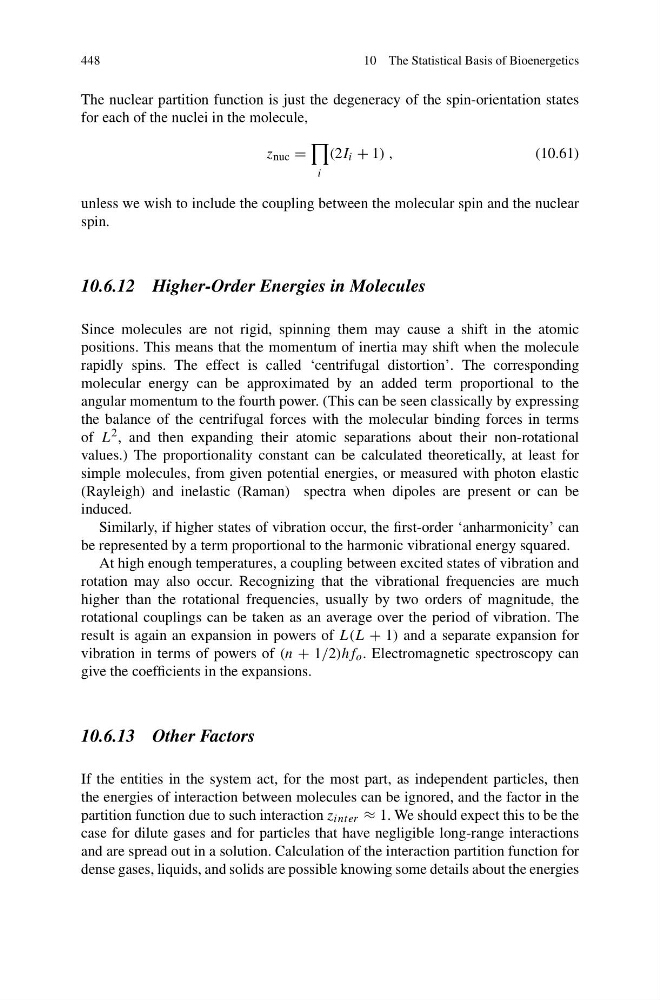
The nuclear partition function is just the degeneracy of the spin-orientation states
for each of the nuclei in the molecule,
z nuc =
i
(2I i + 1) ,
(10.61)
unless we wish to include the coupling between the molecular spin and the nuclear
spin.
10.6.12 Higher-Order Energies in Molecules
Since molecules are not rigid, spinning them may cause a shift in the atomic
positions. This means that the momentum of inertia may shift when the molecule
rapidly spins. The effect is called ‘centrifugal distortion’. The corresponding
molecular energy can be approximated by an added term proportional to the
angular momentum to the fourth power. (This can be seen classically by expressing
the balance of the centrifugal forces with the molecular binding forces in terms
of L 2 , and then expanding their atomic separations about their non-rotational
values.) The proportionality constant can be calculated theoretically, at least for
simple molecules, from given potential energies, or measured with photon elastic
(Rayleigh) and inelastic (Raman) spectra when dipoles are present or can be
induced.
Similarly, if higher states of vibration occur, the first-order ‘anharmonicity’ can
be represented by a term proportional to the harmonic vibrational energy squared.
At high enough temperatures, a coupling between excited states of vibration and
rotation may also occur. Recognizing that the vibrational frequencies are much
higher than the rotational frequencies, usually by two orders of magnitude, the
rotational couplings can be taken as an average over the period of vibration. The
result is again an expansion in powers of L(L + 1) and a separate expansion for
vibration in terms of powers of (n + 1/2)hf o . Electromagnetic spectroscopy can
give the coefficients in the expansions.
10.6.13 Other Factors
If the entities in the system act, for the most part, as independent particles, then
the energies of interaction between molecules can be ignored, and the factor in the
partition function due to such interaction z inter ≈ 1. We should expect this to be the
case for dilute gases and for particles that have negligible long-range interactions
and are spread out in a solution. Calculation of the interaction partition function for
dense gases, liquids, and solids are possible knowing some details about the energies
10 The Statistical Basis of Bioenergetics
The nuclear partition function is just the degeneracy of the spin-orientation states
for each of the nuclei in the molecule,
z nuc =
i
(2I i + 1) ,
(10.61)
unless we wish to include the coupling between the molecular spin and the nuclear
spin.
10.6.12 Higher-Order Energies in Molecules
Since molecules are not rigid, spinning them may cause a shift in the atomic
positions. This means that the momentum of inertia may shift when the molecule
rapidly spins. The effect is called ‘centrifugal distortion’. The corresponding
molecular energy can be approximated by an added term proportional to the
angular momentum to the fourth power. (This can be seen classically by expressing
the balance of the centrifugal forces with the molecular binding forces in terms
of L 2 , and then expanding their atomic separations about their non-rotational
values.) The proportionality constant can be calculated theoretically, at least for
simple molecules, from given potential energies, or measured with photon elastic
(Rayleigh) and inelastic (Raman) spectra when dipoles are present or can be
induced.
Similarly, if higher states of vibration occur, the first-order ‘anharmonicity’ can
be represented by a term proportional to the harmonic vibrational energy squared.
At high enough temperatures, a coupling between excited states of vibration and
rotation may also occur. Recognizing that the vibrational frequencies are much
higher than the rotational frequencies, usually by two orders of magnitude, the
rotational couplings can be taken as an average over the period of vibration. The
result is again an expansion in powers of L(L + 1) and a separate expansion for
vibration in terms of powers of (n + 1/2)hf o . Electromagnetic spectroscopy can
give the coefficients in the expansions.
10.6.13 Other Factors
If the entities in the system act, for the most part, as independent particles, then
the energies of interaction between molecules can be ignored, and the factor in the
partition function due to such interaction z inter ≈ 1. We should expect this to be the
case for dilute gases and for particles that have negligible long-range interactions
and are spread out in a solution. Calculation of the interaction partition function for
dense gases, liquids, and solids are possible knowing some details about the energies