

10.6 Partition Function for a Gas
447
z vib =
i
n i
exp (−βhf i (n i + 1/2)) .
(10.58)
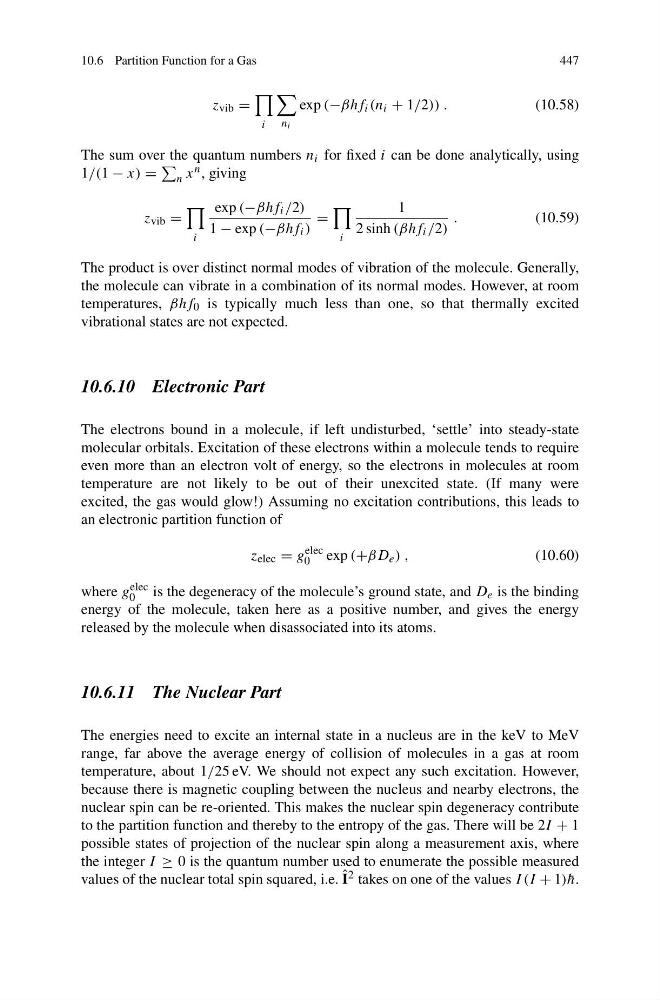
The sum over the quantum numbers n i for fixed i can be done analytically, using
1/(1 − x) =
n x n , giving
z vib =
i
exp (−βhf i /2)
1 − exp (−βhf i )
=
i
1
2 sinh (βhf i /2)
.
(10.59)
The product is over distinct normal modes of vibration of the molecule. Generally,
the molecule can vibrate in a combination of its normal modes. However, at room
temperatures, βhf 0 is typically much less than one, so that thermally excited
vibrational states are not expected.
10.6.10 Electronic Part
The electrons bound in a molecule, if left undisturbed, ‘settle’ into steady-state
molecular orbitals. Excitation of these electrons within a molecule tends to require
even more than an electron volt of energy, so the electrons in molecules at room
temperature are not likely to be out of their unexcited state. (If many were
excited, the gas would glow!) Assuming no excitation contributions, this leads to
an electronic partition function of
z elec = g
elec
0 exp (+βD e ) ,
(10.60)
where g elec
0
is the degeneracy of the molecule’s ground state, and D e is the binding
energy of the molecule, taken here as a positive number, and gives the energy
released by the molecule when disassociated into its atoms.
10.6.11 The Nuclear Part
The energies need to excite an internal state in a nucleus are in the keV to MeV
range, far above the average energy of collision of molecules in a gas at room
temperature, about 1/25 eV. We should not expect any such excitation. However,
because there is magnetic coupling between the nucleus and nearby electrons, the
nuclear spin can be re-oriented. This makes the nuclear spin degeneracy contribute
to the partition function and thereby to the entropy of the gas. There will be 2I + 1
possible states of projection of the nuclear spin along a measurement axis, where
the integer I ≥ 0 is the quantum number used to enumerate the possible measured
values of the nuclear total spin squared, i.e. ˆ
I 2 takes on one of the values I (I + 1) ¯
h.
447
z vib =
i
n i
exp (−βhf i (n i + 1/2)) .
(10.58)
The sum over the quantum numbers n i for fixed i can be done analytically, using
1/(1 − x) =
n x n , giving
z vib =
i
exp (−βhf i /2)
1 − exp (−βhf i )
=
i
1
2 sinh (βhf i /2)
.
(10.59)
The product is over distinct normal modes of vibration of the molecule. Generally,
the molecule can vibrate in a combination of its normal modes. However, at room
temperatures, βhf 0 is typically much less than one, so that thermally excited
vibrational states are not expected.
10.6.10 Electronic Part
The electrons bound in a molecule, if left undisturbed, ‘settle’ into steady-state
molecular orbitals. Excitation of these electrons within a molecule tends to require
even more than an electron volt of energy, so the electrons in molecules at room
temperature are not likely to be out of their unexcited state. (If many were
excited, the gas would glow!) Assuming no excitation contributions, this leads to
an electronic partition function of
z elec = g
elec
0 exp (+βD e ) ,
(10.60)
where g elec
0
is the degeneracy of the molecule’s ground state, and D e is the binding
energy of the molecule, taken here as a positive number, and gives the energy
released by the molecule when disassociated into its atoms.
10.6.11 The Nuclear Part
The energies need to excite an internal state in a nucleus are in the keV to MeV
range, far above the average energy of collision of molecules in a gas at room
temperature, about 1/25 eV. We should not expect any such excitation. However,
because there is magnetic coupling between the nucleus and nearby electrons, the
nuclear spin can be re-oriented. This makes the nuclear spin degeneracy contribute
to the partition function and thereby to the entropy of the gas. There will be 2I + 1
possible states of projection of the nuclear spin along a measurement axis, where
the integer I ≥ 0 is the quantum number used to enumerate the possible measured
values of the nuclear total spin squared, i.e. ˆ
I 2 takes on one of the values I (I + 1) ¯
h.