

446
10 The Statistical Basis of Bioenergetics
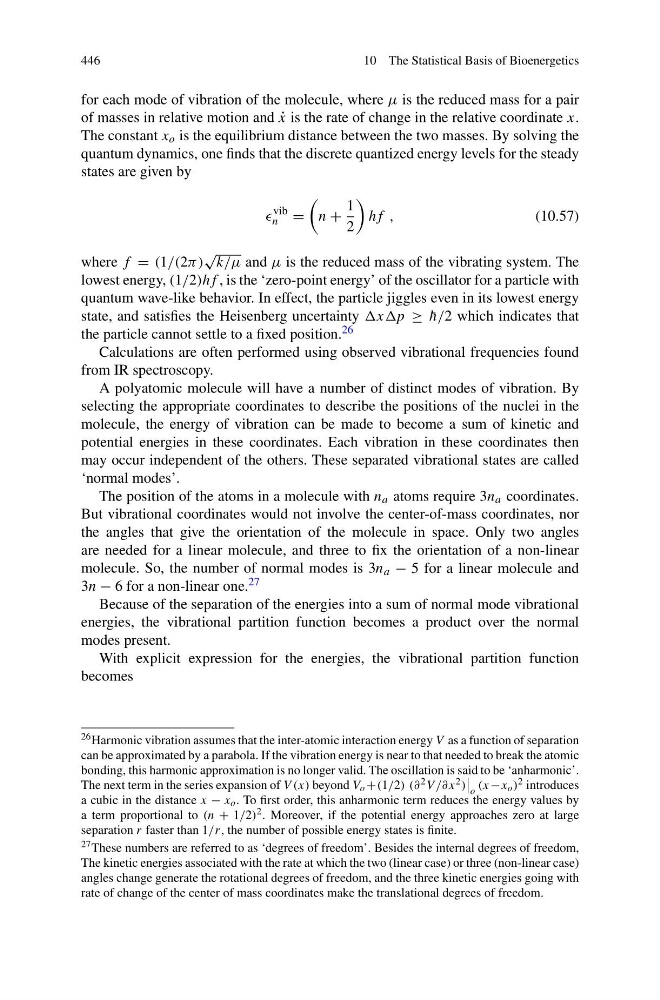
for each mode of vibration of the molecule, where μ is the reduced mass for a pair
of masses in relative motion and ˙
x is the rate of change in the relative coordinate x.
The constant x o is the equilibrium distance between the two masses. By solving the
quantum dynamics, one finds that the discrete quantized energy levels for the steady
states are given by
vib
n =
n +
1
2
hf ,
(10.57)
where f = (1/(2π)
√
k/μ and μ is the reduced mass of the vibrating system. The
lowest energy, (1/2)hf , is the ‘zero-point energy’ of the oscillator for a particle with
quantum wave-like behavior. In effect, the particle jiggles even in its lowest energy
state, and satisfies the Heisenberg uncertainty ≥ ¯
h/2 which indicates that
the particle cannot settle to a fixed position. 26
Calculations are often performed using observed vibrational frequencies found
from IR spectroscopy.
A polyatomic molecule will have a number of distinct modes of vibration. By
selecting the appropriate coordinates to describe the positions of the nuclei in the
molecule, the energy of vibration can be made to become a sum of kinetic and
potential energies in these coordinates. Each vibration in these coordinates then
may occur independent of the others. These separated vibrational states are called
‘normal modes’.
The position of the atoms in a molecule with n a atoms require 3n a coordinates.
But vibrational coordinates would not involve the center-of-mass coordinates, nor
the angles that give the orientation of the molecule in space. Only two angles
are needed for a linear molecule, and three to fix the orientation of a non-linear
molecule. So, the number of normal modes is 3n a − 5 for a linear molecule and
3n − 6 for a non-linear one. 27
Because of the separation of the energies into a sum of normal mode vibrational
energies, the vibrational partition function becomes a product over the normal
modes present.
With explicit expression for the energies, the vibrational partition function
becomes
26 Harmonic vibration assumes that the inter-atomic interaction energy V as a function of separation
can be approximated by a parabola. If the vibration energy is near to that needed to break the atomic
bonding, this harmonic approximation is no longer valid. The oscillation is said to be ‘anharmonic’.
The next term in the series expansion of V (x) beyond V o +(1/2) (∂ 2 V /∂x 2 )
o
(x −x o ) 2 introduces
a cubic in the distance x − x o . To first order, this anharmonic term reduces the energy values by
a term proportional to (n + 1/2) 2 . Moreover, if the potential energy approaches zero at large
separation r faster than 1/r, the number of possible energy states is finite.
27 These numbers are referred to as ‘degrees of freedom’. Besides the internal degrees of freedom,
The kinetic energies associated with the rate at which the two (linear case) or three (non-linear case)
angles change generate the rotational degrees of freedom, and the three kinetic energies going with
rate of change of the center of mass coordinates make the translational degrees of freedom.
10 The Statistical Basis of Bioenergetics
for each mode of vibration of the molecule, where μ is the reduced mass for a pair
of masses in relative motion and ˙
x is the rate of change in the relative coordinate x.
The constant x o is the equilibrium distance between the two masses. By solving the
quantum dynamics, one finds that the discrete quantized energy levels for the steady
states are given by
vib
n =
n +
1
2
hf ,
(10.57)
where f = (1/(2π)
√
k/μ and μ is the reduced mass of the vibrating system. The
lowest energy, (1/2)hf , is the ‘zero-point energy’ of the oscillator for a particle with
quantum wave-like behavior. In effect, the particle jiggles even in its lowest energy
state, and satisfies the Heisenberg uncertainty ≥ ¯
h/2 which indicates that
the particle cannot settle to a fixed position. 26
Calculations are often performed using observed vibrational frequencies found
from IR spectroscopy.
A polyatomic molecule will have a number of distinct modes of vibration. By
selecting the appropriate coordinates to describe the positions of the nuclei in the
molecule, the energy of vibration can be made to become a sum of kinetic and
potential energies in these coordinates. Each vibration in these coordinates then
may occur independent of the others. These separated vibrational states are called
‘normal modes’.
The position of the atoms in a molecule with n a atoms require 3n a coordinates.
But vibrational coordinates would not involve the center-of-mass coordinates, nor
the angles that give the orientation of the molecule in space. Only two angles
are needed for a linear molecule, and three to fix the orientation of a non-linear
molecule. So, the number of normal modes is 3n a − 5 for a linear molecule and
3n − 6 for a non-linear one. 27
Because of the separation of the energies into a sum of normal mode vibrational
energies, the vibrational partition function becomes a product over the normal
modes present.
With explicit expression for the energies, the vibrational partition function
becomes
26 Harmonic vibration assumes that the inter-atomic interaction energy V as a function of separation
can be approximated by a parabola. If the vibration energy is near to that needed to break the atomic
bonding, this harmonic approximation is no longer valid. The oscillation is said to be ‘anharmonic’.
The next term in the series expansion of V (x) beyond V o +(1/2) (∂ 2 V /∂x 2 )
o
(x −x o ) 2 introduces
a cubic in the distance x − x o . To first order, this anharmonic term reduces the energy values by
a term proportional to (n + 1/2) 2 . Moreover, if the potential energy approaches zero at large
separation r faster than 1/r, the number of possible energy states is finite.
27 These numbers are referred to as ‘degrees of freedom’. Besides the internal degrees of freedom,
The kinetic energies associated with the rate at which the two (linear case) or three (non-linear case)
angles change generate the rotational degrees of freedom, and the three kinetic energies going with
rate of change of the center of mass coordinates make the translational degrees of freedom.