

10.6 Partition Function for a Gas
437
z = z trans · z rot · z vib · z elec · z coupling · z nucl .
(10.41)
Here, z is called the molecular partition function.
10.6.1 The Translational Part
We will work out z trans for an ideal gas left in a closed box for a long enough
time that the particles have come to a steady state. The quantum energy levels
for the free particles in a box can be found by setting up waves in the box with
nodes at the boundaries. Suppose the box has a length L x along the x direction.
The longest wave which fits the box has half a wavelength across the box. The
next has two halves, and so forth. So n x λ x /2 = L x , with n x = 1, 2, 3, · · · .
The momentum of such a particle wave will be p x = h/λ x . The kinetic energy
will be p 2 /2m. So the energy of waves across any direction of the box will be
n x ,n y ,n z = h 2
n 2
x /L 2
x + n 2
y /L 2
y + n 2
z /L 2
z
/(8m). The lowest values for any one
of the integers {n x , n y , n z } is not zero, but rather one, because of the Heisenberg
uncertainty principle: The uncertainty in momentum for a particle limited to a region
of space cannot be zero. Thus, the lowest translational energy in a cubicle box of
volume V will not be zero, but rather 3h 2 /(8mV 2/3 ). Ordinarily, this is a very small
energy compared to k B T . The largest values for the {n x , n y , n z } are determined
by the total energy available in the system. If E is the total energy in a system
of particles confined to a cubicle box of volume V , then the largest of any of the
{n x , n y , n z } will be
(8mV 2/3 /h 2 )E − 2.
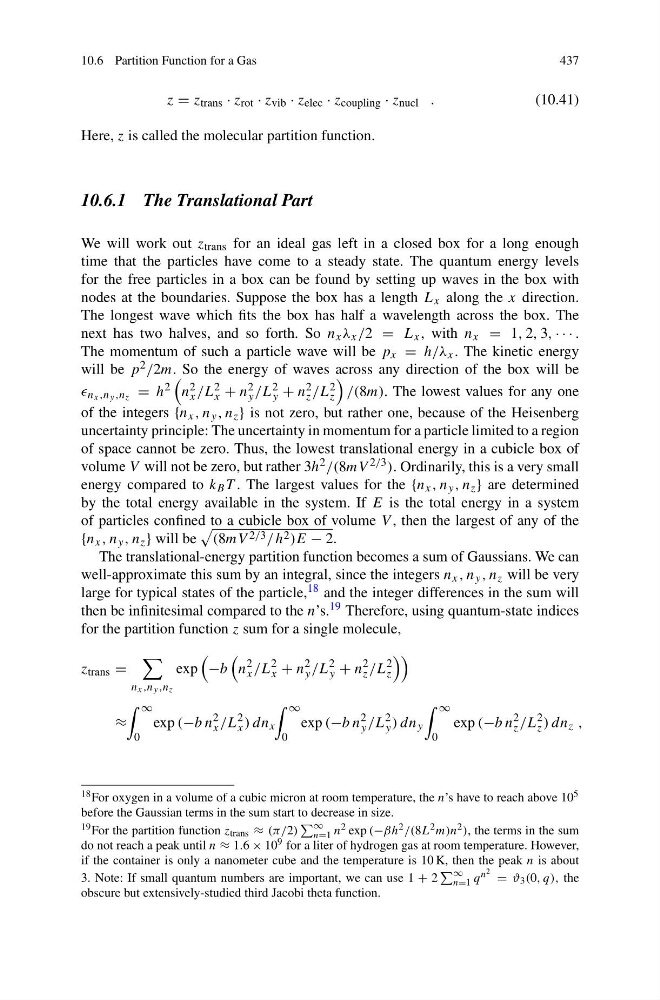
The translational-energy partition function becomes a sum of Gaussians. We can
well-approximate this sum by an integral, since the integers n x , n y , n z will be very
large for typical states of the particle, 18 and the integer differences in the sum will
then be infinitesimal compared to the n’s. 19 Therefore, using quantum-state indices
for the partition function z sum for a single molecule,
z trans =
n x ,n y ,n z
exp
−b
n
2
x /L
2
x + n
2
y /L
2
y + n
2
z /L
2
z
≈
∞
0
exp (−b n
2
x /L
2
x ) dn x
∞
0
exp (−b n
2
y /L
2
y ) dn y
∞
0
exp (−b n
2
z /L
2
z ) dn z ,
18 For oxygen in a volume of a cubic micron at room temperature, the n’s have to reach above 10 5
before the Gaussian terms in the sum start to decrease in size.
19 For the partition function z trans ≈ (π/2)
∞
n=1 n 2 exp (−βh 2 /(8L 2 m)n 2 ), the terms in the sum
do not reach a peak until n ≈ 1.6 × 10 9 for a liter of hydrogen gas at room temperature. However,
if the container is only a nanometer cube and the temperature is 10 K, then the peak n is about
3. Note: If small quantum numbers are important, we can use 1 + 2
∞
n=1 q n 2 = ϑ 3 (0, q), the
obscure but extensively-studied third Jacobi theta function.
437
z = z trans · z rot · z vib · z elec · z coupling · z nucl .
(10.41)
Here, z is called the molecular partition function.
10.6.1 The Translational Part
We will work out z trans for an ideal gas left in a closed box for a long enough
time that the particles have come to a steady state. The quantum energy levels
for the free particles in a box can be found by setting up waves in the box with
nodes at the boundaries. Suppose the box has a length L x along the x direction.
The longest wave which fits the box has half a wavelength across the box. The
next has two halves, and so forth. So n x λ x /2 = L x , with n x = 1, 2, 3, · · · .
The momentum of such a particle wave will be p x = h/λ x . The kinetic energy
will be p 2 /2m. So the energy of waves across any direction of the box will be
n x ,n y ,n z = h 2
n 2
x /L 2
x + n 2
y /L 2
y + n 2
z /L 2
z
/(8m). The lowest values for any one
of the integers {n x , n y , n z } is not zero, but rather one, because of the Heisenberg
uncertainty principle: The uncertainty in momentum for a particle limited to a region
of space cannot be zero. Thus, the lowest translational energy in a cubicle box of
volume V will not be zero, but rather 3h 2 /(8mV 2/3 ). Ordinarily, this is a very small
energy compared to k B T . The largest values for the {n x , n y , n z } are determined
by the total energy available in the system. If E is the total energy in a system
of particles confined to a cubicle box of volume V , then the largest of any of the
{n x , n y , n z } will be
(8mV 2/3 /h 2 )E − 2.
The translational-energy partition function becomes a sum of Gaussians. We can
well-approximate this sum by an integral, since the integers n x , n y , n z will be very
large for typical states of the particle, 18 and the integer differences in the sum will
then be infinitesimal compared to the n’s. 19 Therefore, using quantum-state indices
for the partition function z sum for a single molecule,
z trans =
n x ,n y ,n z
exp
−b
n
2
x /L
2
x + n
2
y /L
2
y + n
2
z /L
2
z
≈
∞
0
exp (−b n
2
x /L
2
x ) dn x
∞
0
exp (−b n
2
y /L
2
y ) dn y
∞
0
exp (−b n
2
z /L
2
z ) dn z ,
18 For oxygen in a volume of a cubic micron at room temperature, the n’s have to reach above 10 5
before the Gaussian terms in the sum start to decrease in size.
19 For the partition function z trans ≈ (π/2)
∞
n=1 n 2 exp (−βh 2 /(8L 2 m)n 2 ), the terms in the sum
do not reach a peak until n ≈ 1.6 × 10 9 for a liter of hydrogen gas at room temperature. However,
if the container is only a nanometer cube and the temperature is 10 K, then the peak n is about
3. Note: If small quantum numbers are important, we can use 1 + 2
∞
n=1 q n 2 = ϑ 3 (0, q), the
obscure but extensively-studied third Jacobi theta function.