

438
10 The Statistical Basis of Bioenergetics
=
2πm
h 2
3/2 L x L y L z
β 3/2 ,
(10.42)
where, for convenience, we put b ≡ βh 2 /(8m), and have used the Gaussian integral
∞
0 exp (−x 2 )dx = (1/2)
√
π. The result is
z trans =
2πm
h 2
3/2 V
β 3/2 ,
(10.43)
with V = L x L y L z being the volume of the box.
But for an ideal gas whose molecules cannot be excited internally, we know from
thermodynamics that its system energy E = (3/2)N k B T . Thus, using Eq. (10.11)
in the form E = −∂(ln z)/∂β, applied to an ideal gas with no internal molecular
energy states, we will have
β =
1
k B T
.
We now invoke the fact that any system in thermal contact with this ideal gas will
have the same temperature, so that this ideal gas will define, as a thermometer, the
temperature of any other system.
The quantity in Eq. (10.43)
T ≡
h 2
2πmk B T
(10.44)
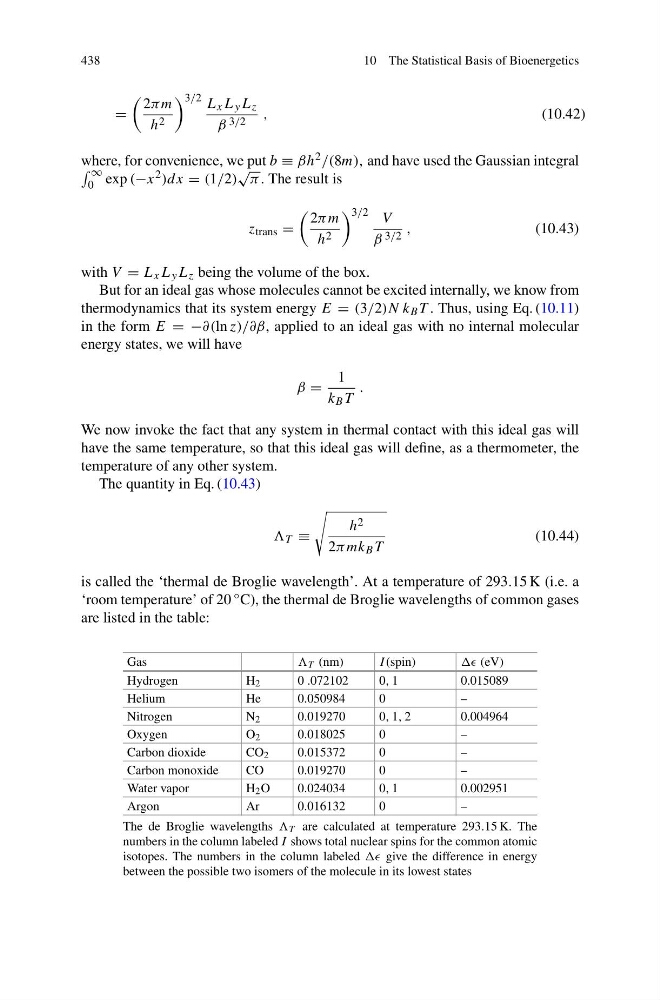
is called the ‘thermal de Broglie wavelength’. At a temperature of 293.15 K (i.e. a
‘room temperature’ of 20 ◦ C), the thermal de Broglie wavelengths of common gases
are listed in the table:
Gas
T (nm)
I (spin)
(eV)
Hydrogen
H 2
0 .072102
0, 1
0.015089
Helium
He
0.050984
0
–
Nitrogen
N 2
0.019270
0, 1, 2
0.004964
Oxygen
O 2
0.018025
0
–
Carbon dioxide
CO 2
0.015372
0
–
Carbon monoxide
CO
0.019270
0
–
Water vapor
H 2 O
0.024034
0, 1
0.002951
Argon
Ar
0.016132
0
–
The de Broglie wavelengths T are calculated at temperature 293.15 K. The
numbers in the column labeled I shows total nuclear spins for the common atomic
isotopes. The numbers in the column labeled give the difference in energy
between the possible two isomers of the molecule in its lowest states
10 The Statistical Basis of Bioenergetics
=
2πm
h 2
3/2 L x L y L z
β 3/2 ,
(10.42)
where, for convenience, we put b ≡ βh 2 /(8m), and have used the Gaussian integral
∞
0 exp (−x 2 )dx = (1/2)
√
π. The result is
z trans =
2πm
h 2
3/2 V
β 3/2 ,
(10.43)
with V = L x L y L z being the volume of the box.
But for an ideal gas whose molecules cannot be excited internally, we know from
thermodynamics that its system energy E = (3/2)N k B T . Thus, using Eq. (10.11)
in the form E = −∂(ln z)/∂β, applied to an ideal gas with no internal molecular
energy states, we will have
β =
1
k B T
.
We now invoke the fact that any system in thermal contact with this ideal gas will
have the same temperature, so that this ideal gas will define, as a thermometer, the
temperature of any other system.
The quantity in Eq. (10.43)
T ≡
h 2
2πmk B T
(10.44)
is called the ‘thermal de Broglie wavelength’. At a temperature of 293.15 K (i.e. a
‘room temperature’ of 20 ◦ C), the thermal de Broglie wavelengths of common gases
are listed in the table:
Gas
T (nm)
I (spin)
(eV)
Hydrogen
H 2
0 .072102
0, 1
0.015089
Helium
He
0.050984
0
–
Nitrogen
N 2
0.019270
0, 1, 2
0.004964
Oxygen
O 2
0.018025
0
–
Carbon dioxide
CO 2
0.015372
0
–
Carbon monoxide
CO
0.019270
0
–
Water vapor
H 2 O
0.024034
0, 1
0.002951
Argon
Ar
0.016132
0
–
The de Broglie wavelengths T are calculated at temperature 293.15 K. The
numbers in the column labeled I shows total nuclear spins for the common atomic
isotopes. The numbers in the column labeled give the difference in energy
between the possible two isomers of the molecule in its lowest states