

436
10 The Statistical Basis of Bioenergetics
E = E A + E B .
It follows that the enthalpy and the free energies, being extensive thermodynamic
variables, add. In the case of the Helmholtz free energy, A = E − T S, we have,
using Eq. (10.24),
A = A A + A B = −N A k B T ln (eZ A /N A ) − N B k B T ln (eZ B /N B )
and so
μ A = −k B T ln (Z A /N A ) , μ B = −k B T ln (Z B /N B ) .
(10.39)
10.6 Partition Function for a Gas
The energies accessible to the molecules in an ordinary gas can be separated into a
sum of terms corresponding to the kinetic energy and various potential energies each
molecule can have. The translational kinetic energy for non-relativistic motion of a
molecule takes the usual form of (1/2)p 2 /(2m), where p is the momentum of the
molecule and m its mass. If the molecule spins, it will also have rotational kinetic
energy. Molecules can also be excited into vibrational motion. If the vibrational
amplitude is small, the vibrational energy will be harmonic. If molecular stretching
occurs due to the molecule having a spin, then rotational and vibrational energies
associated with vibration during rotation will not be separable. However, the
energies needed to cause rotational stretching by collisions are so high compared
to room temperature energies (1/40 eV) that we can neglect their contribution.
During collisions of sufficient impact, the electrons in molecules might be sent to
excitation states of their electrons. The energies in this case are called ‘electronic’.
At the centers of the atoms of molecules are nuclei, which can change state by
interactions with the s-shell of the surrounding electrons. Energies associated with
nuclear excitations are labeled ‘nuclear’. Finally, any intermolecular interactions
have potential energies which add to the total energy. For the moment, we will
ignore the intermolecular interactions, so that the molecules can be considered
acting independently. Each of the possible quantum numbers associated with the
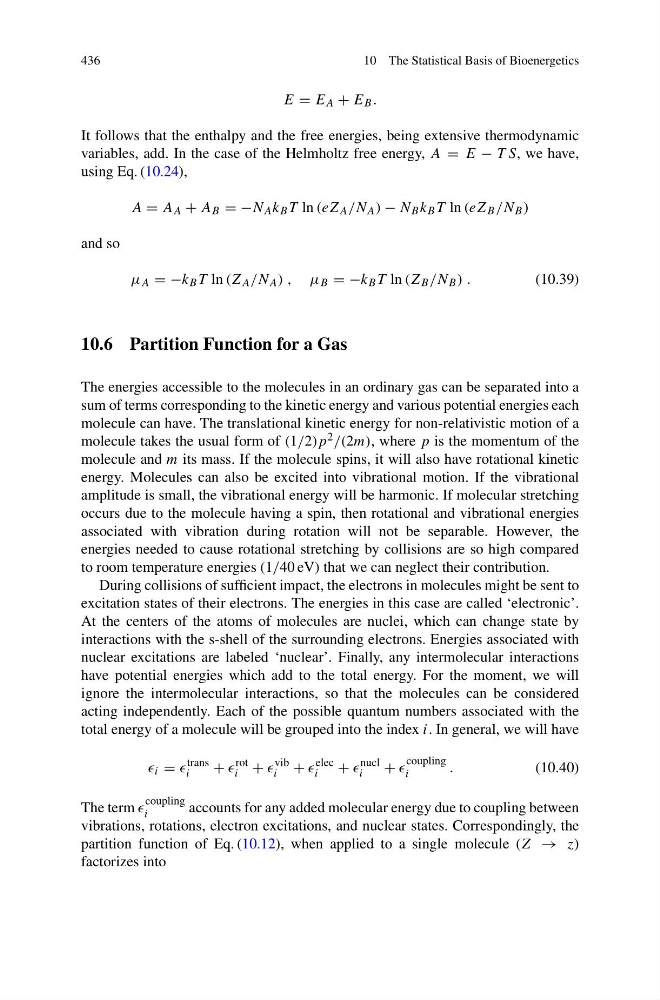
total energy of a molecule will be grouped into the index i. In general, we will have
i =
trans
i
+
rot
i +
vib
i +
elec
i
+
nucl
i
+
coupling
i
.
(10.40)
The term
coupling
i
accounts for any added molecular energy due to coupling between
vibrations, rotations, electron excitations, and nuclear states. Correspondingly, the
partition function of Eq. (10.12), when applied to a single molecule (Z → z)
factorizes into
10 The Statistical Basis of Bioenergetics
E = E A + E B .
It follows that the enthalpy and the free energies, being extensive thermodynamic
variables, add. In the case of the Helmholtz free energy, A = E − T S, we have,
using Eq. (10.24),
A = A A + A B = −N A k B T ln (eZ A /N A ) − N B k B T ln (eZ B /N B )
and so
μ A = −k B T ln (Z A /N A ) , μ B = −k B T ln (Z B /N B ) .
(10.39)
10.6 Partition Function for a Gas
The energies accessible to the molecules in an ordinary gas can be separated into a
sum of terms corresponding to the kinetic energy and various potential energies each
molecule can have. The translational kinetic energy for non-relativistic motion of a
molecule takes the usual form of (1/2)p 2 /(2m), where p is the momentum of the
molecule and m its mass. If the molecule spins, it will also have rotational kinetic
energy. Molecules can also be excited into vibrational motion. If the vibrational
amplitude is small, the vibrational energy will be harmonic. If molecular stretching
occurs due to the molecule having a spin, then rotational and vibrational energies
associated with vibration during rotation will not be separable. However, the
energies needed to cause rotational stretching by collisions are so high compared
to room temperature energies (1/40 eV) that we can neglect their contribution.
During collisions of sufficient impact, the electrons in molecules might be sent to
excitation states of their electrons. The energies in this case are called ‘electronic’.
At the centers of the atoms of molecules are nuclei, which can change state by
interactions with the s-shell of the surrounding electrons. Energies associated with
nuclear excitations are labeled ‘nuclear’. Finally, any intermolecular interactions
have potential energies which add to the total energy. For the moment, we will
ignore the intermolecular interactions, so that the molecules can be considered
acting independently. Each of the possible quantum numbers associated with the
total energy of a molecule will be grouped into the index i. In general, we will have
i =
trans
i
+
rot
i +
vib
i +
elec
i
+
nucl
i
+
coupling
i
.
(10.40)
The term
coupling
i
accounts for any added molecular energy due to coupling between
vibrations, rotations, electron excitations, and nuclear states. Correspondingly, the
partition function of Eq. (10.12), when applied to a single molecule (Z → z)
factorizes into