

10.5 Statistical Definition of Entropy
435
p A = p B
(10.37)
μ A = μ B .
(10.38)
We expect the temperature and pressure to balance with walls between the two
systems that can conduct heat and can move, and the chemical potentials will
balance at one temperature and pressure for the two systems when the particle
diffusion rates from system A to B matches that from B to A.
The identification of β with the inverse of k B T for an ideal gas will be shown
in Sect. 10.6.1. If one of the two systems A or B is an ideal gas, it can act as a
thermometer, since the other system must also have the same β = 1/(k B T ).
10.5.4 Equilibrium for a Mixture of Independent Particles
Now suppose we have two systems of particles, A and B, put in thermal contact, and
so reaching the same temperature, but without any change in the volumes taken up
by each set of particles. These systems may be a mixture of two types of particles,
or two boxes, one of each type, put into thermal contact, but without the transfer of
work or particles. If we consider the combined system, then W = W A W B , because
the distribution of the particles in each system is independent of the other system.
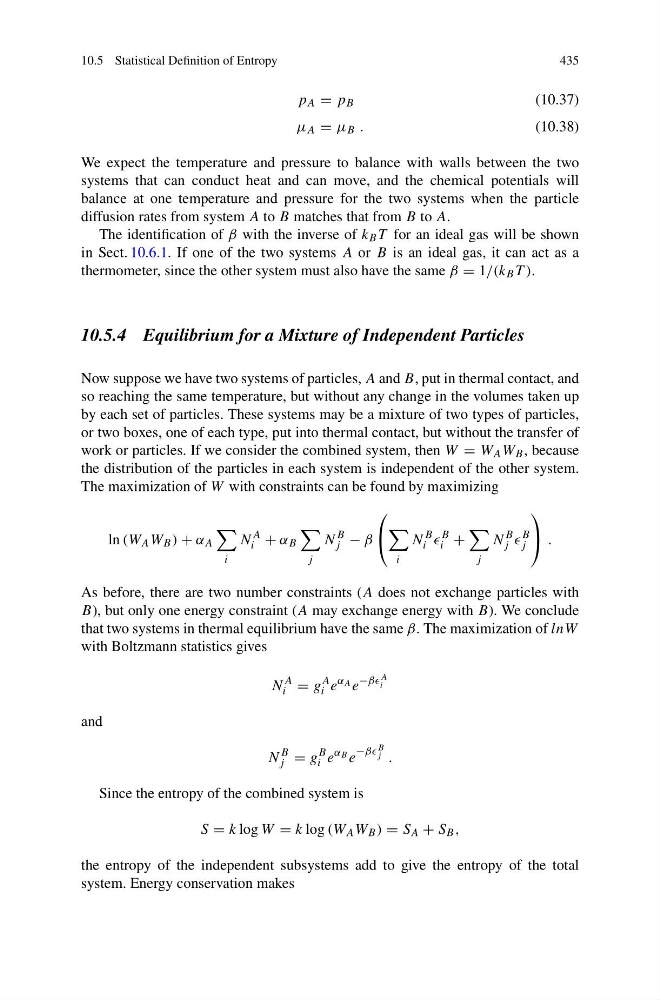
The maximization of W with constraints can be found by maximizing
ln (W A W B ) + α A
i
N
A
i + α B
j
N
B
j − β
⎛
⎝
i
N
B
i
B
i +
j
N
B
j
B
j
⎞
⎠ .
As before, there are two number constraints (A does not exchange particles with
B), but only one energy constraint (A may exchange energy with B). We conclude
that two systems in thermal equilibrium have the same β. The maximization of lnW
with Boltzmann statistics gives
N
A
i = g
A
i e
α A e
−ββ A
i
and
N
B
j = g
B
i e
α B e
−ββ B
j .
Since the entropy of the combined system is
S = k log W = k log (W A W B ) = S A + S B ,
the entropy of the independent subsystems add to give the entropy of the total
system. Energy conservation makes
435
p A = p B
(10.37)
μ A = μ B .
(10.38)
We expect the temperature and pressure to balance with walls between the two
systems that can conduct heat and can move, and the chemical potentials will
balance at one temperature and pressure for the two systems when the particle
diffusion rates from system A to B matches that from B to A.
The identification of β with the inverse of k B T for an ideal gas will be shown
in Sect. 10.6.1. If one of the two systems A or B is an ideal gas, it can act as a
thermometer, since the other system must also have the same β = 1/(k B T ).
10.5.4 Equilibrium for a Mixture of Independent Particles
Now suppose we have two systems of particles, A and B, put in thermal contact, and
so reaching the same temperature, but without any change in the volumes taken up
by each set of particles. These systems may be a mixture of two types of particles,
or two boxes, one of each type, put into thermal contact, but without the transfer of
work or particles. If we consider the combined system, then W = W A W B , because
the distribution of the particles in each system is independent of the other system.
The maximization of W with constraints can be found by maximizing
ln (W A W B ) + α A
i
N
A
i + α B
j
N
B
j − β
⎛
⎝
i
N
B
i
B
i +
j
N
B
j
B
j
⎞
⎠ .
As before, there are two number constraints (A does not exchange particles with
B), but only one energy constraint (A may exchange energy with B). We conclude
that two systems in thermal equilibrium have the same β. The maximization of lnW
with Boltzmann statistics gives
N
A
i = g
A
i e
α A e
−ββ A
i
and
N
B
j = g
B
i e
α B e
−ββ B
j .
Since the entropy of the combined system is
S = k log W = k log (W A W B ) = S A + S B ,
the entropy of the independent subsystems add to give the entropy of the total
system. Energy conservation makes