

434
10 The Statistical Basis of Bioenergetics
number of particles. As the combined systems are isolated, their combined energy,
volume, and particle number will be fixed, and we can write
E = E A + E B
V = V A + V B
N = N A + N B .
(10.31)
where the subscripts {A, B} refer to the selected system. If the two systems are
not in thermodynamic equilibrium, then exchanges of heat, work, and particles
will make the combined entropy of the two systems increase until it reaches a
maximum. If these exchanges occur quasi-statically, so that each system remains
close to equilibrium, then the changes in the entropy of each system can be tracked
through the small changes in the ways of distributing particles among the quantum
states of each, and the small changes in the energy values for these states due to
volume changes. We will arrange for the systems in the ensemble to have only small
surface interactions, so that the quantum states of any one member of the ensemble
in its volume will be little affected by small surface interactions, and we can count
distributions of particles in each system independently, expressing the total entropy
as
S = ln (W A W B ) = ln W A + ln W B = S A + S B .
(10.32)
When equilibrium is reached,
S(E, V , N) = S A (E A , V A , N A ) + S B (E B , V B , N B )
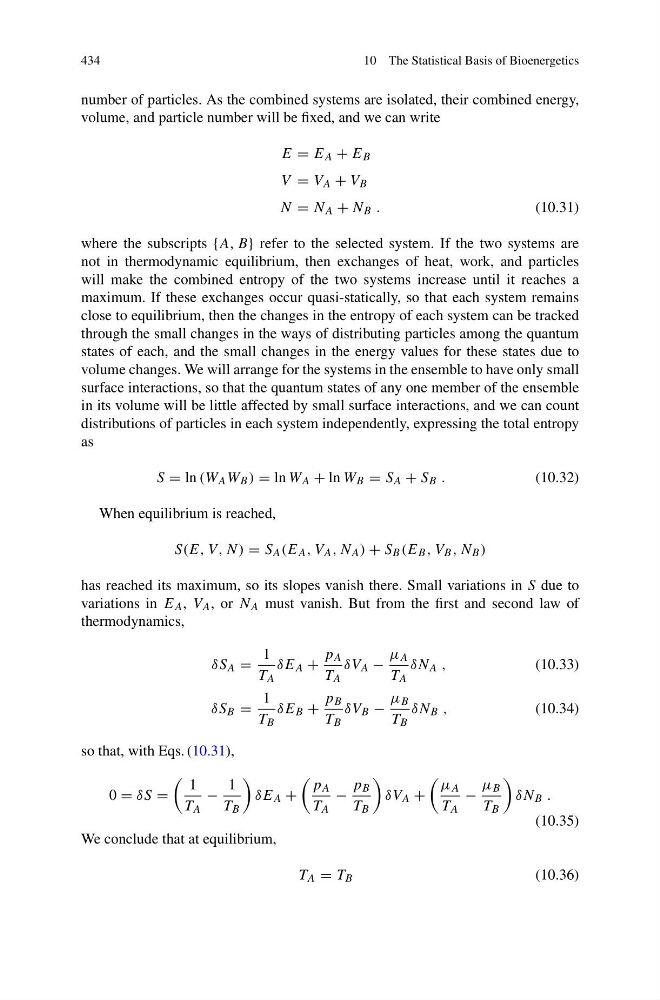
has reached its maximum, so its slopes vanish there. Small variations in S due to
variations in E A , V A , or N A must vanish. But from the first and second law of
thermodynamics,
δS A =
1
T A
δE A +
p A
T A
δV A −
μ A
T A
δN A ,
(10.33)
δS B =
1
T B
δE B +
p B
T B
δV B −
μ B
T B
δN B ,
(10.34)
so that, with Eqs. (10.31),
0 = δS =
1
T A
−
1
T B
δE A +
p A
T A
−
p B
T B
δV A +
μ A
T A
−
μ B
T B
δN B .
(10.35)
We conclude that at equilibrium,
T A = T B
(10.36)
10 The Statistical Basis of Bioenergetics
number of particles. As the combined systems are isolated, their combined energy,
volume, and particle number will be fixed, and we can write
E = E A + E B
V = V A + V B
N = N A + N B .
(10.31)
where the subscripts {A, B} refer to the selected system. If the two systems are
not in thermodynamic equilibrium, then exchanges of heat, work, and particles
will make the combined entropy of the two systems increase until it reaches a
maximum. If these exchanges occur quasi-statically, so that each system remains
close to equilibrium, then the changes in the entropy of each system can be tracked
through the small changes in the ways of distributing particles among the quantum
states of each, and the small changes in the energy values for these states due to
volume changes. We will arrange for the systems in the ensemble to have only small
surface interactions, so that the quantum states of any one member of the ensemble
in its volume will be little affected by small surface interactions, and we can count
distributions of particles in each system independently, expressing the total entropy
as
S = ln (W A W B ) = ln W A + ln W B = S A + S B .
(10.32)
When equilibrium is reached,
S(E, V , N) = S A (E A , V A , N A ) + S B (E B , V B , N B )
has reached its maximum, so its slopes vanish there. Small variations in S due to
variations in E A , V A , or N A must vanish. But from the first and second law of
thermodynamics,
δS A =
1
T A
δE A +
p A
T A
δV A −
μ A
T A
δN A ,
(10.33)
δS B =
1
T B
δE B +
p B
T B
δV B −
μ B
T B
δN B ,
(10.34)
so that, with Eqs. (10.31),
0 = δS =
1
T A
−
1
T B
δE A +
p A
T A
−
p B
T B
δV A +
μ A
T A
−
μ B
T B
δN B .
(10.35)
We conclude that at equilibrium,
T A = T B
(10.36)