

10.5 Statistical Definition of Entropy
431
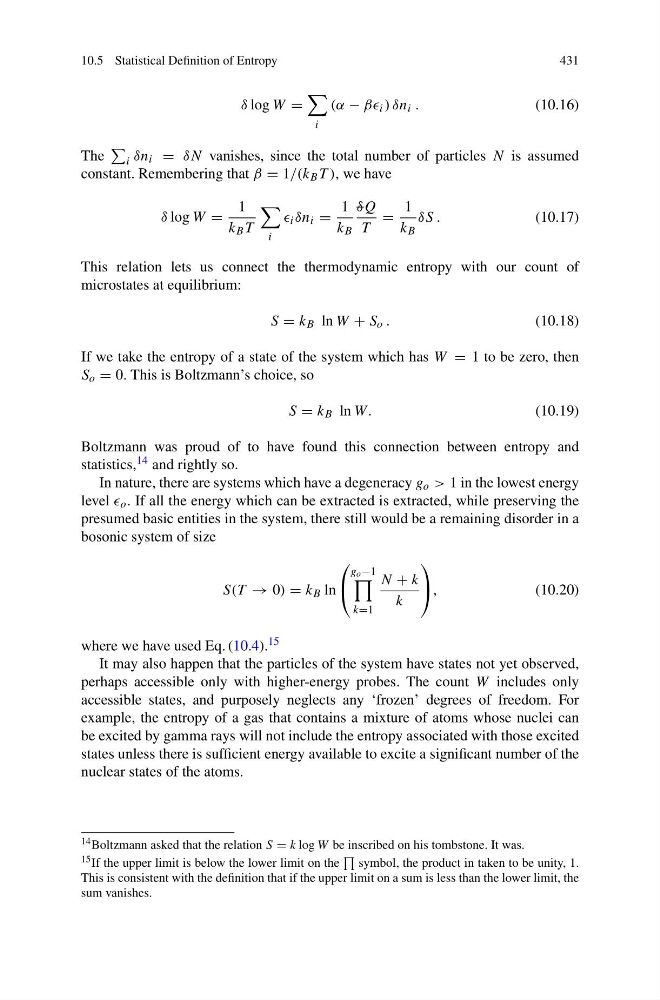
δ log W =
i
(α − ββ i ) δn i .
(10.16)
The
i δn i = δN vanishes, since the total number of particles N is assumed
constant. Remembering that β = 1/(k B T ), we have
δ log W =
1
k B T
i
i δn i =
1
k B
δQ
T
=
1
k B
δS .
(10.17)
This relation lets us connect the thermodynamic entropy with our count of
microstates at equilibrium:
S = k B ln W + S o .
(10.18)
If we take the entropy of a state of the system which has W = 1 to be zero, then
S o = 0. This is Boltzmann’s choice, so
S = k B ln W.
(10.19)
Boltzmann was proud of to have found this connection between entropy and
statistics, 14 and rightly so.
In nature, there are systems which have a degeneracy g o > 1 in the lowest energy
level o . If all the energy which can be extracted is extracted, while preserving the
presumed basic entities in the system, there still would be a remaining disorder in a
bosonic system of size
S(T → 0) = k B ln
⎛
⎝
g o −1
k=1
N + k
k
⎞
⎠ ,
(10.20)
where we have used Eq. (10.4). 15
It may also happen that the particles of the system have states not yet observed,
perhaps accessible only with higher-energy probes. The count W includes only
accessible states, and purposely neglects any ‘frozen’ degrees of freedom. For
example, the entropy of a gas that contains a mixture of atoms whose nuclei can
be excited by gamma rays will not include the entropy associated with those excited
states unless there is sufficient energy available to excite a significant number of the
nuclear states of the atoms.
14 Boltzmann asked that the relation S = k log W be inscribed on his tombstone. It was.
15 If the upper limit is below the lower limit on the
symbol, the product in taken to be unity, 1.
This is consistent with the definition that if the upper limit on a sum is less than the lower limit, the
sum vanishes.
431
δ log W =
i
(α − ββ i ) δn i .
(10.16)
The
i δn i = δN vanishes, since the total number of particles N is assumed
constant. Remembering that β = 1/(k B T ), we have
δ log W =
1
k B T
i
i δn i =
1
k B
δQ
T
=
1
k B
δS .
(10.17)
This relation lets us connect the thermodynamic entropy with our count of
microstates at equilibrium:
S = k B ln W + S o .
(10.18)
If we take the entropy of a state of the system which has W = 1 to be zero, then
S o = 0. This is Boltzmann’s choice, so
S = k B ln W.
(10.19)
Boltzmann was proud of to have found this connection between entropy and
statistics, 14 and rightly so.
In nature, there are systems which have a degeneracy g o > 1 in the lowest energy
level o . If all the energy which can be extracted is extracted, while preserving the
presumed basic entities in the system, there still would be a remaining disorder in a
bosonic system of size
S(T → 0) = k B ln
⎛
⎝
g o −1
k=1
N + k
k
⎞
⎠ ,
(10.20)
where we have used Eq. (10.4). 15
It may also happen that the particles of the system have states not yet observed,
perhaps accessible only with higher-energy probes. The count W includes only
accessible states, and purposely neglects any ‘frozen’ degrees of freedom. For
example, the entropy of a gas that contains a mixture of atoms whose nuclei can
be excited by gamma rays will not include the entropy associated with those excited
states unless there is sufficient energy available to excite a significant number of the
nuclear states of the atoms.
14 Boltzmann asked that the relation S = k log W be inscribed on his tombstone. It was.
15 If the upper limit is below the lower limit on the
symbol, the product in taken to be unity, 1.
This is consistent with the definition that if the upper limit on a sum is less than the lower limit, the
sum vanishes.