

432
10 The Statistical Basis of Bioenergetics
Because ln W is greater for more disordered systems, zero for perfectly ordered
ones, and is additive for two independent systems, we use ln W to DEFINE
disorder, 16 whether a system is near equilibrium or not:
The disorder of a system is proportional to the logarithm of the number of ways of
distributing the basic entities amongst the accessible states in the system, holding the
number per state fixed.
S D ∝ ln W .
(10.21)
Our generalization of entropy (Eq. (10.21)) to a measure of disorder will be particularly useful in the theory of information storage, information transfer, biological
analyzers, and of the dynamics of ordering, to be introduced later in Chap. 12. The
expression works even far from equilibrium, where the thermodynamic entropy
has little meaning. That information loss is directly connected to the production
of entropy was established by Leo Szilárd (see Sect. 12.1).
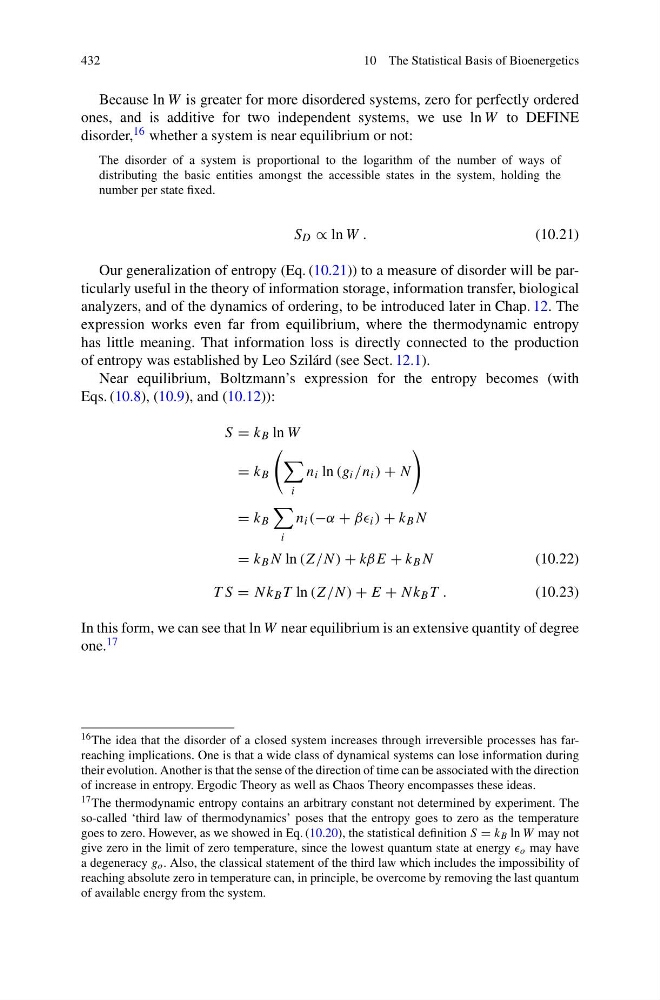
Near equilibrium, Boltzmann’s expression for the entropy becomes (with
Eqs. (10.8), (10.9), and (10.12)):
S = k B ln W
= k B
i
n i ln (g i /n i ) + N
= k B
i
n i (−α + ββ i ) + k B N
= k B N ln (Z/N ) + kβE + k B N
(10.22)
T S = Nk B T ln (Z/N ) + E + Nk B T .
(10.23)
In this form, we can see that ln W near equilibrium is an extensive quantity of degree
one. 17
16 The idea that the disorder of a closed system increases through irreversible processes has farreaching implications. One is that a wide class of dynamical systems can lose information during
their evolution. Another is that the sense of the direction of time can be associated with the direction
of increase in entropy. Ergodic Theory as well as Chaos Theory encompasses these ideas.
17 The thermodynamic entropy contains an arbitrary constant not determined by experiment. The
so-called ‘third law of thermodynamics’ poses that the entropy goes to zero as the temperature
goes to zero. However, as we showed in Eq. (10.20), the statistical definition S = k B ln W may not
give zero in the limit of zero temperature, since the lowest quantum state at energy o may have
a degeneracy g o . Also, the classical statement of the third law which includes the impossibility of
reaching absolute zero in temperature can, in principle, be overcome by removing the last quantum
of available energy from the system.
10 The Statistical Basis of Bioenergetics
Because ln W is greater for more disordered systems, zero for perfectly ordered
ones, and is additive for two independent systems, we use ln W to DEFINE
disorder, 16 whether a system is near equilibrium or not:
The disorder of a system is proportional to the logarithm of the number of ways of
distributing the basic entities amongst the accessible states in the system, holding the
number per state fixed.
S D ∝ ln W .
(10.21)
Our generalization of entropy (Eq. (10.21)) to a measure of disorder will be particularly useful in the theory of information storage, information transfer, biological
analyzers, and of the dynamics of ordering, to be introduced later in Chap. 12. The
expression works even far from equilibrium, where the thermodynamic entropy
has little meaning. That information loss is directly connected to the production
of entropy was established by Leo Szilárd (see Sect. 12.1).
Near equilibrium, Boltzmann’s expression for the entropy becomes (with
Eqs. (10.8), (10.9), and (10.12)):
S = k B ln W
= k B
i
n i ln (g i /n i ) + N
= k B
i
n i (−α + ββ i ) + k B N
= k B N ln (Z/N ) + kβE + k B N
(10.22)
T S = Nk B T ln (Z/N ) + E + Nk B T .
(10.23)
In this form, we can see that ln W near equilibrium is an extensive quantity of degree
one. 17
16 The idea that the disorder of a closed system increases through irreversible processes has farreaching implications. One is that a wide class of dynamical systems can lose information during
their evolution. Another is that the sense of the direction of time can be associated with the direction
of increase in entropy. Ergodic Theory as well as Chaos Theory encompasses these ideas.
17 The thermodynamic entropy contains an arbitrary constant not determined by experiment. The
so-called ‘third law of thermodynamics’ poses that the entropy goes to zero as the temperature
goes to zero. However, as we showed in Eq. (10.20), the statistical definition S = k B ln W may not
give zero in the limit of zero temperature, since the lowest quantum state at energy o may have
a degeneracy g o . Also, the classical statement of the third law which includes the impossibility of
reaching absolute zero in temperature can, in principle, be overcome by removing the last quantum
of available energy from the system.