

430
10 The Statistical Basis of Bioenergetics
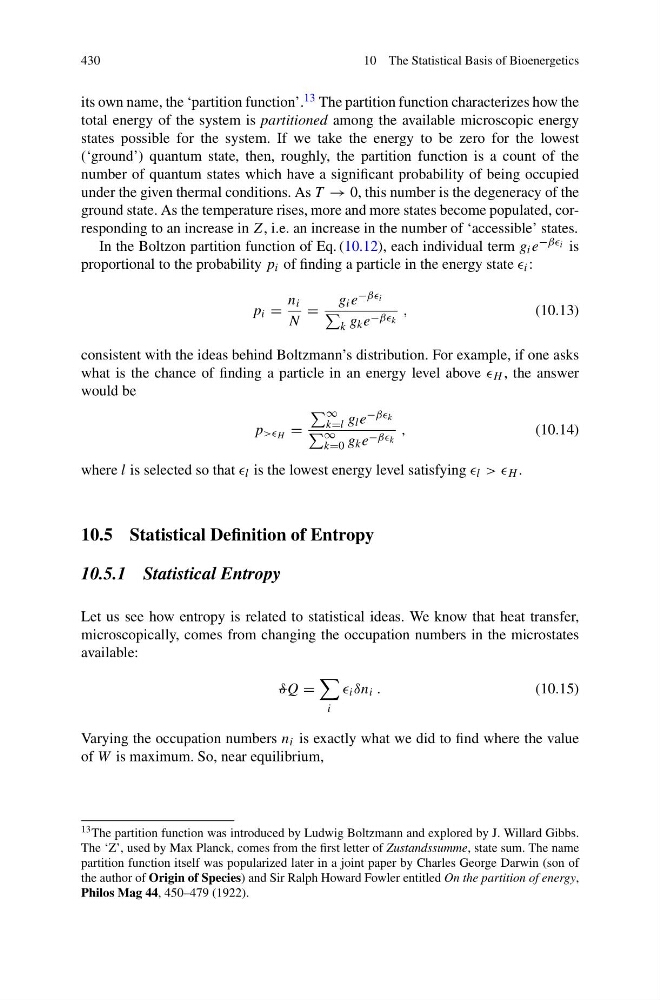
its own name, the ‘partition function’. 13 The partition function characterizes how the
total energy of the system is partitioned among the available microscopic energy
states possible for the system. If we take the energy to be zero for the lowest
(‘ground’) quantum state, then, roughly, the partition function is a count of the
number of quantum states which have a significant probability of being occupied
under the given thermal conditions. As T → 0, this number is the degeneracy of the
ground state. As the temperature rises, more and more states become populated, corresponding to an increase in Z, i.e. an increase in the number of ‘accessible’ states.
In the Boltzon partition function of Eq. (10.12), each individual term g i e −ββ i is
proportional to the probability p i of finding a particle in the energy state i :
p i =
n i
N
=
g i e −ββ i
k g k e −ββ k
,
(10.13)
consistent with the ideas behind Boltzmann’s distribution. For example, if one asks
what is the chance of finding a particle in an energy level above H , the answer
would be
p >> H =
∞
k=l g l e −ββ k
∞
k=0 g k e −ββ k
,
(10.14)
where l is selected so that l is the lowest energy level satisfying l > > H .
10.5 Statistical Definition of Entropy
10.5.1 Statistical Entropy
Let us see how entropy is related to statistical ideas. We know that heat transfer,
microscopically, comes from changing the occupation numbers in the microstates
available:
δQ =
i
i δn i .
(10.15)
Varying the occupation numbers n i is exactly what we did to find where the value
of W is maximum. So, near equilibrium,
13 The partition function was introduced by Ludwig Boltzmann and explored by J. Willard Gibbs.
The ‘Z’, used by Max Planck, comes from the first letter of Zustandssumme, state sum. The name
partition function itself was popularized later in a joint paper by Charles George Darwin (son of
the author of Origin of Species) and Sir Ralph Howard Fowler entitled On the partition of energy,
Philos Mag 44, 450–479 (1922).
10 The Statistical Basis of Bioenergetics
its own name, the ‘partition function’. 13 The partition function characterizes how the
total energy of the system is partitioned among the available microscopic energy
states possible for the system. If we take the energy to be zero for the lowest
(‘ground’) quantum state, then, roughly, the partition function is a count of the
number of quantum states which have a significant probability of being occupied
under the given thermal conditions. As T → 0, this number is the degeneracy of the
ground state. As the temperature rises, more and more states become populated, corresponding to an increase in Z, i.e. an increase in the number of ‘accessible’ states.
In the Boltzon partition function of Eq. (10.12), each individual term g i e −ββ i is
proportional to the probability p i of finding a particle in the energy state i :
p i =
n i
N
=
g i e −ββ i
k g k e −ββ k
,
(10.13)
consistent with the ideas behind Boltzmann’s distribution. For example, if one asks
what is the chance of finding a particle in an energy level above H , the answer
would be
p >> H =
∞
k=l g l e −ββ k
∞
k=0 g k e −ββ k
,
(10.14)
where l is selected so that l is the lowest energy level satisfying l > > H .
10.5 Statistical Definition of Entropy
10.5.1 Statistical Entropy
Let us see how entropy is related to statistical ideas. We know that heat transfer,
microscopically, comes from changing the occupation numbers in the microstates
available:
δQ =
i
i δn i .
(10.15)
Varying the occupation numbers n i is exactly what we did to find where the value
of W is maximum. So, near equilibrium,
13 The partition function was introduced by Ludwig Boltzmann and explored by J. Willard Gibbs.
The ‘Z’, used by Max Planck, comes from the first letter of Zustandssumme, state sum. The name
partition function itself was popularized later in a joint paper by Charles George Darwin (son of
the author of Origin of Species) and Sir Ralph Howard Fowler entitled On the partition of energy,
Philos Mag 44, 450–479 (1922).