

10.4 Classical Limit
429
equilibrium distribution. Even so, we can apply thermodynamic considerations to
many biosystems, since
• Life systems tend to maintain the needed biological important macromolecules;
• The time scale for the transformation and degradation of highly energetic
structural macromolecules is long compared to biochemical reaction times;
• Many biochemical reactions occur in a ‘sea’ of water, which acts to distribute
heat by thermal diffusion and to reduce concentration gradients by material
diffusion;
• Actions which occur locally with only a few molecules taking part are often
repeated throughout a cell, so that averages over the large set of actions may
have manageable fluctuations.
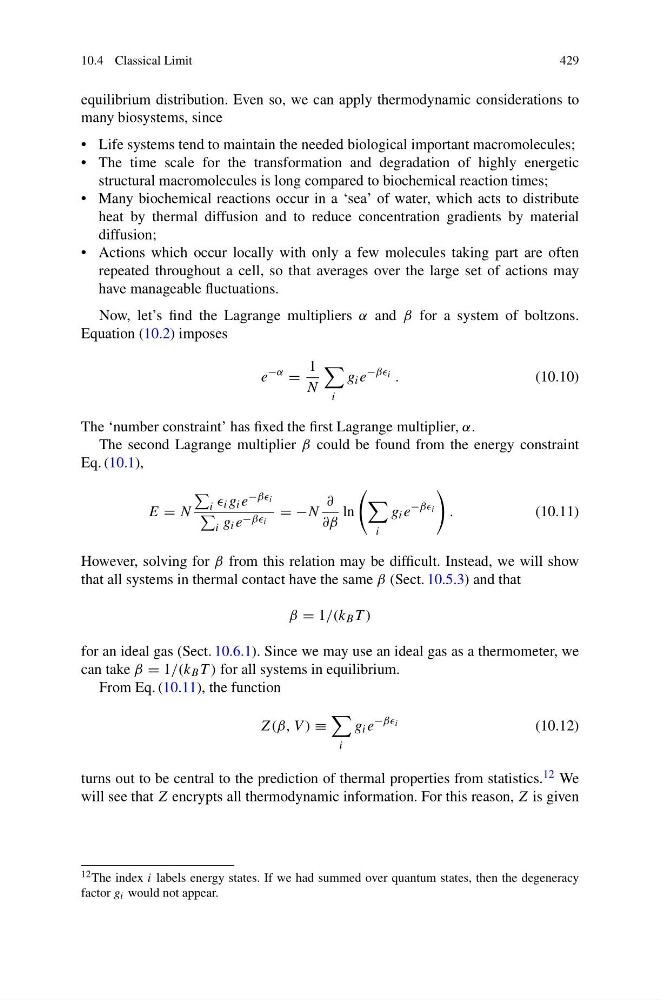
Now, let’s find the Lagrange multipliers α and β for a system of boltzons.
Equation (10.2) imposes
e
−α
=
1
N
i
g i e
−ββ i .
(10.10)
The ‘number constraint’ has fixed the first Lagrange multiplier, α.
The second Lagrange multiplier β could be found from the energy constraint
Eq. (10.1),
E = N
i i g i e −ββ i
i g i e −ββ i
= −N
∂
∂β
ln
i
g i e
−ββ i
.
(10.11)
However, solving for β from this relation may be difficult. Instead, we will show
that all systems in thermal contact have the same β (Sect. 10.5.3) and that
β = 1/(k B T )
for an ideal gas (Sect. 10.6.1). Since we may use an ideal gas as a thermometer, we
can take β = 1/(k B T ) for all systems in equilibrium.
From Eq. (10.11), the function
Z(β, V ) ≡
i
g i e
−ββ i
(10.12)
turns out to be central to the prediction of thermal properties from statistics. 12 We
will see that Z encrypts all thermodynamic information. For this reason, Z is given
12 The index i labels energy states. If we had summed over quantum states, then the degeneracy
factor g i would not appear.
429
equilibrium distribution. Even so, we can apply thermodynamic considerations to
many biosystems, since
• Life systems tend to maintain the needed biological important macromolecules;
• The time scale for the transformation and degradation of highly energetic
structural macromolecules is long compared to biochemical reaction times;
• Many biochemical reactions occur in a ‘sea’ of water, which acts to distribute
heat by thermal diffusion and to reduce concentration gradients by material
diffusion;
• Actions which occur locally with only a few molecules taking part are often
repeated throughout a cell, so that averages over the large set of actions may
have manageable fluctuations.
Now, let’s find the Lagrange multipliers α and β for a system of boltzons.
Equation (10.2) imposes
e
−α
=
1
N
i
g i e
−ββ i .
(10.10)
The ‘number constraint’ has fixed the first Lagrange multiplier, α.
The second Lagrange multiplier β could be found from the energy constraint
Eq. (10.1),
E = N
i i g i e −ββ i
i g i e −ββ i
= −N
∂
∂β
ln
i
g i e
−ββ i
.
(10.11)
However, solving for β from this relation may be difficult. Instead, we will show
that all systems in thermal contact have the same β (Sect. 10.5.3) and that
β = 1/(k B T )
for an ideal gas (Sect. 10.6.1). Since we may use an ideal gas as a thermometer, we
can take β = 1/(k B T ) for all systems in equilibrium.
From Eq. (10.11), the function
Z(β, V ) ≡
i
g i e
−ββ i
(10.12)
turns out to be central to the prediction of thermal properties from statistics. 12 We
will see that Z encrypts all thermodynamic information. For this reason, Z is given
12 The index i labels energy states. If we had summed over quantum states, then the degeneracy
factor g i would not appear.