

406
9 Bioenergetics
9.21.4 ATP Pumps
As an example of applying equilibrium considerations to an important biochemical
set of reactions, let’s look at the steady-state conditions of sodium and potassium
ions across a neuron. Active sodium-potassium pumps, other active pumps, and
passive switching-diffusion channels in the neuron membrane wall create an electric
field across the membrane of about −70 mV under resting conditions. The wall
has a thickness of about 3.5 nm, so the electric field across the membrane is
about 2 × 10 7 N/C toward the inside. The approximate concentration of sodium
and potassium ions for an inactive neuron membrane given in the above Table.
Adenosine Triphosphate (ATP) supplies the energy for the active transport pumps.
Only the energy stored in the phosphate group’s binding to one ATP molecule is
needed for each cycle of the transport mechanism.
For each of the sodium-potassium pumps, three sodium ions are forced across a
neuron membrane through an especially dedicated protein channel in the wall of the
cell membrane. At the same time, two potassium ions are allowed to pass into the
cell through this same channel. The reactions can be represented by:
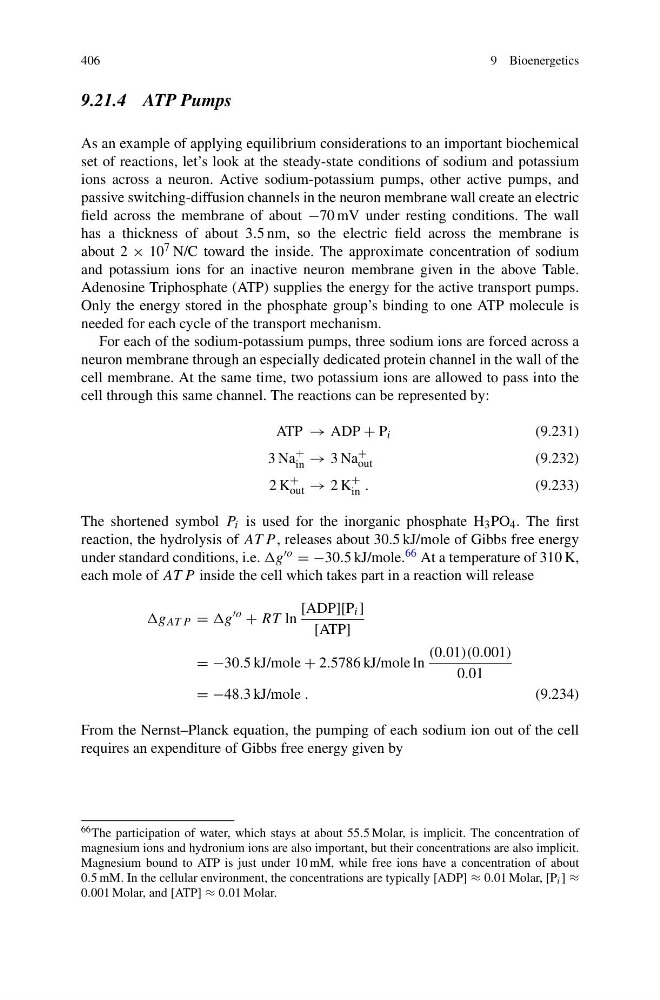
ATP → ADP + P i
(9.231)
3 Na
+
in → 3 Na
+
out
(9.232)
2 K
+
out → 2 K
+
in .
(9.233)
The shortened symbol P i is used for the inorganic phosphate H 3 PO 4 . The first
reaction, the hydrolysis of AT P , releases about 30.5 kJ/mole of Gibbs free energy
under standard conditions, i.e. g o = −30.5 kJ/mole. 66 At a temperature of 310 K,
each mole of AT P inside the cell which takes part in a reaction will release
g AT P = g
o
+ RT ln
[ADP][P i ]
[ATP]
= −30.5 kJ/mole + 2.5786 kJ/mole ln
(0.01)(0.001)
0.01
= −48.3 kJ/mole .
(9.234)
From the Nernst–Planck equation, the pumping of each sodium ion out of the cell
requires an expenditure of Gibbs free energy given by
66 The participation of water, which stays at about 55.5 Molar, is implicit. The concentration of
magnesium ions and hydronium ions are also important, but their concentrations are also implicit.
Magnesium bound to ATP is just under 10 mM, while free ions have a concentration of about
0.5 mM. In the cellular environment, the concentrations are typically [ADP] ≈ 0.01 Molar, [P i ] ≈
0.001 Molar, and [ATP] ≈ 0.01 Molar.
9 Bioenergetics
9.21.4 ATP Pumps
As an example of applying equilibrium considerations to an important biochemical
set of reactions, let’s look at the steady-state conditions of sodium and potassium
ions across a neuron. Active sodium-potassium pumps, other active pumps, and
passive switching-diffusion channels in the neuron membrane wall create an electric
field across the membrane of about −70 mV under resting conditions. The wall
has a thickness of about 3.5 nm, so the electric field across the membrane is
about 2 × 10 7 N/C toward the inside. The approximate concentration of sodium
and potassium ions for an inactive neuron membrane given in the above Table.
Adenosine Triphosphate (ATP) supplies the energy for the active transport pumps.
Only the energy stored in the phosphate group’s binding to one ATP molecule is
needed for each cycle of the transport mechanism.
For each of the sodium-potassium pumps, three sodium ions are forced across a
neuron membrane through an especially dedicated protein channel in the wall of the
cell membrane. At the same time, two potassium ions are allowed to pass into the
cell through this same channel. The reactions can be represented by:
ATP → ADP + P i
(9.231)
3 Na
+
in → 3 Na
+
out
(9.232)
2 K
+
out → 2 K
+
in .
(9.233)
The shortened symbol P i is used for the inorganic phosphate H 3 PO 4 . The first
reaction, the hydrolysis of AT P , releases about 30.5 kJ/mole of Gibbs free energy
under standard conditions, i.e. g o = −30.5 kJ/mole. 66 At a temperature of 310 K,
each mole of AT P inside the cell which takes part in a reaction will release
g AT P = g
o
+ RT ln
[ADP][P i ]
[ATP]
= −30.5 kJ/mole + 2.5786 kJ/mole ln
(0.01)(0.001)
0.01
= −48.3 kJ/mole .
(9.234)
From the Nernst–Planck equation, the pumping of each sodium ion out of the cell
requires an expenditure of Gibbs free energy given by
66 The participation of water, which stays at about 55.5 Molar, is implicit. The concentration of
magnesium ions and hydronium ions are also important, but their concentrations are also implicit.
Magnesium bound to ATP is just under 10 mM, while free ions have a concentration of about
0.5 mM. In the cellular environment, the concentrations are typically [ADP] ≈ 0.01 Molar, [P i ] ≈
0.001 Molar, and [ATP] ≈ 0.01 Molar.