

9.21 Biochemical Reactions
407
g
Na = −zFFV + RT ln
[Na
+
out ]
[Na
+
in ]
= −(+1)(96.5 kJ/mole · volt)(−70 mV)
+(2.5786 kJ/mole ln
0.155
0.015
= 6.755 kJ/mole + 6.022 kJ/mole
= 12.78 kJ/mole ,
(9.235)
and the passage of each potassium ion into the cell requires
g
K = zFFV + RT ln
[K
+
in ]
[K
+
out ]
= (+1)(96.5 kJ/mole · volt)(−70 mV)
+(2.5786 kJ/mole) ln
0.150
0.005
= −6.755 kJ/mole + 8.770 kJ/mole
= 2.015 kJ/mole .
(9.236)
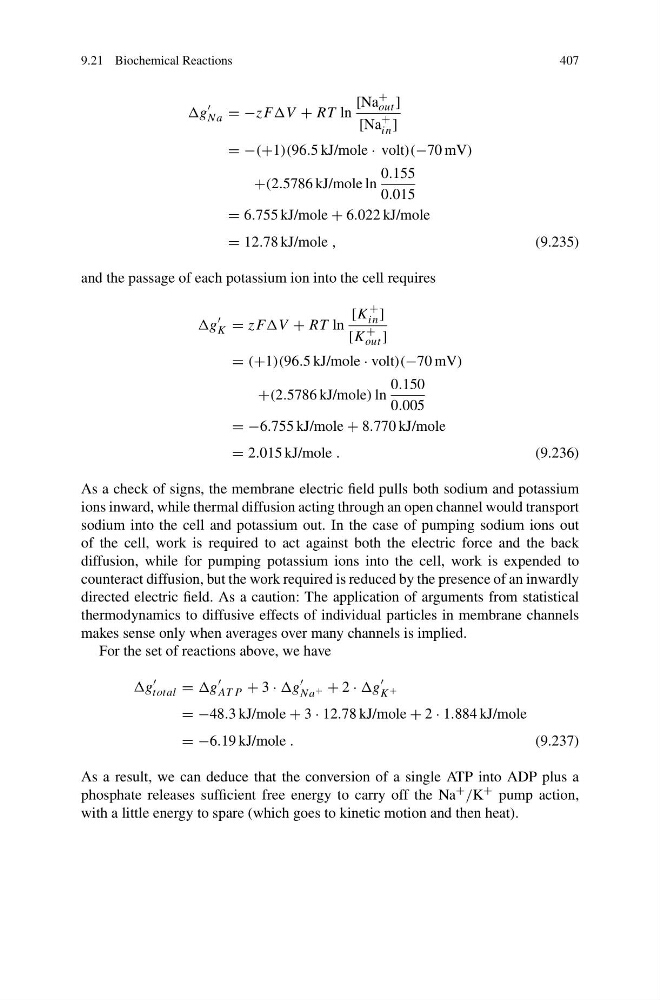
As a check of signs, the membrane electric field pulls both sodium and potassium
ions inward, while thermal diffusion acting through an open channel would transport
sodium into the cell and potassium out. In the case of pumping sodium ions out
of the cell, work is required to act against both the electric force and the back
diffusion, while for pumping potassium ions into the cell, work is expended to
counteract diffusion, but the work required is reduced by the presence of an inwardly
directed electric field. As a caution: The application of arguments from statistical
thermodynamics to diffusive effects of individual particles in membrane channels
makes sense only when averages over many channels is implied.
For the set of reactions above, we have
g
total = g
AT P + 3 · g
Na + + 2 · g
K +
= −48.3 kJ/mole + 3 · 12.78 kJ/mole + 2 · 1.884 kJ/mole
= −6.19 kJ/mole .
(9.237)
As a result, we can deduce that the conversion of a single ATP into ADP plus a
phosphate releases sufficient free energy to carry off the Na
+ /K
+ pump action,
with a little energy to spare (which goes to kinetic motion and then heat).
407
g
Na = −zFFV + RT ln
[Na
+
out ]
[Na
+
in ]
= −(+1)(96.5 kJ/mole · volt)(−70 mV)
+(2.5786 kJ/mole ln
0.155
0.015
= 6.755 kJ/mole + 6.022 kJ/mole
= 12.78 kJ/mole ,
(9.235)
and the passage of each potassium ion into the cell requires
g
K = zFFV + RT ln
[K
+
in ]
[K
+
out ]
= (+1)(96.5 kJ/mole · volt)(−70 mV)
+(2.5786 kJ/mole) ln
0.150
0.005
= −6.755 kJ/mole + 8.770 kJ/mole
= 2.015 kJ/mole .
(9.236)
As a check of signs, the membrane electric field pulls both sodium and potassium
ions inward, while thermal diffusion acting through an open channel would transport
sodium into the cell and potassium out. In the case of pumping sodium ions out
of the cell, work is required to act against both the electric force and the back
diffusion, while for pumping potassium ions into the cell, work is expended to
counteract diffusion, but the work required is reduced by the presence of an inwardly
directed electric field. As a caution: The application of arguments from statistical
thermodynamics to diffusive effects of individual particles in membrane channels
makes sense only when averages over many channels is implied.
For the set of reactions above, we have
g
total = g
AT P + 3 · g
Na + + 2 · g
K +
= −48.3 kJ/mole + 3 · 12.78 kJ/mole + 2 · 1.884 kJ/mole
= −6.19 kJ/mole .
(9.237)
As a result, we can deduce that the conversion of a single ATP into ADP plus a
phosphate releases sufficient free energy to carry off the Na
+ /K
+ pump action,
with a little energy to spare (which goes to kinetic motion and then heat).