

9.21 Biochemical Reactions
405
μ
I
k = μ
O
k .
(9.230)
Cellular membranes, made from a phospholipid protein bilayer, act as an
electrical insulator. But water and small ions may be allowed to pass through the
membrane through membrane channels. These are special pores in the membrane
constructed with proteins. They include diffusion channels, leakage channels,
voltage-gated channels, ligand-gated channels, mechanical-stress-gated channels,
temperature-gated channels, ionic pumps, assisted exchangers, and facilitated transporters. Those channels that carry particles against a concentration gradient require
the input of energy, such as by the work done by the membrane potential, or directly
by the action of ATP at the location of the inside of the channel. Cells membranes
can also release or engulf vacuoles of material in a process of exo- or endocytosis.
Suppose that in diffusing from the inside to the outside through passive channels,
ions must pass through an electric field generated by a difference in concentration of
ions across the membrane. If the electric potential across the membrane is V O − V I ,
then the average energy of positive ions on the outside will be less than the average
energy of those positive ions on the inside by e(V O − V I ). Now to compare the
energy states on the outside to those of the inside, we let O
i = I
i −e(V O −V I ). Then
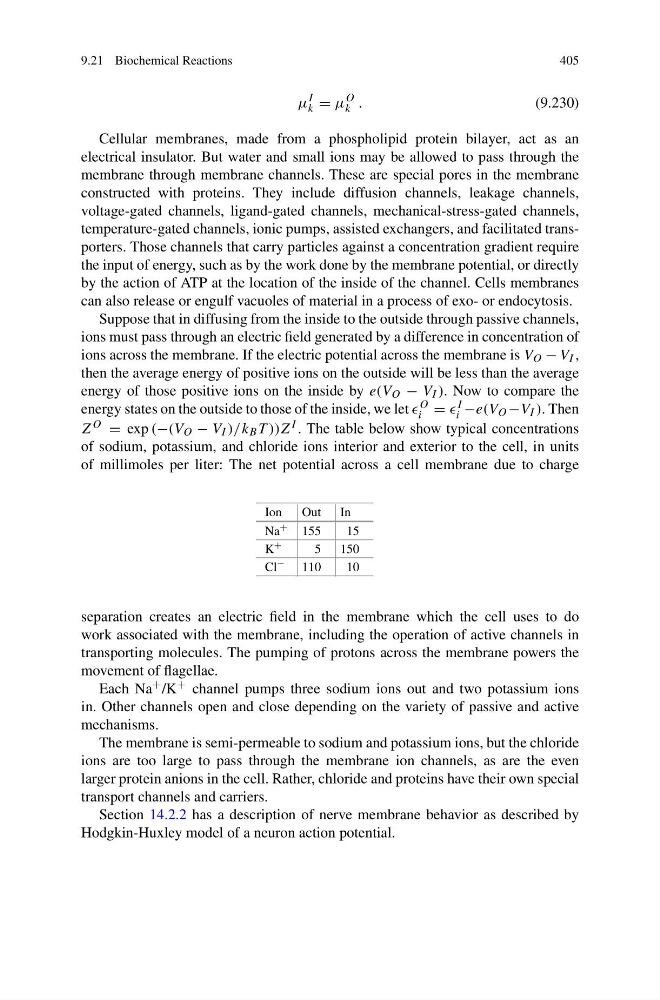
Z O = exp (−(V O − V I )/k B T ))Z I . The table below show typical concentrations
of sodium, potassium, and chloride ions interior and exterior to the cell, in units
of millimoles per liter: The net potential across a cell membrane due to charge
Ion
Out
In
Na
+
155
15
K
+
5
150
Cl
−
110
10
separation creates an electric field in the membrane which the cell uses to do
work associated with the membrane, including the operation of active channels in
transporting molecules. The pumping of protons across the membrane powers the
movement of flagellae.
Each Na + /K + channel pumps three sodium ions out and two potassium ions
in. Other channels open and close depending on the variety of passive and active
mechanisms.
The membrane is semi-permeable to sodium and potassium ions, but the chloride
ions are too large to pass through the membrane ion channels, as are the even
larger protein anions in the cell. Rather, chloride and proteins have their own special
transport channels and carriers.
Section 14.2.2 has a description of nerve membrane behavior as described by
Hodgkin-Huxley model of a neuron action potential.
405
μ
I
k = μ
O
k .
(9.230)
Cellular membranes, made from a phospholipid protein bilayer, act as an
electrical insulator. But water and small ions may be allowed to pass through the
membrane through membrane channels. These are special pores in the membrane
constructed with proteins. They include diffusion channels, leakage channels,
voltage-gated channels, ligand-gated channels, mechanical-stress-gated channels,
temperature-gated channels, ionic pumps, assisted exchangers, and facilitated transporters. Those channels that carry particles against a concentration gradient require
the input of energy, such as by the work done by the membrane potential, or directly
by the action of ATP at the location of the inside of the channel. Cells membranes
can also release or engulf vacuoles of material in a process of exo- or endocytosis.
Suppose that in diffusing from the inside to the outside through passive channels,
ions must pass through an electric field generated by a difference in concentration of
ions across the membrane. If the electric potential across the membrane is V O − V I ,
then the average energy of positive ions on the outside will be less than the average
energy of those positive ions on the inside by e(V O − V I ). Now to compare the
energy states on the outside to those of the inside, we let O
i = I
i −e(V O −V I ). Then
Z O = exp (−(V O − V I )/k B T ))Z I . The table below show typical concentrations
of sodium, potassium, and chloride ions interior and exterior to the cell, in units
of millimoles per liter: The net potential across a cell membrane due to charge
Ion
Out
In
Na
+
155
15
K
+
5
150
Cl
−
110
10
separation creates an electric field in the membrane which the cell uses to do
work associated with the membrane, including the operation of active channels in
transporting molecules. The pumping of protons across the membrane powers the
movement of flagellae.
Each Na + /K + channel pumps three sodium ions out and two potassium ions
in. Other channels open and close depending on the variety of passive and active
mechanisms.
The membrane is semi-permeable to sodium and potassium ions, but the chloride
ions are too large to pass through the membrane ion channels, as are the even
larger protein anions in the cell. Rather, chloride and proteins have their own special
transport channels and carriers.
Section 14.2.2 has a description of nerve membrane behavior as described by
Hodgkin-Huxley model of a neuron action potential.