

388
9 Bioenergetics
Neglecting the relatively low contribution of calcium, the potential across a nerve
cell, with active pumps maintaining a given set of concentrations, is
V m =
RT
F
ln
P Na [Na
+
] O + P K [K
+
] O + P Cl [Cl
−
] I
P Na [Na
+
] I + P K [K
+
] I + P Cl [Cl
−
] O
.
(9.181)
The P α ≡ D α //x is the ‘permeability’ of the ion type α (with units length over
time). The potential V m represents the electric potential on the inside of a cell
(compared to the outside), and the indices I and O refer to the inside and outside
of the membrane. The effective diffusion constant D α for ions moving through
cell-wall channels is difficult to calculate, so the permeabilities (for both open and
closed channels) are usually determined experimentally. Because a ratio appears in
the Goldman Equation (9.181), the permeabilities can be converted into fractional
permeabilities f i = P i /
P k or percents of the overall permeability by all ions
able to move across the cell membrane.
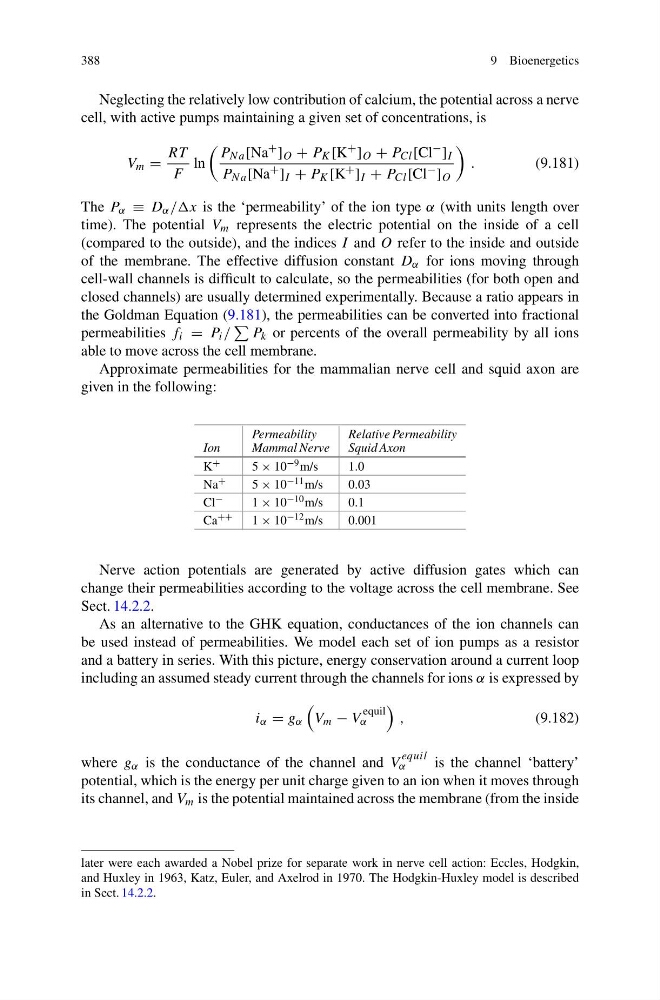
Approximate permeabilities for the mammalian nerve cell and squid axon are
given in the following:
Permeability
Relative Permeability
Ion
Mammal Nerve Squid Axon
K +
5 × 10 −9 m/s
1.0
Na +
5 × 10 −11 m/s
0.03
Cl −
1 × 10 −10 m/s
0.1
Ca ++
1 × 10 −12 m/s
0.001
Nerve action potentials are generated by active diffusion gates which can
change their permeabilities according to the voltage across the cell membrane. See
Sect. 14.2.2.
As an alternative to the GHK equation, conductances of the ion channels can
be used instead of permeabilities. We model each set of ion pumps as a resistor
and a battery in series. With this picture, energy conservation around a current loop
including an assumed steady current through the channels for ions α is expressed by
i α = g α
V m − V
equil
α
,
(9.182)
where g α is the conductance of the channel and V
equil
α
is the channel ‘battery’
potential, which is the energy per unit charge given to an ion when it moves through
its channel, and V m is the potential maintained across the membrane (from the inside
later were each awarded a Nobel prize for separate work in nerve cell action: Eccles, Hodgkin,
and Huxley in 1963, Katz, Euler, and Axelrod in 1970. The Hodgkin-Huxley model is described
in Sect. 14.2.2.
9 Bioenergetics
Neglecting the relatively low contribution of calcium, the potential across a nerve
cell, with active pumps maintaining a given set of concentrations, is
V m =
RT
F
ln
P Na [Na
+
] O + P K [K
+
] O + P Cl [Cl
−
] I
P Na [Na
+
] I + P K [K
+
] I + P Cl [Cl
−
] O
.
(9.181)
The P α ≡ D α //x is the ‘permeability’ of the ion type α (with units length over
time). The potential V m represents the electric potential on the inside of a cell
(compared to the outside), and the indices I and O refer to the inside and outside
of the membrane. The effective diffusion constant D α for ions moving through
cell-wall channels is difficult to calculate, so the permeabilities (for both open and
closed channels) are usually determined experimentally. Because a ratio appears in
the Goldman Equation (9.181), the permeabilities can be converted into fractional
permeabilities f i = P i /
P k or percents of the overall permeability by all ions
able to move across the cell membrane.
Approximate permeabilities for the mammalian nerve cell and squid axon are
given in the following:
Permeability
Relative Permeability
Ion
Mammal Nerve Squid Axon
K +
5 × 10 −9 m/s
1.0
Na +
5 × 10 −11 m/s
0.03
Cl −
1 × 10 −10 m/s
0.1
Ca ++
1 × 10 −12 m/s
0.001
Nerve action potentials are generated by active diffusion gates which can
change their permeabilities according to the voltage across the cell membrane. See
Sect. 14.2.2.
As an alternative to the GHK equation, conductances of the ion channels can
be used instead of permeabilities. We model each set of ion pumps as a resistor
and a battery in series. With this picture, energy conservation around a current loop
including an assumed steady current through the channels for ions α is expressed by
i α = g α
V m − V
equil
α
,
(9.182)
where g α is the conductance of the channel and V
equil
α
is the channel ‘battery’
potential, which is the energy per unit charge given to an ion when it moves through
its channel, and V m is the potential maintained across the membrane (from the inside
later were each awarded a Nobel prize for separate work in nerve cell action: Eccles, Hodgkin,
and Huxley in 1963, Katz, Euler, and Axelrod in 1970. The Hodgkin-Huxley model is described
in Sect. 14.2.2.