

9.20 Diffusion
389
to the outside). The potentials V
equil
α
can be found from the Nernst equation for the
given ion. Under steady state conditions,
i α = 0, so
V m =
α
g α
g β
V
equil
α
.
(9.183)
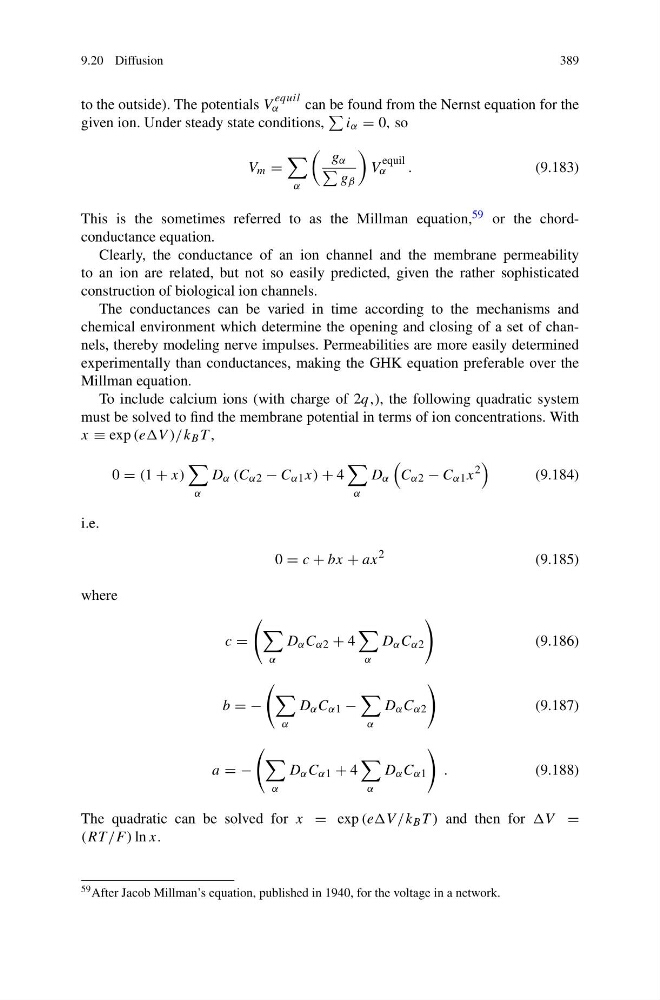
This is the sometimes referred to as the Millman equation, 59 or the chordconductance equation.
Clearly, the conductance of an ion channel and the membrane permeability
to an ion are related, but not so easily predicted, given the rather sophisticated
construction of biological ion channels.
The conductances can be varied in time according to the mechanisms and
chemical environment which determine the opening and closing of a set of channels, thereby modeling nerve impulses. Permeabilities are more easily determined
experimentally than conductances, making the GHK equation preferable over the
Millman equation.
To include calcium ions (with charge of 2q,), the following quadratic system
must be solved to find the membrane potential in terms of ion concentrations. With
x ≡ exp (eeV )/k B T ,
0 = (1 + x)
α
D α (C α2 − C α1 x) + 4
α
D α
C α2 − C α1 x
2
(9.184)
i.e.
0 = c + bx + ax
2
(9.185)
where
c =
α
D α C α2 + 4
α
D α C α2
(9.186)
b = −
α
D α C α1 −
α
D α C α2
(9.187)
a = −
α
D α C α1 + 4
α
D α C α1
.
(9.188)
The quadratic can be solved for x = exp (eeV /k B T ) and then for V =
(RT /F ) ln x.
59 After Jacob Millman’s equation, published in 1940, for the voltage in a network.
389
to the outside). The potentials V
equil
α
can be found from the Nernst equation for the
given ion. Under steady state conditions,
i α = 0, so
V m =
α
g α
g β
V
equil
α
.
(9.183)
This is the sometimes referred to as the Millman equation, 59 or the chordconductance equation.
Clearly, the conductance of an ion channel and the membrane permeability
to an ion are related, but not so easily predicted, given the rather sophisticated
construction of biological ion channels.
The conductances can be varied in time according to the mechanisms and
chemical environment which determine the opening and closing of a set of channels, thereby modeling nerve impulses. Permeabilities are more easily determined
experimentally than conductances, making the GHK equation preferable over the
Millman equation.
To include calcium ions (with charge of 2q,), the following quadratic system
must be solved to find the membrane potential in terms of ion concentrations. With
x ≡ exp (eeV )/k B T ,
0 = (1 + x)
α
D α (C α2 − C α1 x) + 4
α
D α
C α2 − C α1 x
2
(9.184)
i.e.
0 = c + bx + ax
2
(9.185)
where
c =
α
D α C α2 + 4
α
D α C α2
(9.186)
b = −
α
D α C α1 −
α
D α C α2
(9.187)
a = −
α
D α C α1 + 4
α
D α C α1
.
(9.188)
The quadratic can be solved for x = exp (eeV /k B T ) and then for V =
(RT /F ) ln x.
59 After Jacob Millman’s equation, published in 1940, for the voltage in a network.