

9.20 Diffusion
387
This flow still has both diffusive and forced contributions. Note that in this case,
Ohm’s law, which has a linear relationship between the electric current and the
electric field, holds only for weak fields.
During steady conditions, the total charge carried by the ions across the
membrane must add to zero, which makes
α
q α J α = 0 .
(9.176)
We have
α
q
2
α D α
C α1 − C αo exp
−
q α
k B T V
1 − exp
−
q α
k B T V
= 0 .
(9.177)
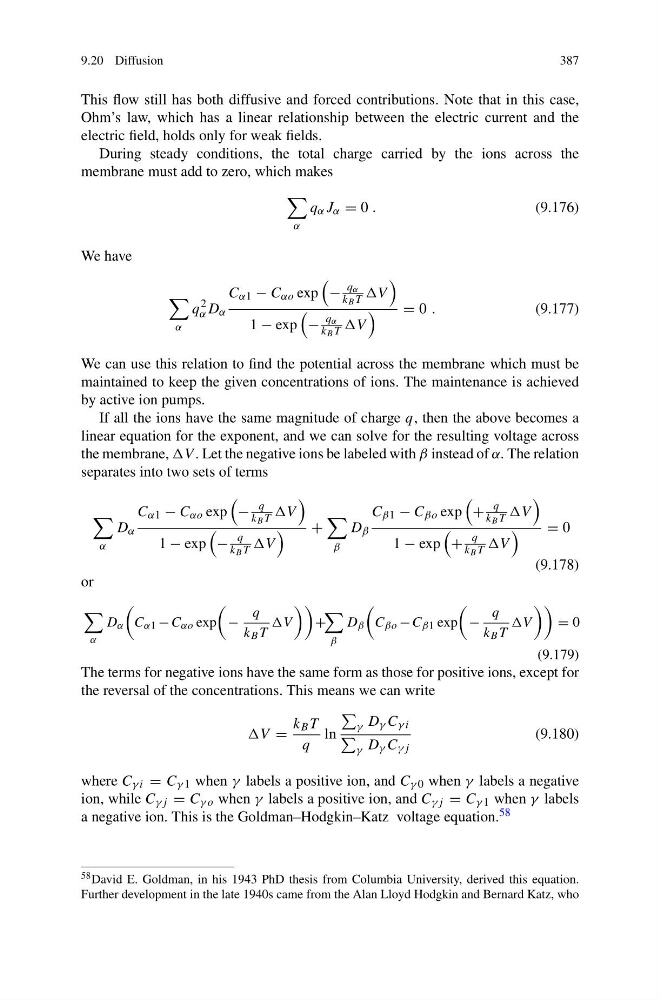
We can use this relation to find the potential across the membrane which must be
maintained to keep the given concentrations of ions. The maintenance is achieved
by active ion pumps.
If all the ions have the same magnitude of charge q, then the above becomes a
linear equation for the exponent, and we can solve for the resulting voltage across
the membrane, V . Let the negative ions be labeled with β instead of α. The relation
separates into two sets of terms
α
D α
C α1 − C αo exp
−
q
k B T V
1 − exp
−
q
k B T V
+
β
D β
C β1 − C βo exp
+
q
k B T V
1 − exp
+
q
k B T V
= 0
(9.178)
or
α
D α
C α1 − C αo exp
−
q
k B T
V
+
β
D β
C βo − C β1 exp
−
q
k B T
V
= 0
(9.179)
The terms for negative ions have the same form as those for positive ions, except for
the reversal of the concentrations. This means we can write
V =
k B T
q
ln
γ D γ C γ i
γ D γ C γj
(9.180)
where C γ i = C γ 1 when γ labels a positive ion, and C γ 0 when γ labels a negative
ion, while C γj = C γ o when γ labels a positive ion, and C γj = C γ 1 when γ labels
a negative ion. This is the Goldman–Hodgkin–Katz voltage equation. 58
58 David E. Goldman, in his 1943 PhD thesis from Columbia University, derived this equation.
Further development in the late 1940s came from the Alan Lloyd Hodgkin and Bernard Katz, who
387
This flow still has both diffusive and forced contributions. Note that in this case,
Ohm’s law, which has a linear relationship between the electric current and the
electric field, holds only for weak fields.
During steady conditions, the total charge carried by the ions across the
membrane must add to zero, which makes
α
q α J α = 0 .
(9.176)
We have
α
q
2
α D α
C α1 − C αo exp
−
q α
k B T V
1 − exp
−
q α
k B T V
= 0 .
(9.177)
We can use this relation to find the potential across the membrane which must be
maintained to keep the given concentrations of ions. The maintenance is achieved
by active ion pumps.
If all the ions have the same magnitude of charge q, then the above becomes a
linear equation for the exponent, and we can solve for the resulting voltage across
the membrane, V . Let the negative ions be labeled with β instead of α. The relation
separates into two sets of terms
α
D α
C α1 − C αo exp
−
q
k B T V
1 − exp
−
q
k B T V
+
β
D β
C β1 − C βo exp
+
q
k B T V
1 − exp
+
q
k B T V
= 0
(9.178)
or
α
D α
C α1 − C αo exp
−
q
k B T
V
+
β
D β
C βo − C β1 exp
−
q
k B T
V
= 0
(9.179)
The terms for negative ions have the same form as those for positive ions, except for
the reversal of the concentrations. This means we can write
V =
k B T
q
ln
γ D γ C γ i
γ D γ C γj
(9.180)
where C γ i = C γ 1 when γ labels a positive ion, and C γ 0 when γ labels a negative
ion, while C γj = C γ o when γ labels a positive ion, and C γj = C γ 1 when γ labels
a negative ion. This is the Goldman–Hodgkin–Katz voltage equation. 58
58 David E. Goldman, in his 1943 PhD thesis from Columbia University, derived this equation.
Further development in the late 1940s came from the Alan Lloyd Hodgkin and Bernard Katz, who