

386
9 Bioenergetics
9.20.2 Active Transport Across Membranes
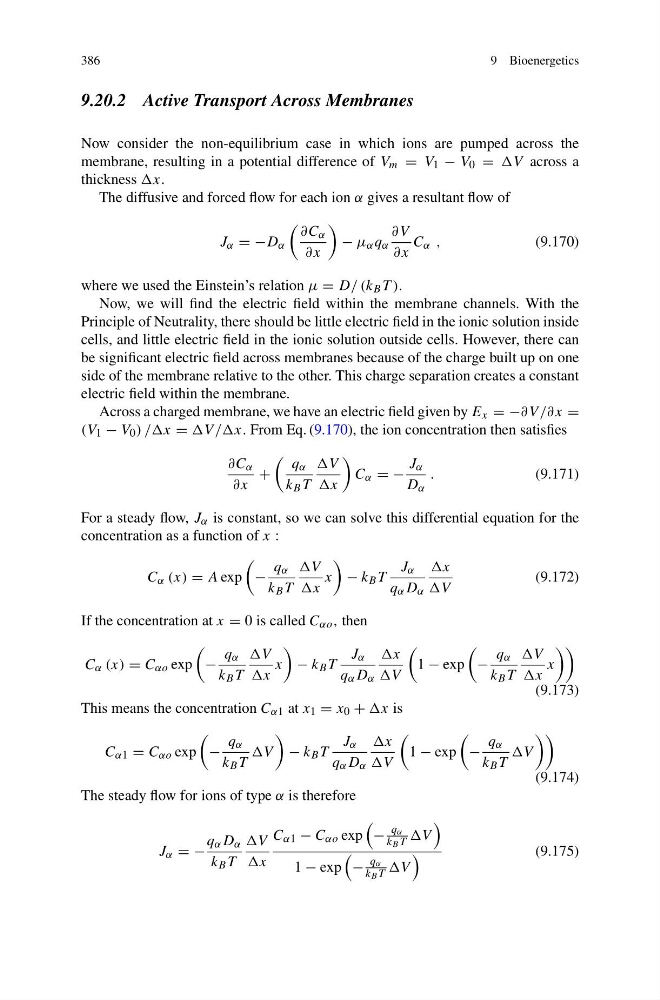
Now consider the non-equilibrium case in which ions are pumped across the
membrane, resulting in a potential difference of V m = V 1 − V 0 = V across a
thickness x.
The diffusive and forced flow for each ion α gives a resultant flow of
J α = −D α
∂C α
∂x
− μ α q α
∂V
∂x
C α ,
(9.170)
where we used the Einstein’s relation μ = D/ (k B T ).
Now, we will find the electric field within the membrane channels. With the
Principle of Neutrality, there should be little electric field in the ionic solution inside
cells, and little electric field in the ionic solution outside cells. However, there can
be significant electric field across membranes because of the charge built up on one
side of the membrane relative to the other. This charge separation creates a constant
electric field within the membrane.
Across a charged membrane, we have an electric field given by E x = −∂V /∂x =
(V 1 − V 0 ) //x = //x. From Eq. (9.170), the ion concentration then satisfies
∂C α
∂x
+
q α
k B T
V
x
C α = −
J α
D α
.
(9.171)
For a steady flow, J α is constant, so we can solve this differential equation for the
concentration as a function of x :
C α (x) = A exp
−
q α
k B T
V
x
x
− k B T
J α
q α D α
x
V
(9.172)
If the concentration at x = 0 is called C αo , then
C α (x) = C αo exp
−
q α
k B T
V
x
x
− k B T
J α
q α D α
x
V
1 − exp
−
q α
k B T
V
x
x
(9.173)
This means the concentration C α1 at x 1 = x 0 + x is
C α1 = C αo exp
−
q α
k B T
V
− k B T
J α
q α D α
x
V
1 − exp
−
q α
k B T
V
(9.174)
The steady flow for ions of type α is therefore
J α = −
q α D α
k B T
V
x
C α1 − C αo exp
−
q α
k B T V
1 − exp
−
q α
k B T V
(9.175)
9 Bioenergetics
9.20.2 Active Transport Across Membranes
Now consider the non-equilibrium case in which ions are pumped across the
membrane, resulting in a potential difference of V m = V 1 − V 0 = V across a
thickness x.
The diffusive and forced flow for each ion α gives a resultant flow of
J α = −D α
∂C α
∂x
− μ α q α
∂V
∂x
C α ,
(9.170)
where we used the Einstein’s relation μ = D/ (k B T ).
Now, we will find the electric field within the membrane channels. With the
Principle of Neutrality, there should be little electric field in the ionic solution inside
cells, and little electric field in the ionic solution outside cells. However, there can
be significant electric field across membranes because of the charge built up on one
side of the membrane relative to the other. This charge separation creates a constant
electric field within the membrane.
Across a charged membrane, we have an electric field given by E x = −∂V /∂x =
(V 1 − V 0 ) //x = //x. From Eq. (9.170), the ion concentration then satisfies
∂C α
∂x
+
q α
k B T
V
x
C α = −
J α
D α
.
(9.171)
For a steady flow, J α is constant, so we can solve this differential equation for the
concentration as a function of x :
C α (x) = A exp
−
q α
k B T
V
x
x
− k B T
J α
q α D α
x
V
(9.172)
If the concentration at x = 0 is called C αo , then
C α (x) = C αo exp
−
q α
k B T
V
x
x
− k B T
J α
q α D α
x
V
1 − exp
−
q α
k B T
V
x
x
(9.173)
This means the concentration C α1 at x 1 = x 0 + x is
C α1 = C αo exp
−
q α
k B T
V
− k B T
J α
q α D α
x
V
1 − exp
−
q α
k B T
V
(9.174)
The steady flow for ions of type α is therefore
J α = −
q α D α
k B T
V
x
C α1 − C αo exp
−
q α
k B T V
1 − exp
−
q α
k B T V
(9.175)