

9.20 Diffusion
385
In biological tissue, the ion channel-pumps typically allow only a few ions
through at a time. One might ask how diffusive statistics applies. The answer is that
these relations apply not to one, but to the average of a large number of channels
across a given membrane.
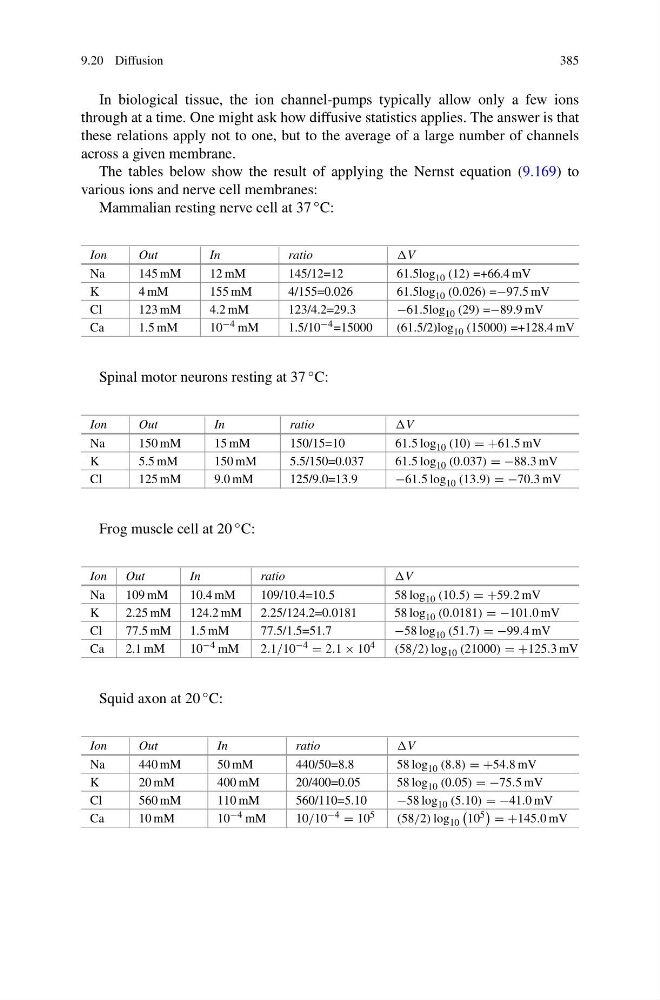
The tables below show the result of applying the Nernst equation (9.169) to
various ions and nerve cell membranes:
Mammalian resting nerve cell at 37 ◦ C:
Ion
Out
In
ratio
V
Na
145 mM
12 mM
145/12=12
61.5log 10 (12) =+66.4 mV
K
4 mM
155 mM
4/155=0.026
61.5log 10 (0.026) =−97.5 mV
Cl
123 mM
4.2 mM
123/4.2=29.3
−61.5log 10 (29) =−89.9 mV
Ca
1.5 mM
10 −4 mM
1.5/10 −4 =15000
(61.5/2)log 10 (15000) =+128.4 mV
Spinal motor neurons resting at 37 ◦ C:
Ion
Out
In
ratio
V
Na
150 mM
15 mM
150/15=10
61.5 log 10 (10) = +61.5 mV
K
5.5 mM
150 mM
5.5/150=0.037
61.5 log 10 (0.037) = −88.3 mV
Cl
125 mM
9.0 mM
125/9.0=13.9
−61.5 log 10 (13.9) = −70.3 mV
Frog muscle cell at 20 ◦ C:
Ion Out
In
ratio
V
Na
109 mM
10.4 mM
109/10.4=10.5
58 log 10 (10.5) = +59.2 mV
K
2.25 mM 124.2 mM 2.25/124.2=0.0181
58 log 10 (0.0181) = −101.0 mV
Cl
77.5 mM 1.5 mM
77.5/1.5=51.7
−58 log 10 (51.7) = −99.4 mV
Ca
2.1 mM
10 −4 mM
2.1/10 −4 = 2.1 × 10 4
(58/2) log 10 (21000) = +125.3 mV
Squid axon at 20 ◦ C:
Ion
Out
In
ratio
V
Na
440 mM
50 mM
440/50=8.8
58 log 10 (8.8) = +54.8 mV
K
20 mM
400 mM
20/400=0.05
58 log 10 (0.05) = −75.5 mV
Cl
560 mM
110 mM
560/110=5.10
−58 log 10 (5.10) = −41.0 mV
Ca
10 mM
10 −4 mM
10/10 −4 = 10 5
(58/2) log 10
10 5 = +145.0 mV
385
In biological tissue, the ion channel-pumps typically allow only a few ions
through at a time. One might ask how diffusive statistics applies. The answer is that
these relations apply not to one, but to the average of a large number of channels
across a given membrane.
The tables below show the result of applying the Nernst equation (9.169) to
various ions and nerve cell membranes:
Mammalian resting nerve cell at 37 ◦ C:
Ion
Out
In
ratio
V
Na
145 mM
12 mM
145/12=12
61.5log 10 (12) =+66.4 mV
K
4 mM
155 mM
4/155=0.026
61.5log 10 (0.026) =−97.5 mV
Cl
123 mM
4.2 mM
123/4.2=29.3
−61.5log 10 (29) =−89.9 mV
Ca
1.5 mM
10 −4 mM
1.5/10 −4 =15000
(61.5/2)log 10 (15000) =+128.4 mV
Spinal motor neurons resting at 37 ◦ C:
Ion
Out
In
ratio
V
Na
150 mM
15 mM
150/15=10
61.5 log 10 (10) = +61.5 mV
K
5.5 mM
150 mM
5.5/150=0.037
61.5 log 10 (0.037) = −88.3 mV
Cl
125 mM
9.0 mM
125/9.0=13.9
−61.5 log 10 (13.9) = −70.3 mV
Frog muscle cell at 20 ◦ C:
Ion Out
In
ratio
V
Na
109 mM
10.4 mM
109/10.4=10.5
58 log 10 (10.5) = +59.2 mV
K
2.25 mM 124.2 mM 2.25/124.2=0.0181
58 log 10 (0.0181) = −101.0 mV
Cl
77.5 mM 1.5 mM
77.5/1.5=51.7
−58 log 10 (51.7) = −99.4 mV
Ca
2.1 mM
10 −4 mM
2.1/10 −4 = 2.1 × 10 4
(58/2) log 10 (21000) = +125.3 mV
Squid axon at 20 ◦ C:
Ion
Out
In
ratio
V
Na
440 mM
50 mM
440/50=8.8
58 log 10 (8.8) = +54.8 mV
K
20 mM
400 mM
20/400=0.05
58 log 10 (0.05) = −75.5 mV
Cl
560 mM
110 mM
560/110=5.10
−58 log 10 (5.10) = −41.0 mV
Ca
10 mM
10 −4 mM
10/10 −4 = 10 5
(58/2) log 10
10 5 = +145.0 mV