

382
9 Bioenergetics
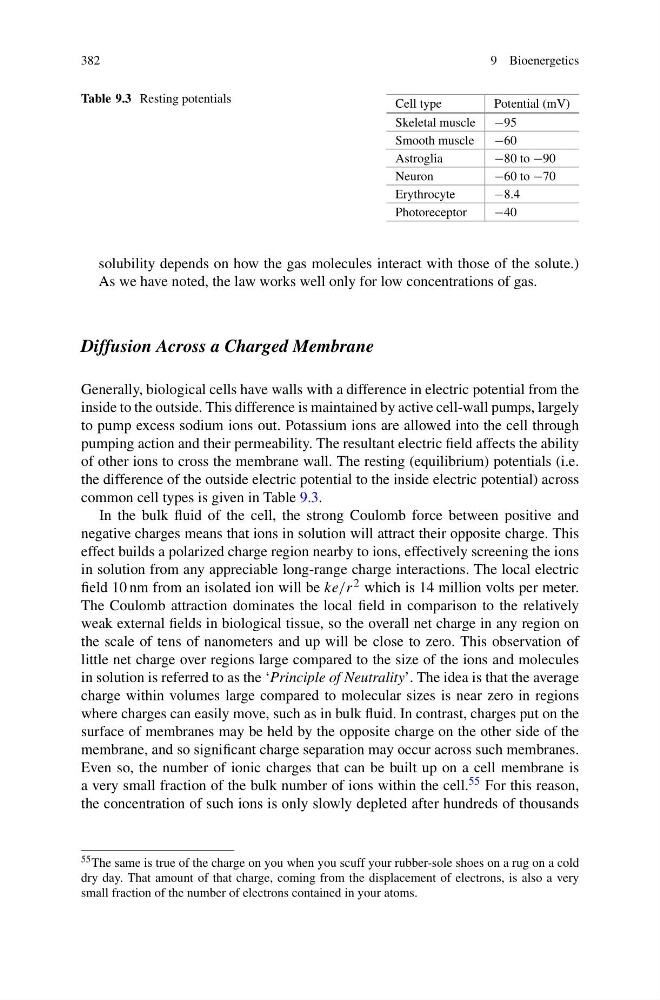
Table 9.3 Resting potentials
Cell type
Potential (mV)
Skeletal muscle −95
Smooth muscle
−60
Astroglia
−80 to −90
Neuron
−60 to −70
Erythrocyte
−8.4
Photoreceptor
−40
solubility depends on how the gas molecules interact with those of the solute.)
As we have noted, the law works well only for low concentrations of gas.
Diffusion Across a Charged Membrane
Generally, biological cells have walls with a difference in electric potential from the
inside to the outside. This difference is maintained by active cell-wall pumps, largely
to pump excess sodium ions out. Potassium ions are allowed into the cell through
pumping action and their permeability. The resultant electric field affects the ability
of other ions to cross the membrane wall. The resting (equilibrium) potentials (i.e.
the difference of the outside electric potential to the inside electric potential) across
common cell types is given in Table 9.3.
In the bulk fluid of the cell, the strong Coulomb force between positive and
negative charges means that ions in solution will attract their opposite charge. This
effect builds a polarized charge region nearby to ions, effectively screening the ions
in solution from any appreciable long-range charge interactions. The local electric
field 10 nm from an isolated ion will be ke/r 2 which is 14 million volts per meter.
The Coulomb attraction dominates the local field in comparison to the relatively
weak external fields in biological tissue, so the overall net charge in any region on
the scale of tens of nanometers and up will be close to zero. This observation of
little net charge over regions large compared to the size of the ions and molecules
in solution is referred to as the ‘Principle of Neutrality’. The idea is that the average
charge within volumes large compared to molecular sizes is near zero in regions
where charges can easily move, such as in bulk fluid. In contrast, charges put on the
surface of membranes may be held by the opposite charge on the other side of the
membrane, and so significant charge separation may occur across such membranes.
Even so, the number of ionic charges that can be built up on a cell membrane is
a very small fraction of the bulk number of ions within the cell. 55 For this reason,
the concentration of such ions is only slowly depleted after hundreds of thousands
55 The same is true of the charge on you when you scuff your rubber-sole shoes on a rug on a cold
dry day. That amount of that charge, coming from the displacement of electrons, is also a very
small fraction of the number of electrons contained in your atoms.
9 Bioenergetics
Table 9.3 Resting potentials
Cell type
Potential (mV)
Skeletal muscle −95
Smooth muscle
−60
Astroglia
−80 to −90
Neuron
−60 to −70
Erythrocyte
−8.4
Photoreceptor
−40
solubility depends on how the gas molecules interact with those of the solute.)
As we have noted, the law works well only for low concentrations of gas.
Diffusion Across a Charged Membrane
Generally, biological cells have walls with a difference in electric potential from the
inside to the outside. This difference is maintained by active cell-wall pumps, largely
to pump excess sodium ions out. Potassium ions are allowed into the cell through
pumping action and their permeability. The resultant electric field affects the ability
of other ions to cross the membrane wall. The resting (equilibrium) potentials (i.e.
the difference of the outside electric potential to the inside electric potential) across
common cell types is given in Table 9.3.
In the bulk fluid of the cell, the strong Coulomb force between positive and
negative charges means that ions in solution will attract their opposite charge. This
effect builds a polarized charge region nearby to ions, effectively screening the ions
in solution from any appreciable long-range charge interactions. The local electric
field 10 nm from an isolated ion will be ke/r 2 which is 14 million volts per meter.
The Coulomb attraction dominates the local field in comparison to the relatively
weak external fields in biological tissue, so the overall net charge in any region on
the scale of tens of nanometers and up will be close to zero. This observation of
little net charge over regions large compared to the size of the ions and molecules
in solution is referred to as the ‘Principle of Neutrality’. The idea is that the average
charge within volumes large compared to molecular sizes is near zero in regions
where charges can easily move, such as in bulk fluid. In contrast, charges put on the
surface of membranes may be held by the opposite charge on the other side of the
membrane, and so significant charge separation may occur across such membranes.
Even so, the number of ionic charges that can be built up on a cell membrane is
a very small fraction of the bulk number of ions within the cell. 55 For this reason,
the concentration of such ions is only slowly depleted after hundreds of thousands
55 The same is true of the charge on you when you scuff your rubber-sole shoes on a rug on a cold
dry day. That amount of that charge, coming from the displacement of electrons, is also a very
small fraction of the number of electrons contained in your atoms.