

9.20 Diffusion
383
of nerve impulses across a given nerve cell, principally involving the movement of
sodium and potassium ions across the nerve cell wall. The potential built up across
the wall by active pumps (using ATP) becomes a ready source of energy powering
nerve pulses.
Now, suppose a biomolecular membrane has ionic charges separated across the
membrane. Then an electric field E x will exist across it. If the membrane has a
thickness of x, then the separated ions will have created a potential difference
across the membrane of V = −E x Any positive ions within a diffusion
channel in the membrane will be pulled in the direction of the electric field, and
negative ions will be pulled in the opposite direction. If they can move, they will
reach a terminal drift speed. 56 But the terminal drift speed is also influenced not
only by electric fields, but also by thermal motion, which will generate diffusive
drift of ions in all directions, including in the opposite direction to the field. The
net effect is determined by the Boltzmann distribution of ion energies contained in
Eq. (9.153).
Alternative to a Boltzmann argument (as in Sect. 9.20), consider the ions that
can move through the membrane channels responding to the electric force F x =
−q∂V /∂x. While being pulled, collision of the ions with neighboring particles will
create a drag on the ions. If the electric field were the only agent causing ion motion,
the ion’s average speed, after many collisions, could be taken in proportion to the
dragging force f due to collisions with other molecules or the channel walls, acting
on the ions in the channels. For low velocities, f = μ −1 v, where μ is the ion
mobility. When the ion reaches a terminal speed, the drag force must balance the
electric force: μ −1 v = qE x . This is a disguised form of Ohm’s law. In this case,
the current density is qCv, where q is the ion charge, C the ion concentration, and
v the average ion speed.
Now consider the effect of a concentration gradient on the motion of ions.
Neglecting ion-ion interactions, which is a good approximation for dilute ion
concentrations, a concentration gradient causes a diffusive flow in proportional to
the negative gradient of the concentration, i.e. v D C = −D ∂C/∂x, where D is the
diffusion constant. (This is Fick’s law introduced in Eq. (9.144).) This flow includes
diffusion in a direction opposite to that caused by an external electric field. 57 At
equilibrium, there should be no net flow of the ions, so at any point x in the channel,
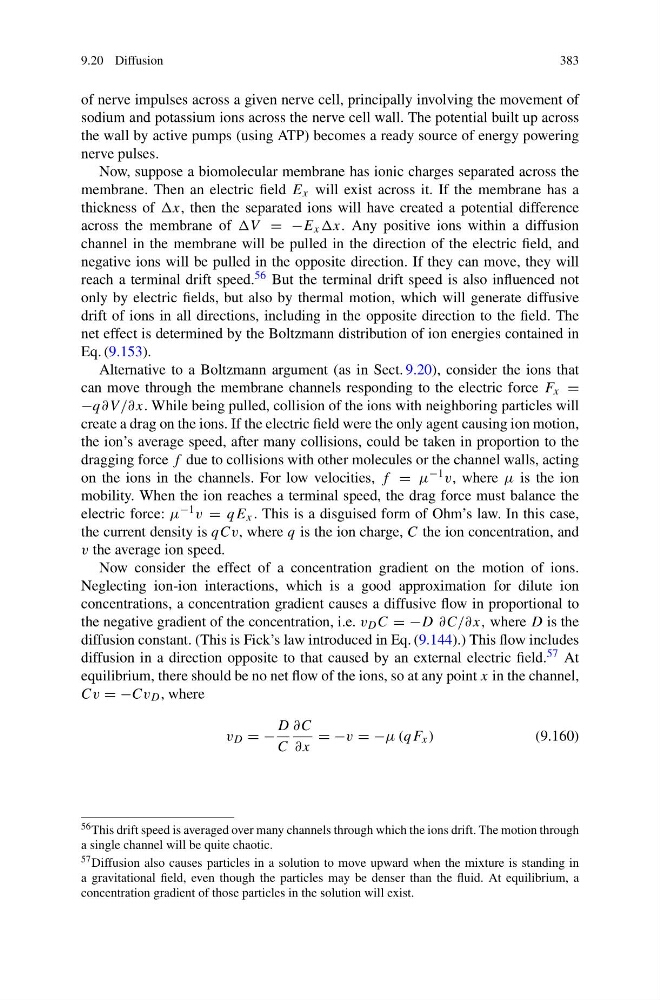
Cv = −Cv D , where
v D = −
D
C
∂C
∂x
= −v = −μ (qF x )
(9.160)
56 This drift speed is averaged over many channels through which the ions drift. The motion through
a single channel will be quite chaotic.
57 Diffusion also causes particles in a solution to move upward when the mixture is standing in
a gravitational field, even though the particles may be denser than the fluid. At equilibrium, a
concentration gradient of those particles in the solution will exist.
383
of nerve impulses across a given nerve cell, principally involving the movement of
sodium and potassium ions across the nerve cell wall. The potential built up across
the wall by active pumps (using ATP) becomes a ready source of energy powering
nerve pulses.
Now, suppose a biomolecular membrane has ionic charges separated across the
membrane. Then an electric field E x will exist across it. If the membrane has a
thickness of x, then the separated ions will have created a potential difference
across the membrane of V = −E x Any positive ions within a diffusion
channel in the membrane will be pulled in the direction of the electric field, and
negative ions will be pulled in the opposite direction. If they can move, they will
reach a terminal drift speed. 56 But the terminal drift speed is also influenced not
only by electric fields, but also by thermal motion, which will generate diffusive
drift of ions in all directions, including in the opposite direction to the field. The
net effect is determined by the Boltzmann distribution of ion energies contained in
Eq. (9.153).
Alternative to a Boltzmann argument (as in Sect. 9.20), consider the ions that
can move through the membrane channels responding to the electric force F x =
−q∂V /∂x. While being pulled, collision of the ions with neighboring particles will
create a drag on the ions. If the electric field were the only agent causing ion motion,
the ion’s average speed, after many collisions, could be taken in proportion to the
dragging force f due to collisions with other molecules or the channel walls, acting
on the ions in the channels. For low velocities, f = μ −1 v, where μ is the ion
mobility. When the ion reaches a terminal speed, the drag force must balance the
electric force: μ −1 v = qE x . This is a disguised form of Ohm’s law. In this case,
the current density is qCv, where q is the ion charge, C the ion concentration, and
v the average ion speed.
Now consider the effect of a concentration gradient on the motion of ions.
Neglecting ion-ion interactions, which is a good approximation for dilute ion
concentrations, a concentration gradient causes a diffusive flow in proportional to
the negative gradient of the concentration, i.e. v D C = −D ∂C/∂x, where D is the
diffusion constant. (This is Fick’s law introduced in Eq. (9.144).) This flow includes
diffusion in a direction opposite to that caused by an external electric field. 57 At
equilibrium, there should be no net flow of the ions, so at any point x in the channel,
Cv = −Cv D , where
v D = −
D
C
∂C
∂x
= −v = −μ (qF x )
(9.160)
56 This drift speed is averaged over many channels through which the ions drift. The motion through
a single channel will be quite chaotic.
57 Diffusion also causes particles in a solution to move upward when the mixture is standing in
a gravitational field, even though the particles may be denser than the fluid. At equilibrium, a
concentration gradient of those particles in the solution will exist.