

9.20 Diffusion
381
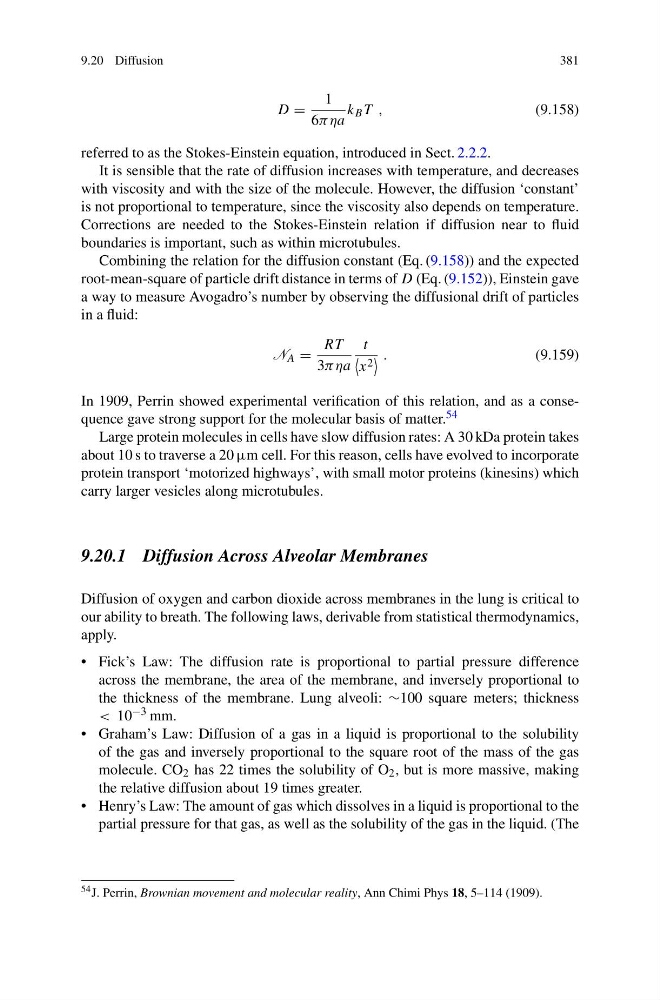
D =
1
6πηa
k B T ,
(9.158)
referred to as the Stokes-Einstein equation, introduced in Sect. 2.2.2.
It is sensible that the rate of diffusion increases with temperature, and decreases
with viscosity and with the size of the molecule. However, the diffusion ‘constant’
is not proportional to temperature, since the viscosity also depends on temperature.
Corrections are needed to the Stokes-Einstein relation if diffusion near to fluid
boundaries is important, such as within microtubules.
Combining the relation for the diffusion constant (Eq. (9.158)) and the expected
root-mean-square of particle drift distance in terms of D (Eq. (9.152)), Einstein gave
a way to measure Avogadro’s number by observing the diffusional drift of particles
in a fluid:
N A =
RT
3πηa
t
x 2
.
(9.159)
In 1909, Perrin showed experimental verification of this relation, and as a consequence gave strong support for the molecular basis of matter. 54
Large protein molecules in cells have slow diffusion rates: A 30 kDa protein takes
about 10 s to traverse a 20 μm cell. For this reason, cells have evolved to incorporate
protein transport ‘motorized highways’, with small motor proteins (kinesins) which
carry larger vesicles along microtubules.
9.20.1 Diffusion Across Alveolar Membranes
Diffusion of oxygen and carbon dioxide across membranes in the lung is critical to
our ability to breath. The following laws, derivable from statistical thermodynamics,
apply.
• Fick’s Law: The diffusion rate is proportional to partial pressure difference
across the membrane, the area of the membrane, and inversely proportional to
the thickness of the membrane. Lung alveoli: ∼100 square meters; thickness
< 10 −3 mm.
• Graham’s Law: Diffusion of a gas in a liquid is proportional to the solubility
of the gas and inversely proportional to the square root of the mass of the gas
molecule. CO 2 has 22 times the solubility of O 2 , but is more massive, making
the relative diffusion about 19 times greater.
• Henry’s Law: The amount of gas which dissolves in a liquid is proportional to the
partial pressure for that gas, as well as the solubility of the gas in the liquid. (The
54 J. Perrin, Brownian movement and molecular reality, Ann Chimi Phys 18, 5–114 (1909).
381
D =
1
6πηa
k B T ,
(9.158)
referred to as the Stokes-Einstein equation, introduced in Sect. 2.2.2.
It is sensible that the rate of diffusion increases with temperature, and decreases
with viscosity and with the size of the molecule. However, the diffusion ‘constant’
is not proportional to temperature, since the viscosity also depends on temperature.
Corrections are needed to the Stokes-Einstein relation if diffusion near to fluid
boundaries is important, such as within microtubules.
Combining the relation for the diffusion constant (Eq. (9.158)) and the expected
root-mean-square of particle drift distance in terms of D (Eq. (9.152)), Einstein gave
a way to measure Avogadro’s number by observing the diffusional drift of particles
in a fluid:
N A =
RT
3πηa
t
x 2
.
(9.159)
In 1909, Perrin showed experimental verification of this relation, and as a consequence gave strong support for the molecular basis of matter. 54
Large protein molecules in cells have slow diffusion rates: A 30 kDa protein takes
about 10 s to traverse a 20 μm cell. For this reason, cells have evolved to incorporate
protein transport ‘motorized highways’, with small motor proteins (kinesins) which
carry larger vesicles along microtubules.
9.20.1 Diffusion Across Alveolar Membranes
Diffusion of oxygen and carbon dioxide across membranes in the lung is critical to
our ability to breath. The following laws, derivable from statistical thermodynamics,
apply.
• Fick’s Law: The diffusion rate is proportional to partial pressure difference
across the membrane, the area of the membrane, and inversely proportional to
the thickness of the membrane. Lung alveoli: ∼100 square meters; thickness
< 10 −3 mm.
• Graham’s Law: Diffusion of a gas in a liquid is proportional to the solubility
of the gas and inversely proportional to the square root of the mass of the gas
molecule. CO 2 has 22 times the solubility of O 2 , but is more massive, making
the relative diffusion about 19 times greater.
• Henry’s Law: The amount of gas which dissolves in a liquid is proportional to the
partial pressure for that gas, as well as the solubility of the gas in the liquid. (The
54 J. Perrin, Brownian movement and molecular reality, Ann Chimi Phys 18, 5–114 (1909).