

9.18 Vapor Pressure
371
S = (∂S/∂N 1 )dN 1 + (∂S/∂N 2 )dN 2 ,
and
V = (∂V /∂N 1 )dN 1 + (∂V /∂N 2 )dN 2 ,
we can write
dp
dT
=
S
V
,
(9.126)
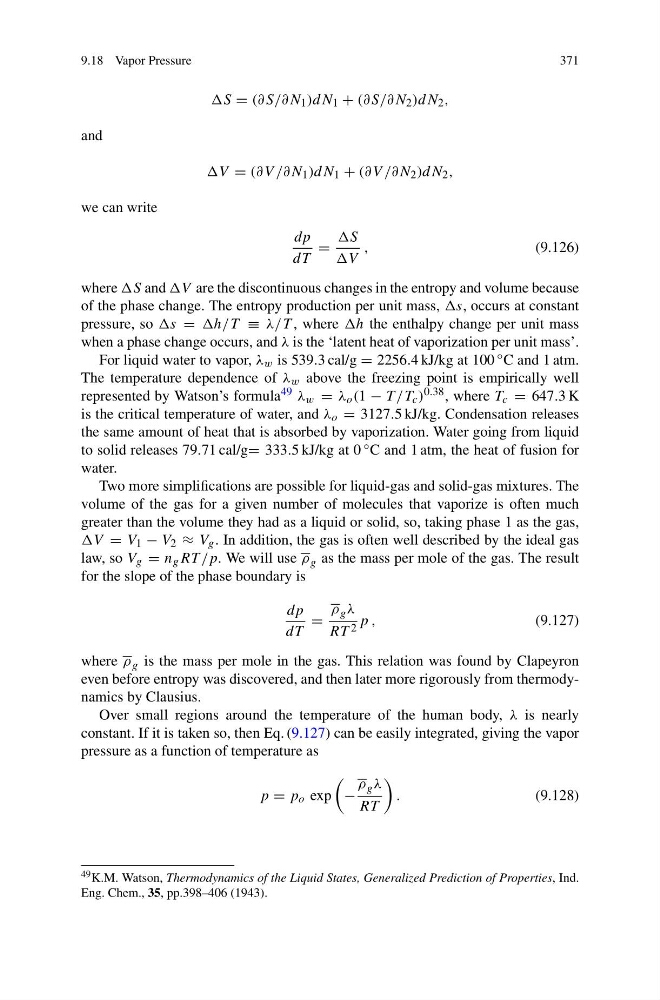
where S and V are the discontinuous changes in the entropy and volume because
of the phase change. The entropy production per unit mass, s, occurs at constant
pressure, so s = ≡ λ/T , where h the enthalpy change per unit mass
when a phase change occurs, and λ is the ‘latent heat of vaporization per unit mass’.
For liquid water to vapor, λ w is 539.3 cal/g = 2256.4 kJ/kg at 100 ◦ C and 1 atm.
The temperature dependence of λ w above the freezing point is empirically well
represented by Watson’s formula 49 λ w = λ o (1 − T /T c ) 0.38 , where T c = 647.3 K
is the critical temperature of water, and λ o = 3127.5 kJ/kg. Condensation releases
the same amount of heat that is absorbed by vaporization. Water going from liquid
to solid releases 79.71 cal/g= 333.5 kJ/kg at 0 ◦ C and 1 atm, the heat of fusion for
water.
Two more simplifications are possible for liquid-gas and solid-gas mixtures. The
volume of the gas for a given number of molecules that vaporize is often much
greater than the volume they had as a liquid or solid, so, taking phase 1 as the gas,
V = V 1 − V 2 ≈ V g . In addition, the gas is often well described by the ideal gas
law, so V g = n g RT /p. We will use ρ g as the mass per mole of the gas. The result
for the slope of the phase boundary is
dp
dT
=
ρ g λ
RT 2 p ,
(9.127)
where ρ g is the mass per mole in the gas. This relation was found by Clapeyron
even before entropy was discovered, and then later more rigorously from thermodynamics by Clausius.
Over small regions around the temperature of the human body, λ is nearly
constant. If it is taken so, then Eq. (9.127) can be easily integrated, giving the vapor
pressure as a function of temperature as
p = p o exp
−
ρ g λ
RT
.
(9.128)
49 K.M. Watson, Thermodynamics of the Liquid States, Generalized Prediction of Properties, Ind.
Eng. Chem., 35, pp.398–406 (1943).
371
S = (∂S/∂N 1 )dN 1 + (∂S/∂N 2 )dN 2 ,
and
V = (∂V /∂N 1 )dN 1 + (∂V /∂N 2 )dN 2 ,
we can write
dp
dT
=
S
V
,
(9.126)
where S and V are the discontinuous changes in the entropy and volume because
of the phase change. The entropy production per unit mass, s, occurs at constant
pressure, so s = ≡ λ/T , where h the enthalpy change per unit mass
when a phase change occurs, and λ is the ‘latent heat of vaporization per unit mass’.
For liquid water to vapor, λ w is 539.3 cal/g = 2256.4 kJ/kg at 100 ◦ C and 1 atm.
The temperature dependence of λ w above the freezing point is empirically well
represented by Watson’s formula 49 λ w = λ o (1 − T /T c ) 0.38 , where T c = 647.3 K
is the critical temperature of water, and λ o = 3127.5 kJ/kg. Condensation releases
the same amount of heat that is absorbed by vaporization. Water going from liquid
to solid releases 79.71 cal/g= 333.5 kJ/kg at 0 ◦ C and 1 atm, the heat of fusion for
water.
Two more simplifications are possible for liquid-gas and solid-gas mixtures. The
volume of the gas for a given number of molecules that vaporize is often much
greater than the volume they had as a liquid or solid, so, taking phase 1 as the gas,
V = V 1 − V 2 ≈ V g . In addition, the gas is often well described by the ideal gas
law, so V g = n g RT /p. We will use ρ g as the mass per mole of the gas. The result
for the slope of the phase boundary is
dp
dT
=
ρ g λ
RT 2 p ,
(9.127)
where ρ g is the mass per mole in the gas. This relation was found by Clapeyron
even before entropy was discovered, and then later more rigorously from thermodynamics by Clausius.
Over small regions around the temperature of the human body, λ is nearly
constant. If it is taken so, then Eq. (9.127) can be easily integrated, giving the vapor
pressure as a function of temperature as
p = p o exp
−
ρ g λ
RT
.
(9.128)
49 K.M. Watson, Thermodynamics of the Liquid States, Generalized Prediction of Properties, Ind.
Eng. Chem., 35, pp.398–406 (1943).