

372
9 Bioenergetics
Improvements to account for the temperature dependence of the latent heat can
be represented by fits to semi-empirical formulae, such as the following for saturated
water vapor over liquid water and ice for temperatures in the range −100 ◦ C< T <
100 ◦ C:
p = p o
T o
T
α
exp
β
1 −
T o
T
.
(9.129)
Here, p o is 6.0495 mPa, T o is 273.15 K. The numbers α and β are 5.09 and 24.938
for vapor over liquid, and 0.555 and 23.051 for vapor over ice. 50
When there is more than one volatile component in a system, each dissolved
in one solvent, we can still use the balancing of chemical potentials, one for each
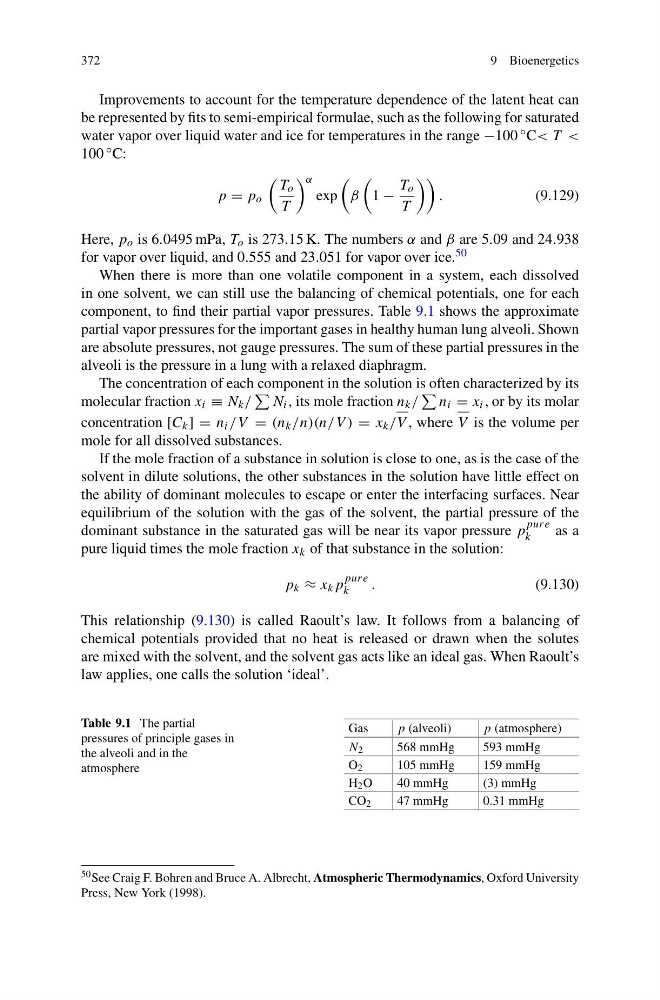
component, to find their partial vapor pressures. Table 9.1 shows the approximate
partial vapor pressures for the important gases in healthy human lung alveoli. Shown
are absolute pressures, not gauge pressures. The sum of these partial pressures in the
alveoli is the pressure in a lung with a relaxed diaphragm.
The concentration of each component in the solution is often characterized by its
molecular fraction x i ≡ N k /
N i , its mole fraction n k /
n i = x i , or by its molar
concentration [C k ] = n i /V = (n k /n)(n/V ) = x k /V , where V is the volume per
mole for all dissolved substances.
If the mole fraction of a substance in solution is close to one, as is the case of the
solvent in dilute solutions, the other substances in the solution have little effect on
the ability of dominant molecules to escape or enter the interfacing surfaces. Near
equilibrium of the solution with the gas of the solvent, the partial pressure of the
dominant substance in the saturated gas will be near its vapor pressure p
pure
k
as a
pure liquid times the mole fraction x k of that substance in the solution:
p k ≈ x k p
pure
k
.
(9.130)
This relationship (9.130) is called Raoult’s law. It follows from a balancing of
chemical potentials provided that no heat is released or drawn when the solutes
are mixed with the solvent, and the solvent gas acts like an ideal gas. When Raoult’s
law applies, one calls the solution ‘ideal’.
Table 9.1 The partial
pressures of principle gases in
the alveoli and in the
atmosphere
Gas
p (alveoli)
p (atmosphere)
N 2
568 mmHg
593 mmHg
O 2
105 mmHg
159 mmHg
H 2 O
40 mmHg
(3) mmHg
CO 2
47 mmHg
0.31 mmHg
50 See Craig F. Bohren and Bruce A. Albrecht, Atmospheric Thermodynamics, Oxford University
Press, New York (1998).
9 Bioenergetics
Improvements to account for the temperature dependence of the latent heat can
be represented by fits to semi-empirical formulae, such as the following for saturated
water vapor over liquid water and ice for temperatures in the range −100 ◦ C< T <
100 ◦ C:
p = p o
T o
T
α
exp
β
1 −
T o
T
.
(9.129)
Here, p o is 6.0495 mPa, T o is 273.15 K. The numbers α and β are 5.09 and 24.938
for vapor over liquid, and 0.555 and 23.051 for vapor over ice. 50
When there is more than one volatile component in a system, each dissolved
in one solvent, we can still use the balancing of chemical potentials, one for each
component, to find their partial vapor pressures. Table 9.1 shows the approximate
partial vapor pressures for the important gases in healthy human lung alveoli. Shown
are absolute pressures, not gauge pressures. The sum of these partial pressures in the
alveoli is the pressure in a lung with a relaxed diaphragm.
The concentration of each component in the solution is often characterized by its
molecular fraction x i ≡ N k /
N i , its mole fraction n k /
n i = x i , or by its molar
concentration [C k ] = n i /V = (n k /n)(n/V ) = x k /V , where V is the volume per
mole for all dissolved substances.
If the mole fraction of a substance in solution is close to one, as is the case of the
solvent in dilute solutions, the other substances in the solution have little effect on
the ability of dominant molecules to escape or enter the interfacing surfaces. Near
equilibrium of the solution with the gas of the solvent, the partial pressure of the
dominant substance in the saturated gas will be near its vapor pressure p
pure
k
as a
pure liquid times the mole fraction x k of that substance in the solution:
p k ≈ x k p
pure
k
.
(9.130)
This relationship (9.130) is called Raoult’s law. It follows from a balancing of
chemical potentials provided that no heat is released or drawn when the solutes
are mixed with the solvent, and the solvent gas acts like an ideal gas. When Raoult’s
law applies, one calls the solution ‘ideal’.
Table 9.1 The partial
pressures of principle gases in
the alveoli and in the
atmosphere
Gas
p (alveoli)
p (atmosphere)
N 2
568 mmHg
593 mmHg
O 2
105 mmHg
159 mmHg
H 2 O
40 mmHg
(3) mmHg
CO 2
47 mmHg
0.31 mmHg
50 See Craig F. Bohren and Bruce A. Albrecht, Atmospheric Thermodynamics, Oxford University
Press, New York (1998).