

9.15 Utility of the Gibbs Free Energy
363
have δS = 0 and δ 2 S < 0, i.e. the slope of S must vanish at equilibrium and
the curvature near equilibrium must be negative, so that S is at a maximum. (See
Fig. 9.6.)
9.14.2 Energy Minimum from the Second Law
The entropy maximum formulation of the second law of thermodynamics can be
reformulated in terms of an energy minimum principle:
If a system, closed to matter and held to fixed entropy, 45 is put into a state of nonequilibrium and allowed to relax, it will evolve toward equilibrium with its internal energy
reaching a minimum.
Near equilibrium, any variation of E under virtual changes in one or more of the
unconstrained extensive variables, apart from the entropy and total particle number,
will have δE = 0 and δ 2 E > 0, i.e. the slope of E must vanish at equilibrium
and the curvatures near equilibrium must be positive, so that E is at a minimum. 46
Similarly, if, near equilibrium, the curvature of the entropy under virtual changes in
any extensive variable other than energy is negative, and the temperature is positive,
then the curvatures of the energy function will be positive. (See Fig. 9.6.)
9.15 Utility of the Gibbs Free Energy
During chemical reactions, in the body and elsewhere, the entropy and the volume
for any subsystems are usually not fixed. Fixed entropy means no heat exchange
and no internal dissipation. Having perfect insulation is practically difficult. Also,
having a fixed volume during a reaction is also difficult in practice for liquids and
solids. Correspondingly, it is hard experimentally to keep the internal energy of a
system fixed during a thermodynamic process. However, J. Willard Gibbs exploited
the fact that the quantity
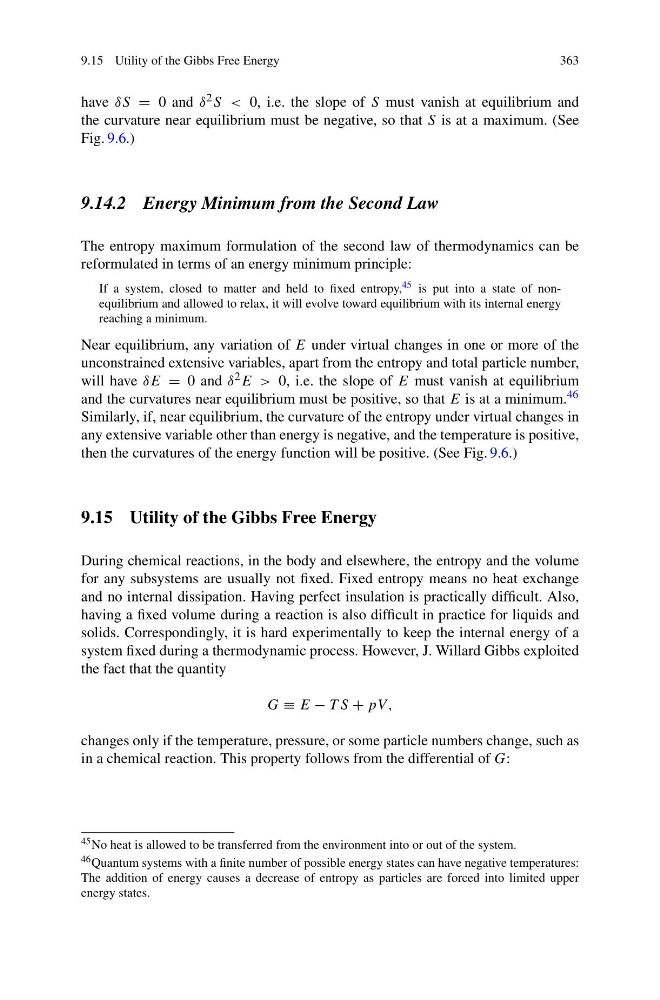
G ≡ E − T S + pV ,
changes only if the temperature, pressure, or some particle numbers change, such as
in a chemical reaction. This property follows from the differential of G:
45 No heat is allowed to be transferred from the environment into or out of the system.
46 Quantum systems with a finite number of possible energy states can have negative temperatures:
The addition of energy causes a decrease of entropy as particles are forced into limited upper
energy states.
363
have δS = 0 and δ 2 S < 0, i.e. the slope of S must vanish at equilibrium and
the curvature near equilibrium must be negative, so that S is at a maximum. (See
Fig. 9.6.)
9.14.2 Energy Minimum from the Second Law
The entropy maximum formulation of the second law of thermodynamics can be
reformulated in terms of an energy minimum principle:
If a system, closed to matter and held to fixed entropy, 45 is put into a state of nonequilibrium and allowed to relax, it will evolve toward equilibrium with its internal energy
reaching a minimum.
Near equilibrium, any variation of E under virtual changes in one or more of the
unconstrained extensive variables, apart from the entropy and total particle number,
will have δE = 0 and δ 2 E > 0, i.e. the slope of E must vanish at equilibrium
and the curvatures near equilibrium must be positive, so that E is at a minimum. 46
Similarly, if, near equilibrium, the curvature of the entropy under virtual changes in
any extensive variable other than energy is negative, and the temperature is positive,
then the curvatures of the energy function will be positive. (See Fig. 9.6.)
9.15 Utility of the Gibbs Free Energy
During chemical reactions, in the body and elsewhere, the entropy and the volume
for any subsystems are usually not fixed. Fixed entropy means no heat exchange
and no internal dissipation. Having perfect insulation is practically difficult. Also,
having a fixed volume during a reaction is also difficult in practice for liquids and
solids. Correspondingly, it is hard experimentally to keep the internal energy of a
system fixed during a thermodynamic process. However, J. Willard Gibbs exploited
the fact that the quantity
G ≡ E − T S + pV ,
changes only if the temperature, pressure, or some particle numbers change, such as
in a chemical reaction. This property follows from the differential of G:
45 No heat is allowed to be transferred from the environment into or out of the system.
46 Quantum systems with a finite number of possible energy states can have negative temperatures:
The addition of energy causes a decrease of entropy as particles are forced into limited upper
energy states.