

362
9 Bioenergetics
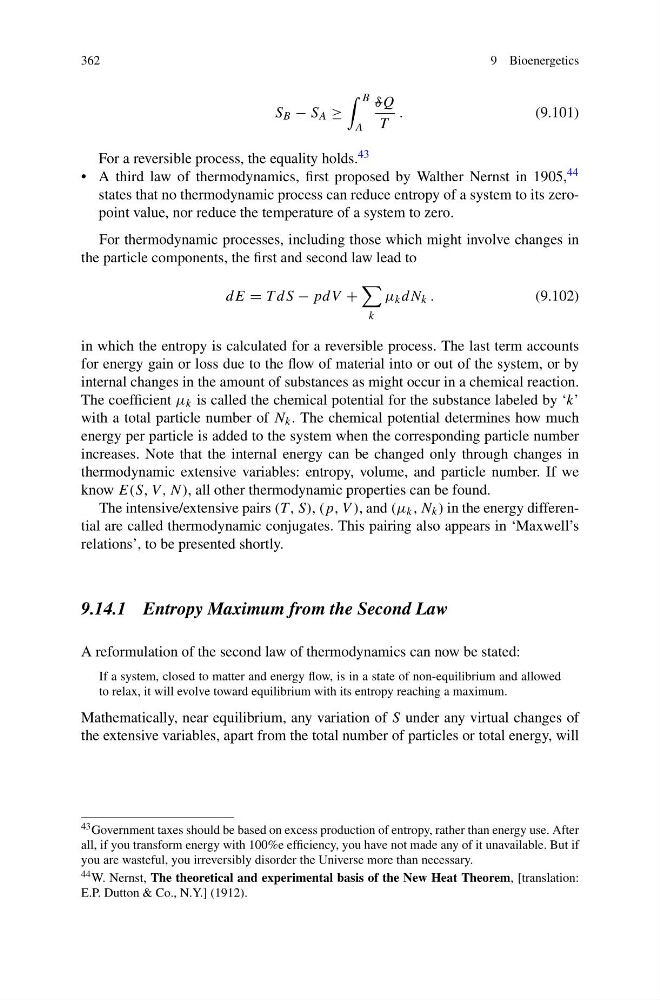
S B − S A ≥
B
A
δQ
T
.
(9.101)
For a reversible process, the equality holds. 43
• A third law of thermodynamics, first proposed by Walther Nernst in 1905, 44
states that no thermodynamic process can reduce entropy of a system to its zeropoint value, nor reduce the temperature of a system to zero.
For thermodynamic processes, including those which might involve changes in
the particle components, the first and second law lead to
dE = T dS − pdV +
k
μ k dN k .
(9.102)
in which the entropy is calculated for a reversible process. The last term accounts
for energy gain or loss due to the flow of material into or out of the system, or by
internal changes in the amount of substances as might occur in a chemical reaction.
The coefficient μ k is called the chemical potential for the substance labeled by ‘k’
with a total particle number of N k . The chemical potential determines how much
energy per particle is added to the system when the corresponding particle number
increases. Note that the internal energy can be changed only through changes in
thermodynamic extensive variables: entropy, volume, and particle number. If we
know E(S, V , N), all other thermodynamic properties can be found.
The intensive/extensive pairs (T , S), (p, V ), and (μ k , N k ) in the energy differential are called thermodynamic conjugates. This pairing also appears in ‘Maxwell’s
relations’, to be presented shortly.
9.14.1 Entropy Maximum from the Second Law
A reformulation of the second law of thermodynamics can now be stated:
If a system, closed to matter and energy flow, is in a state of non-equilibrium and allowed
to relax, it will evolve toward equilibrium with its entropy reaching a maximum.
Mathematically, near equilibrium, any variation of S under any virtual changes of
the extensive variables, apart from the total number of particles or total energy, will
43 Government taxes should be based on excess production of entropy, rather than energy use. After
all, if you transform energy with 100%e efficiency, you have not made any of it unavailable. But if
you are wasteful, you irreversibly disorder the Universe more than necessary.
44 W. Nernst, The theoretical and experimental basis of the New Heat Theorem, [translation:
E.P. Dutton & Co., N.Y.] (1912).
9 Bioenergetics
S B − S A ≥
B
A
δQ
T
.
(9.101)
For a reversible process, the equality holds. 43
• A third law of thermodynamics, first proposed by Walther Nernst in 1905, 44
states that no thermodynamic process can reduce entropy of a system to its zeropoint value, nor reduce the temperature of a system to zero.
For thermodynamic processes, including those which might involve changes in
the particle components, the first and second law lead to
dE = T dS − pdV +
k
μ k dN k .
(9.102)
in which the entropy is calculated for a reversible process. The last term accounts
for energy gain or loss due to the flow of material into or out of the system, or by
internal changes in the amount of substances as might occur in a chemical reaction.
The coefficient μ k is called the chemical potential for the substance labeled by ‘k’
with a total particle number of N k . The chemical potential determines how much
energy per particle is added to the system when the corresponding particle number
increases. Note that the internal energy can be changed only through changes in
thermodynamic extensive variables: entropy, volume, and particle number. If we
know E(S, V , N), all other thermodynamic properties can be found.
The intensive/extensive pairs (T , S), (p, V ), and (μ k , N k ) in the energy differential are called thermodynamic conjugates. This pairing also appears in ‘Maxwell’s
relations’, to be presented shortly.
9.14.1 Entropy Maximum from the Second Law
A reformulation of the second law of thermodynamics can now be stated:
If a system, closed to matter and energy flow, is in a state of non-equilibrium and allowed
to relax, it will evolve toward equilibrium with its entropy reaching a maximum.
Mathematically, near equilibrium, any variation of S under any virtual changes of
the extensive variables, apart from the total number of particles or total energy, will
43 Government taxes should be based on excess production of entropy, rather than energy use. After
all, if you transform energy with 100%e efficiency, you have not made any of it unavailable. But if
you are wasteful, you irreversibly disorder the Universe more than necessary.
44 W. Nernst, The theoretical and experimental basis of the New Heat Theorem, [translation:
E.P. Dutton & Co., N.Y.] (1912).