

364
9 Bioenergetics
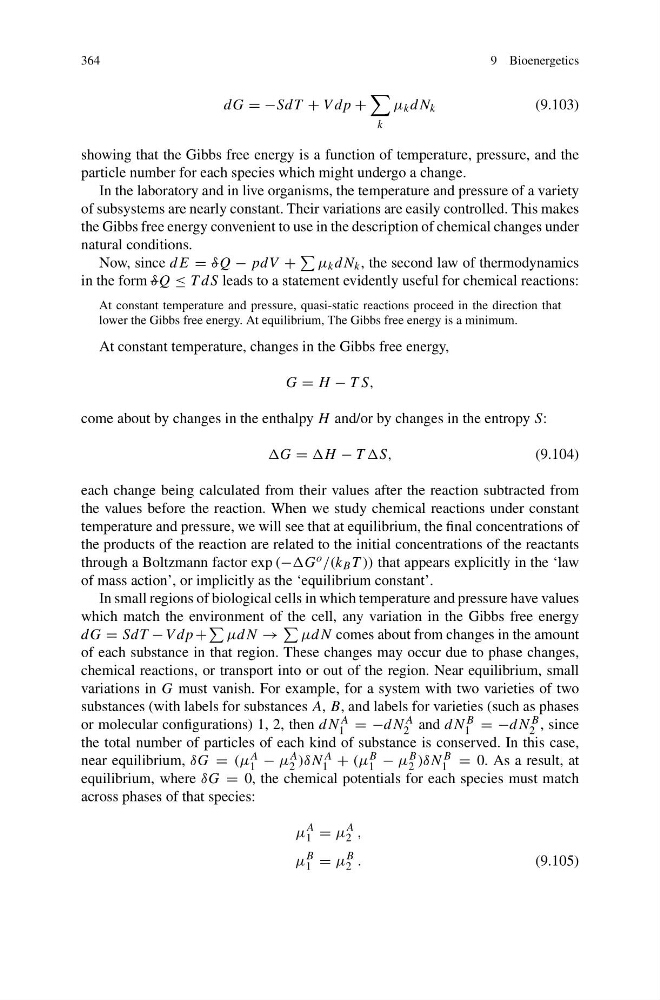
dG = −SdT + V dp +
k
μ k dN k
(9.103)
showing that the Gibbs free energy is a function of temperature, pressure, and the
particle number for each species which might undergo a change.
In the laboratory and in live organisms, the temperature and pressure of a variety
of subsystems are nearly constant. Their variations are easily controlled. This makes
the Gibbs free energy convenient to use in the description of chemical changes under
natural conditions.
Now, since dE = δQ − pdV +
μ k dN k , the second law of thermodynamics
in the form δQ ≤ T dS leads to a statement evidently useful for chemical reactions:
At constant temperature and pressure, quasi-static reactions proceed in the direction that
lower the Gibbs free energy. At equilibrium, The Gibbs free energy is a minimum.
At constant temperature, changes in the Gibbs free energy,
G = H − T S,
come about by changes in the enthalpy H and/or by changes in the entropy S:
G = H − T TS,
(9.104)
each change being calculated from their values after the reaction subtracted from
the values before the reaction. When we study chemical reactions under constant
temperature and pressure, we will see that at equilibrium, the final concentrations of
the products of the reaction are related to the initial concentrations of the reactants
through a Boltzmann factor exp (−G o /(k B T )) that appears explicitly in the ‘law
of mass action’, or implicitly as the ‘equilibrium constant’.
In small regions of biological cells in which temperature and pressure have values
which match the environment of the cell, any variation in the Gibbs free energy
dG = SdT − V dp +
μdN →
μdN comes about from changes in the amount
of each substance in that region. These changes may occur due to phase changes,
chemical reactions, or transport into or out of the region. Near equilibrium, small
variations in G must vanish. For example, for a system with two varieties of two
substances (with labels for substances A, B, and labels for varieties (such as phases
or molecular configurations) 1, 2, then dN A
1 = −dN A
2 and dN B
1 = −dN B
2 , since
the total number of particles of each kind of substance is conserved. In this case,
near equilibrium, δG = (μ A
1 − μ A
2 )δN A
1 + (μ B
1 − μ B
2 )δN B
1 = 0. As a result, at
equilibrium, where δG = 0, the chemical potentials for each species must match
across phases of that species:
μ
A
1 = μ
A
2 ,
μ
B
1 = μ
B
2 .
(9.105)
9 Bioenergetics
dG = −SdT + V dp +
k
μ k dN k
(9.103)
showing that the Gibbs free energy is a function of temperature, pressure, and the
particle number for each species which might undergo a change.
In the laboratory and in live organisms, the temperature and pressure of a variety
of subsystems are nearly constant. Their variations are easily controlled. This makes
the Gibbs free energy convenient to use in the description of chemical changes under
natural conditions.
Now, since dE = δQ − pdV +
μ k dN k , the second law of thermodynamics
in the form δQ ≤ T dS leads to a statement evidently useful for chemical reactions:
At constant temperature and pressure, quasi-static reactions proceed in the direction that
lower the Gibbs free energy. At equilibrium, The Gibbs free energy is a minimum.
At constant temperature, changes in the Gibbs free energy,
G = H − T S,
come about by changes in the enthalpy H and/or by changes in the entropy S:
G = H − T TS,
(9.104)
each change being calculated from their values after the reaction subtracted from
the values before the reaction. When we study chemical reactions under constant
temperature and pressure, we will see that at equilibrium, the final concentrations of
the products of the reaction are related to the initial concentrations of the reactants
through a Boltzmann factor exp (−G o /(k B T )) that appears explicitly in the ‘law
of mass action’, or implicitly as the ‘equilibrium constant’.
In small regions of biological cells in which temperature and pressure have values
which match the environment of the cell, any variation in the Gibbs free energy
dG = SdT − V dp +
μdN →
μdN comes about from changes in the amount
of each substance in that region. These changes may occur due to phase changes,
chemical reactions, or transport into or out of the region. Near equilibrium, small
variations in G must vanish. For example, for a system with two varieties of two
substances (with labels for substances A, B, and labels for varieties (such as phases
or molecular configurations) 1, 2, then dN A
1 = −dN A
2 and dN B
1 = −dN B
2 , since
the total number of particles of each kind of substance is conserved. In this case,
near equilibrium, δG = (μ A
1 − μ A
2 )δN A
1 + (μ B
1 − μ B
2 )δN B
1 = 0. As a result, at
equilibrium, where δG = 0, the chemical potentials for each species must match
across phases of that species:
μ
A
1 = μ
A
2 ,
μ
B
1 = μ
B
2 .
(9.105)