

304
8 Ionizing Radiation and Life
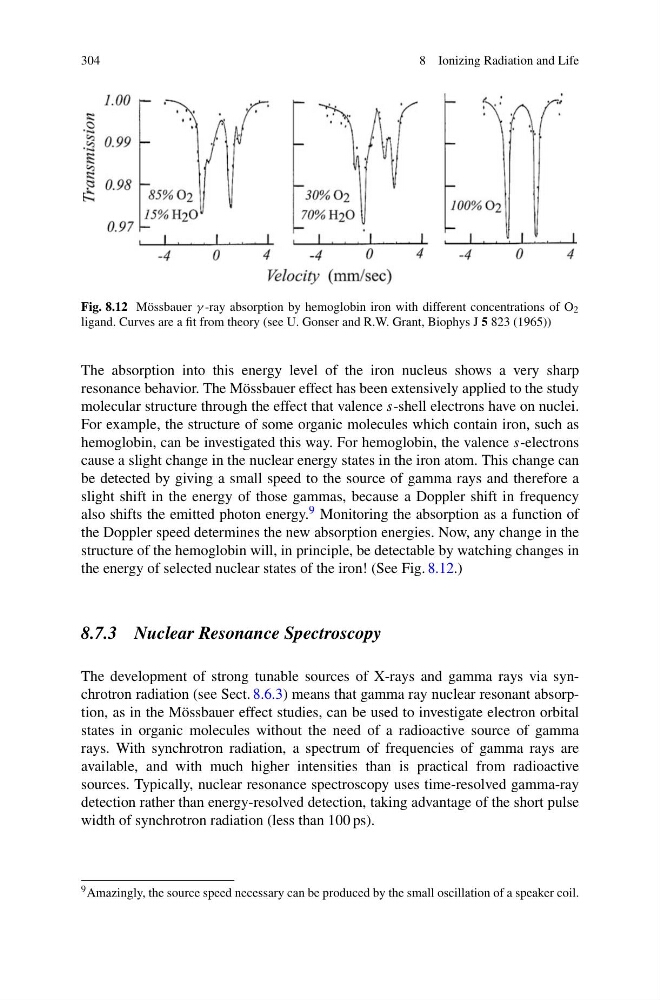
Fig. 8.12 Mössbauer γ -ray absorption by hemoglobin iron with different concentrations of O 2
ligand. Curves are a fit from theory (see U. Gonser and R.W. Grant, Biophys J 5 823 (1965))
The absorption into this energy level of the iron nucleus shows a very sharp
resonance behavior. The Mössbauer effect has been extensively applied to the study
molecular structure through the effect that valence s-shell electrons have on nuclei.
For example, the structure of some organic molecules which contain iron, such as
hemoglobin, can be investigated this way. For hemoglobin, the valence s-electrons
cause a slight change in the nuclear energy states in the iron atom. This change can
be detected by giving a small speed to the source of gamma rays and therefore a
slight shift in the energy of those gammas, because a Doppler shift in frequency
also shifts the emitted photon energy. 9 Monitoring the absorption as a function of
the Doppler speed determines the new absorption energies. Now, any change in the
structure of the hemoglobin will, in principle, be detectable by watching changes in
the energy of selected nuclear states of the iron! (See Fig. 8.12.)
8.7.3 Nuclear Resonance Spectroscopy
The development of strong tunable sources of X-rays and gamma rays via synchrotron radiation (see Sect. 8.6.3) means that gamma ray nuclear resonant absorption, as in the Mössbauer effect studies, can be used to investigate electron orbital
states in organic molecules without the need of a radioactive source of gamma
rays. With synchrotron radiation, a spectrum of frequencies of gamma rays are
available, and with much higher intensities than is practical from radioactive
sources. Typically, nuclear resonance spectroscopy uses time-resolved gamma-ray
detection rather than energy-resolved detection, taking advantage of the short pulse
width of synchrotron radiation (less than 100 ps).
9 Amazingly, the source speed necessary can be produced by the small oscillation of a speaker coil.
8 Ionizing Radiation and Life
Fig. 8.12 Mössbauer γ -ray absorption by hemoglobin iron with different concentrations of O 2
ligand. Curves are a fit from theory (see U. Gonser and R.W. Grant, Biophys J 5 823 (1965))
The absorption into this energy level of the iron nucleus shows a very sharp
resonance behavior. The Mössbauer effect has been extensively applied to the study
molecular structure through the effect that valence s-shell electrons have on nuclei.
For example, the structure of some organic molecules which contain iron, such as
hemoglobin, can be investigated this way. For hemoglobin, the valence s-electrons
cause a slight change in the nuclear energy states in the iron atom. This change can
be detected by giving a small speed to the source of gamma rays and therefore a
slight shift in the energy of those gammas, because a Doppler shift in frequency
also shifts the emitted photon energy. 9 Monitoring the absorption as a function of
the Doppler speed determines the new absorption energies. Now, any change in the
structure of the hemoglobin will, in principle, be detectable by watching changes in
the energy of selected nuclear states of the iron! (See Fig. 8.12.)
8.7.3 Nuclear Resonance Spectroscopy
The development of strong tunable sources of X-rays and gamma rays via synchrotron radiation (see Sect. 8.6.3) means that gamma ray nuclear resonant absorption, as in the Mössbauer effect studies, can be used to investigate electron orbital
states in organic molecules without the need of a radioactive source of gamma
rays. With synchrotron radiation, a spectrum of frequencies of gamma rays are
available, and with much higher intensities than is practical from radioactive
sources. Typically, nuclear resonance spectroscopy uses time-resolved gamma-ray
detection rather than energy-resolved detection, taking advantage of the short pulse
width of synchrotron radiation (less than 100 ps).
9 Amazingly, the source speed necessary can be produced by the small oscillation of a speaker coil.