

8.7 Gamma Rays
303
thousandth the diameter of the atom. The electrons which penetrate nuclei are the socalled s electrons, which have no angular momentum relative to the central nucleus.
Due to those visits, the s valence electrons slightly change the energy levels of
nucleons in the nucleus. Now suppose that nucleus is in an excited state, ready to
decay, and give off a gamma ray. Then the energy (and therefore the associated
frequency) of that emitted gamma ray will be affected by the s valence electrons,
which, in turn, influence the chemistry of the molecule where that nucleus resides.
Gamma rays emitted from a nucleus of an atom have sufficient momentum to
kick the nucleus backward. This causes the gamma ray to suffer a Doppler shift
down in frequency. Rudolf Mössbauer discovered (in 1958) that the kick of the
gamma ray from the nucleus of an atom bound in a solid might not cause the
individual atom to recoil, but rather the recoil momentum is taken up by many atoms
at once. This is a pure quantum effect, in that the bound atom must either remain at
rest relative to its neighbors, or take up a fixed integer number of vibrational quanta
(‘phonons’). The phenomenon was important in Mössbauer’s research in that the
emitted photon, little diminished in energy, could be subsequently absorbed by an
unexcited nucleus of the same kind as the emitter, but some distance away, while,
because of the sharpness of the nuclear levels, the Doppler-shifted gamma ray is
little absorbed.
Gamma rays from excited states in nuclei can have very sharply defined
frequencies, typically a few parts in 10 12 . For resonant absorption of those gamma
rays, the incoming gamma must be within a very small frequency range. Given the
Doppler shift on emission, gases do not show subsequent gamma absorption after
emission. But, as Mössbauer demonstrated, solids can.
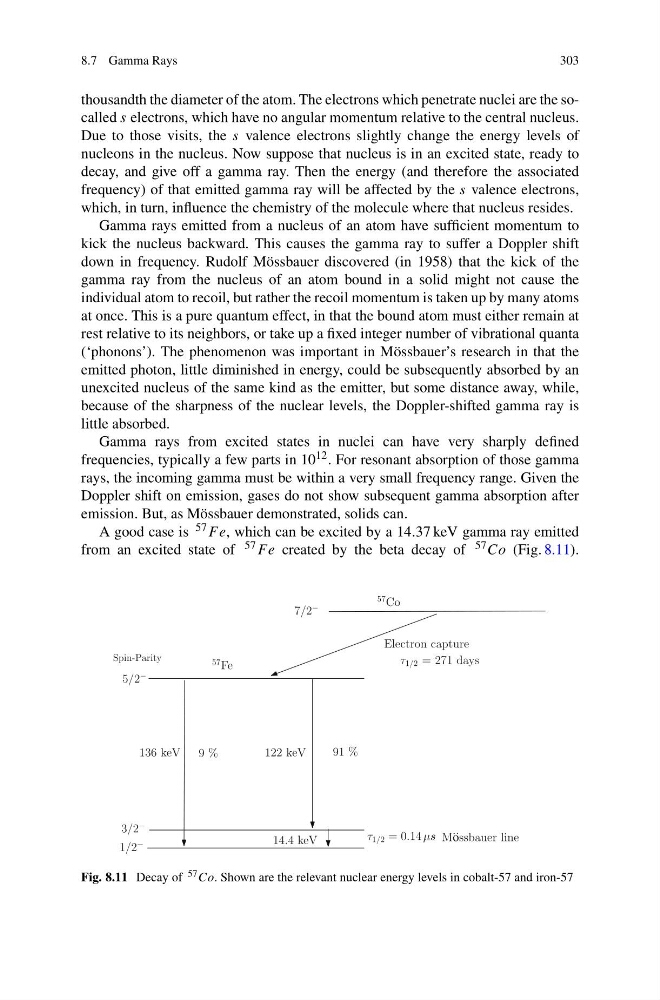
A good case is 57 F e, which can be excited by a 14.37 keV gamma ray emitted
from an excited state of 57 F e created by the beta decay of 57 Co (Fig. 8.11).
9 %
91 %
Mοssbauer line
Spin-Parity
5/2
−
136 keV
14.4 keV
Electron capture
57 Co
τ 1/2 = 271 days
122 keV
57 Fe
τ 1/2 = 0.14 μs
7/2
−
3/2
−
1/2
−
..
Fig. 8.11 Decay of 57 Co. Shown are the relevant nuclear energy levels in cobalt-57 and iron-57
303
thousandth the diameter of the atom. The electrons which penetrate nuclei are the socalled s electrons, which have no angular momentum relative to the central nucleus.
Due to those visits, the s valence electrons slightly change the energy levels of
nucleons in the nucleus. Now suppose that nucleus is in an excited state, ready to
decay, and give off a gamma ray. Then the energy (and therefore the associated
frequency) of that emitted gamma ray will be affected by the s valence electrons,
which, in turn, influence the chemistry of the molecule where that nucleus resides.
Gamma rays emitted from a nucleus of an atom have sufficient momentum to
kick the nucleus backward. This causes the gamma ray to suffer a Doppler shift
down in frequency. Rudolf Mössbauer discovered (in 1958) that the kick of the
gamma ray from the nucleus of an atom bound in a solid might not cause the
individual atom to recoil, but rather the recoil momentum is taken up by many atoms
at once. This is a pure quantum effect, in that the bound atom must either remain at
rest relative to its neighbors, or take up a fixed integer number of vibrational quanta
(‘phonons’). The phenomenon was important in Mössbauer’s research in that the
emitted photon, little diminished in energy, could be subsequently absorbed by an
unexcited nucleus of the same kind as the emitter, but some distance away, while,
because of the sharpness of the nuclear levels, the Doppler-shifted gamma ray is
little absorbed.
Gamma rays from excited states in nuclei can have very sharply defined
frequencies, typically a few parts in 10 12 . For resonant absorption of those gamma
rays, the incoming gamma must be within a very small frequency range. Given the
Doppler shift on emission, gases do not show subsequent gamma absorption after
emission. But, as Mössbauer demonstrated, solids can.
A good case is 57 F e, which can be excited by a 14.37 keV gamma ray emitted
from an excited state of 57 F e created by the beta decay of 57 Co (Fig. 8.11).
9 %
91 %
Mοssbauer line
Spin-Parity
5/2
−
136 keV
14.4 keV
Electron capture
57 Co
τ 1/2 = 271 days
122 keV
57 Fe
τ 1/2 = 0.14 μs
7/2
−
3/2
−
1/2
−
..
Fig. 8.11 Decay of 57 Co. Shown are the relevant nuclear energy levels in cobalt-57 and iron-57