

298
8 Ionizing Radiation and Life
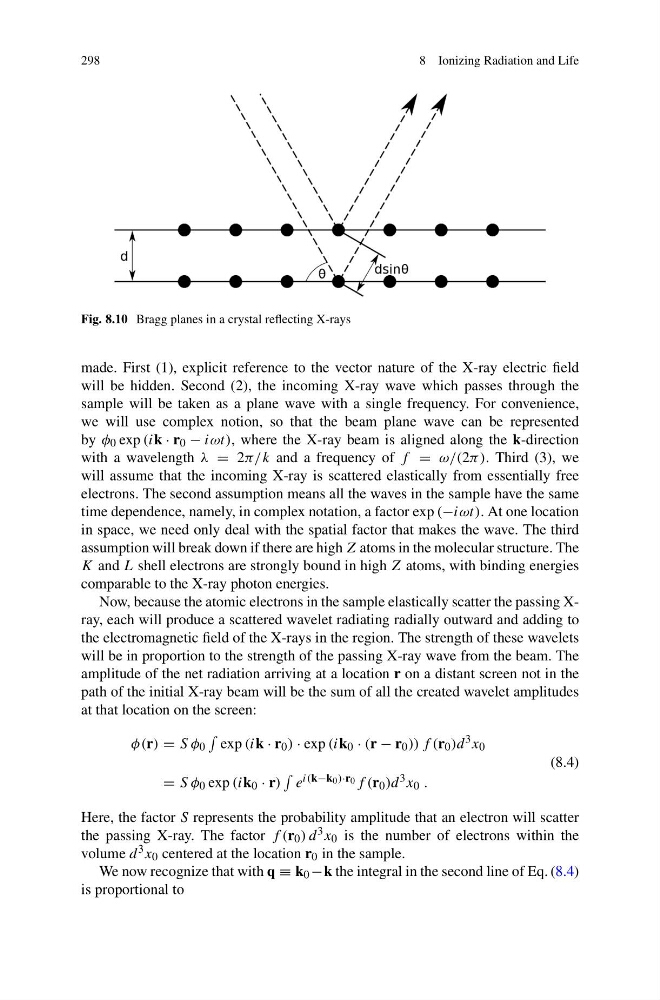
Fig. 8.10 Bragg planes in a crystal reflecting X-rays
made. First (1), explicit reference to the vector nature of the X-ray electric field
will be hidden. Second (2), the incoming X-ray wave which passes through the
sample will be taken as a plane wave with a single frequency. For convenience,
we will use complex notion, so that the beam plane wave can be represented
by φ 0 exp (ik · r 0 − iωt), where the X-ray beam is aligned along the k-direction
with a wavelength λ = 2π/k and a frequency of f = ω/(2π). Third (3), we
will assume that the incoming X-ray is scattered elastically from essentially free
electrons. The second assumption means all the waves in the sample have the same
time dependence, namely, in complex notation, a factor exp (−iωt). At one location
in space, we need only deal with the spatial factor that makes the wave. The third
assumption will break down if there are high Z atoms in the molecular structure. The
K and L shell electrons are strongly bound in high Z atoms, with binding energies
comparable to the X-ray photon energies.
Now, because the atomic electrons in the sample elastically scatter the passing Xray, each will produce a scattered wavelet radiating radially outward and adding to
the electromagnetic field of the X-rays in the region. The strength of these wavelets
will be in proportion to the strength of the passing X-ray wave from the beam. The
amplitude of the net radiation arriving at a location r on a distant screen not in the
path of the initial X-ray beam will be the sum of all the created wavelet amplitudes
at that location on the screen:
φ(r) = S φ 0
exp (ik · r 0 ) · exp (ik 0 · (r − r 0 )) f (r 0 )d 3 x 0
= S φ 0 exp (ik 0 · r)
e i(k−k 0 )·r 0 f (r 0 )d 3 x 0 .
(8.4)
Here, the factor S represents the probability amplitude that an electron will scatter
the passing X-ray. The factor f (r 0 ) d 3 x 0 is the number of electrons within the
volume d 3 x 0 centered at the location r 0 in the sample.
We now recognize that with q ≡ k 0 −k the integral in the second line of Eq. (8.4)
is proportional to
8 Ionizing Radiation and Life
Fig. 8.10 Bragg planes in a crystal reflecting X-rays
made. First (1), explicit reference to the vector nature of the X-ray electric field
will be hidden. Second (2), the incoming X-ray wave which passes through the
sample will be taken as a plane wave with a single frequency. For convenience,
we will use complex notion, so that the beam plane wave can be represented
by φ 0 exp (ik · r 0 − iωt), where the X-ray beam is aligned along the k-direction
with a wavelength λ = 2π/k and a frequency of f = ω/(2π). Third (3), we
will assume that the incoming X-ray is scattered elastically from essentially free
electrons. The second assumption means all the waves in the sample have the same
time dependence, namely, in complex notation, a factor exp (−iωt). At one location
in space, we need only deal with the spatial factor that makes the wave. The third
assumption will break down if there are high Z atoms in the molecular structure. The
K and L shell electrons are strongly bound in high Z atoms, with binding energies
comparable to the X-ray photon energies.
Now, because the atomic electrons in the sample elastically scatter the passing Xray, each will produce a scattered wavelet radiating radially outward and adding to
the electromagnetic field of the X-rays in the region. The strength of these wavelets
will be in proportion to the strength of the passing X-ray wave from the beam. The
amplitude of the net radiation arriving at a location r on a distant screen not in the
path of the initial X-ray beam will be the sum of all the created wavelet amplitudes
at that location on the screen:
φ(r) = S φ 0
exp (ik · r 0 ) · exp (ik 0 · (r − r 0 )) f (r 0 )d 3 x 0
= S φ 0 exp (ik 0 · r)
e i(k−k 0 )·r 0 f (r 0 )d 3 x 0 .
(8.4)
Here, the factor S represents the probability amplitude that an electron will scatter
the passing X-ray. The factor f (r 0 ) d 3 x 0 is the number of electrons within the
volume d 3 x 0 centered at the location r 0 in the sample.
We now recognize that with q ≡ k 0 −k the integral in the second line of Eq. (8.4)
is proportional to