

8.6 Man-made X-rays
293
8.6.2 X-rays Via Bremsstrahlung
X-ray machines are often constructed with a vacuum tube device for producing the
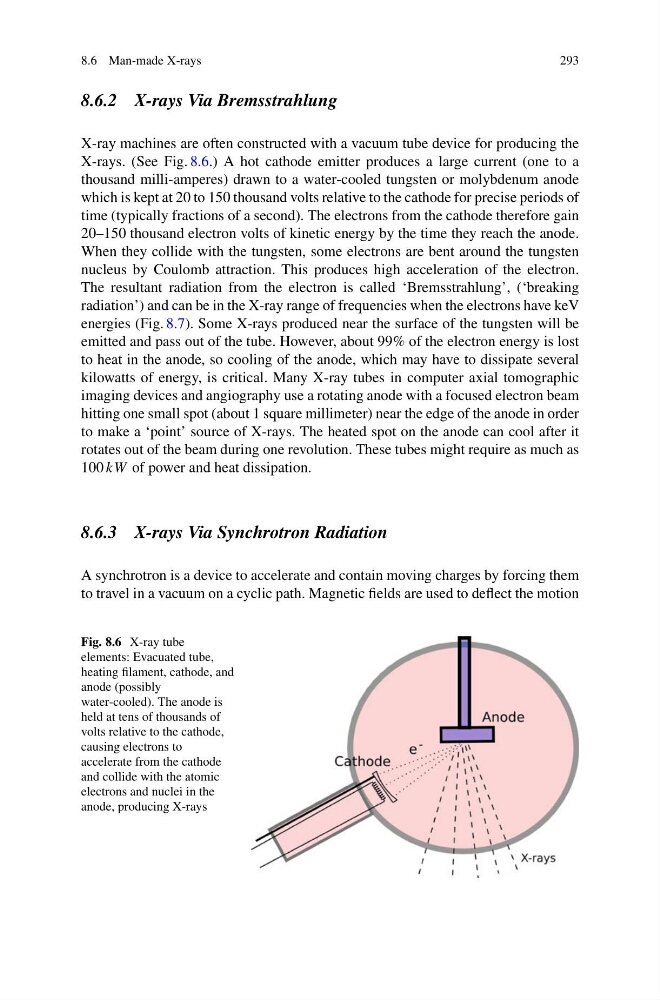
X-rays. (See Fig. 8.6.) A hot cathode emitter produces a large current (one to a
thousand milli-amperes) drawn to a water-cooled tungsten or molybdenum anode
which is kept at 20 to 150 thousand volts relative to the cathode for precise periods of
time (typically fractions of a second). The electrons from the cathode therefore gain
20–150 thousand electron volts of kinetic energy by the time they reach the anode.
When they collide with the tungsten, some electrons are bent around the tungsten
nucleus by Coulomb attraction. This produces high acceleration of the electron.
The resultant radiation from the electron is called ‘Bremsstrahlung’, (‘breaking
radiation’) and can be in the X-ray range of frequencies when the electrons have keV
energies (Fig. 8.7). Some X-rays produced near the surface of the tungsten will be
emitted and pass out of the tube. However, about 99% of the electron energy is lost
to heat in the anode, so cooling of the anode, which may have to dissipate several
kilowatts of energy, is critical. Many X-ray tubes in computer axial tomographic
imaging devices and angiography use a rotating anode with a focused electron beam
hitting one small spot (about 1 square millimeter) near the edge of the anode in order
to make a ‘point’ source of X-rays. The heated spot on the anode can cool after it
rotates out of the beam during one revolution. These tubes might require as much as
100 kW of power and heat dissipation.
8.6.3 X-rays Via Synchrotron Radiation
A synchrotron is a device to accelerate and contain moving charges by forcing them
to travel in a vacuum on a cyclic path. Magnetic fields are used to deflect the motion
Fig. 8.6 X-ray tube
elements: Evacuated tube,
heating filament, cathode, and
anode (possibly
water-cooled). The anode is
held at tens of thousands of
volts relative to the cathode,
causing electrons to
accelerate from the cathode
and collide with the atomic
electrons and nuclei in the
anode, producing X-rays
293
8.6.2 X-rays Via Bremsstrahlung
X-ray machines are often constructed with a vacuum tube device for producing the
X-rays. (See Fig. 8.6.) A hot cathode emitter produces a large current (one to a
thousand milli-amperes) drawn to a water-cooled tungsten or molybdenum anode
which is kept at 20 to 150 thousand volts relative to the cathode for precise periods of
time (typically fractions of a second). The electrons from the cathode therefore gain
20–150 thousand electron volts of kinetic energy by the time they reach the anode.
When they collide with the tungsten, some electrons are bent around the tungsten
nucleus by Coulomb attraction. This produces high acceleration of the electron.
The resultant radiation from the electron is called ‘Bremsstrahlung’, (‘breaking
radiation’) and can be in the X-ray range of frequencies when the electrons have keV
energies (Fig. 8.7). Some X-rays produced near the surface of the tungsten will be
emitted and pass out of the tube. However, about 99% of the electron energy is lost
to heat in the anode, so cooling of the anode, which may have to dissipate several
kilowatts of energy, is critical. Many X-ray tubes in computer axial tomographic
imaging devices and angiography use a rotating anode with a focused electron beam
hitting one small spot (about 1 square millimeter) near the edge of the anode in order
to make a ‘point’ source of X-rays. The heated spot on the anode can cool after it
rotates out of the beam during one revolution. These tubes might require as much as
100 kW of power and heat dissipation.
8.6.3 X-rays Via Synchrotron Radiation
A synchrotron is a device to accelerate and contain moving charges by forcing them
to travel in a vacuum on a cyclic path. Magnetic fields are used to deflect the motion
Fig. 8.6 X-ray tube
elements: Evacuated tube,
heating filament, cathode, and
anode (possibly
water-cooled). The anode is
held at tens of thousands of
volts relative to the cathode,
causing electrons to
accelerate from the cathode
and collide with the atomic
electrons and nuclei in the
anode, producing X-rays