

292
8 Ionizing Radiation and Life
be calculated in quantum theory, including the energy differences due to electron
orbital angular momentum and spin motion. For now, we will estimate the energy
from the Bohr model. The K-shell electrons have no angular momentum, and
their spins are anti-aligned. Each will feel the full force of the nucleus except for
the shielding effect of its mate. As for the effect of the atomic electrons spread
uniformly ‘above’ the K-shell electron, Gauss’ law tells us they will have a net zero
force. Two factors weaken this Gauss’ law argument: First, some outer electrons,
namely those with no angular momentum (called ‘s-shell’ electrons) do not stay
outside the K-shell orbit; Second: They may not be uniformly distributed. The
second point we will neglect, expecting the electron cloud will have a degree
of spherical symmetry. The first point can be estimated by finding how often a
higher shell s-wave electron gets closer to the nucleus than a K-shell electron.
In 1930, Slater calculated such probabilities using simplified Gaussian electron
wave functions. He reported the result by giving the effective nuclear charge,
Z eff = Z − s, that acts on the various electrons in a specific orbital. For the 1s
electrons, s = 0.3. For n > 1 s or p electrons, s = N 2 + 0.85 N 1 + 0.35 N 0 , where
N 2 is the number of electrons in lower principal shells n − 2 and smaller, N 1 is
the number of electrons in lower principal shells n − 1 and smaller, and N 0 is the
number of other electrons in the same shell n. With one K-shell electron missing,
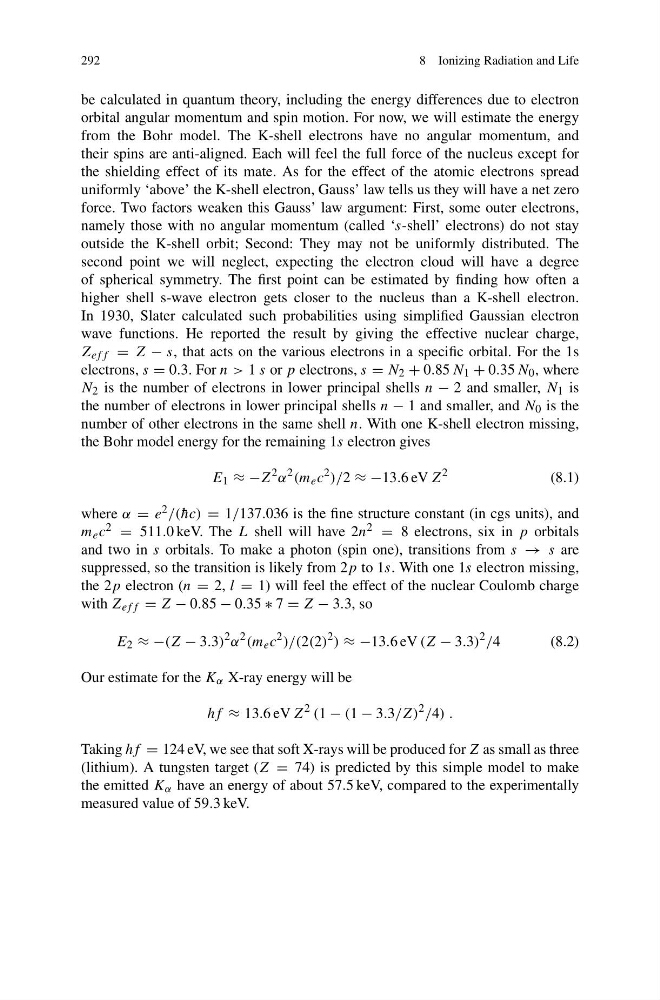
the Bohr model energy for the remaining 1s electron gives
E 1 ≈ −Z
2 α
2 (m e c
2 )/2 ≈ −13.6 eV Z
2
(8.1)
where α = e 2 /( ¯
hc) = 1/137.036 is the fine structure constant (in cgs units), and
m e c 2 = 511.0 keV. The L shell will have 2n 2 = 8 electrons, six in p orbitals
and two in s orbitals. To make a photon (spin one), transitions from s → s are
suppressed, so the transition is likely from 2p to 1s. With one 1s electron missing,
the 2p electron (n = 2, l = 1) will feel the effect of the nuclear Coulomb charge
with Z eff = Z − 0.85 − 0.35 ∗ 7 = Z − 3.3, so
E 2 ≈ −(Z − 3.3)
2 α
2 (m e c
2 )/(2(2)
2 ) ≈ −13.6 eV (Z − 3.3)
2 /4
(8.2)
Our estimate for the K α X-ray energy will be
hf ≈ 13.6 eV Z
2 (1 − (1 − 3.3/Z)
2 /4) .
Taking hf = 124 eV, we see that soft X-rays will be produced for Z as small as three
(lithium). A tungsten target (Z = 74) is predicted by this simple model to make
the emitted K α have an energy of about 57.5 keV, compared to the experimentally
measured value of 59.3 keV.
8 Ionizing Radiation and Life
be calculated in quantum theory, including the energy differences due to electron
orbital angular momentum and spin motion. For now, we will estimate the energy
from the Bohr model. The K-shell electrons have no angular momentum, and
their spins are anti-aligned. Each will feel the full force of the nucleus except for
the shielding effect of its mate. As for the effect of the atomic electrons spread
uniformly ‘above’ the K-shell electron, Gauss’ law tells us they will have a net zero
force. Two factors weaken this Gauss’ law argument: First, some outer electrons,
namely those with no angular momentum (called ‘s-shell’ electrons) do not stay
outside the K-shell orbit; Second: They may not be uniformly distributed. The
second point we will neglect, expecting the electron cloud will have a degree
of spherical symmetry. The first point can be estimated by finding how often a
higher shell s-wave electron gets closer to the nucleus than a K-shell electron.
In 1930, Slater calculated such probabilities using simplified Gaussian electron
wave functions. He reported the result by giving the effective nuclear charge,
Z eff = Z − s, that acts on the various electrons in a specific orbital. For the 1s
electrons, s = 0.3. For n > 1 s or p electrons, s = N 2 + 0.85 N 1 + 0.35 N 0 , where
N 2 is the number of electrons in lower principal shells n − 2 and smaller, N 1 is
the number of electrons in lower principal shells n − 1 and smaller, and N 0 is the
number of other electrons in the same shell n. With one K-shell electron missing,
the Bohr model energy for the remaining 1s electron gives
E 1 ≈ −Z
2 α
2 (m e c
2 )/2 ≈ −13.6 eV Z
2
(8.1)
where α = e 2 /( ¯
hc) = 1/137.036 is the fine structure constant (in cgs units), and
m e c 2 = 511.0 keV. The L shell will have 2n 2 = 8 electrons, six in p orbitals
and two in s orbitals. To make a photon (spin one), transitions from s → s are
suppressed, so the transition is likely from 2p to 1s. With one 1s electron missing,
the 2p electron (n = 2, l = 1) will feel the effect of the nuclear Coulomb charge
with Z eff = Z − 0.85 − 0.35 ∗ 7 = Z − 3.3, so
E 2 ≈ −(Z − 3.3)
2 α
2 (m e c
2 )/(2(2)
2 ) ≈ −13.6 eV (Z − 3.3)
2 /4
(8.2)
Our estimate for the K α X-ray energy will be
hf ≈ 13.6 eV Z
2 (1 − (1 − 3.3/Z)
2 /4) .
Taking hf = 124 eV, we see that soft X-rays will be produced for Z as small as three
(lithium). A tungsten target (Z = 74) is predicted by this simple model to make
the emitted K α have an energy of about 57.5 keV, compared to the experimentally
measured value of 59.3 keV.