

8.6 Man-made X-rays
291
Jiggling the K-shell electrons in atoms with relatively high Z tends to produce
X-rays. Conversely, tissue which contains relatively high Z atoms will be better
absorbers of X-rays compared to tissue which does not.
Gamma rays were found by Paul Villard in 1905 coming from radium. We now
know that many radioactive materials emit gamma rays.
8.6 Man-made X-rays
8.6.1 X-rays Via Characteristic Emission
Among the many ways atoms radiate electromagnetic waves, electron transitions
from a higher atomic shell (labeled by ‘n’) to the lowest-energy shell (the ‘K’ shell,
for which n = 1) are a source of X-rays when the atom has sufficiently high Z (the
atomic number and also the number of protons in its nucleus). This transition will
occur spontaneously if the K shell is missing an electron. (That electron may have
been kicked out by another passing energetic electron.) Among the possible atomic
transitions from higher-energy shells to the K shell, the most likely is from the next
higher shell, called the L shell, with n = 2. The emitted photon carries a unit of
angular momentum. This means that a 2s to 1s transition requires the electron to
flip its spin, a magnetic transition. Such transitions are far less likely than the much
stronger electric dipole 2p to 1s transition. The released photon produces what is
called the ‘K α ’ peak in the X-ray emission spectrum. The next most likely is a
transition from the M shell to the K shell (n = 3 to n = 1), making the ‘K β ’ peak.
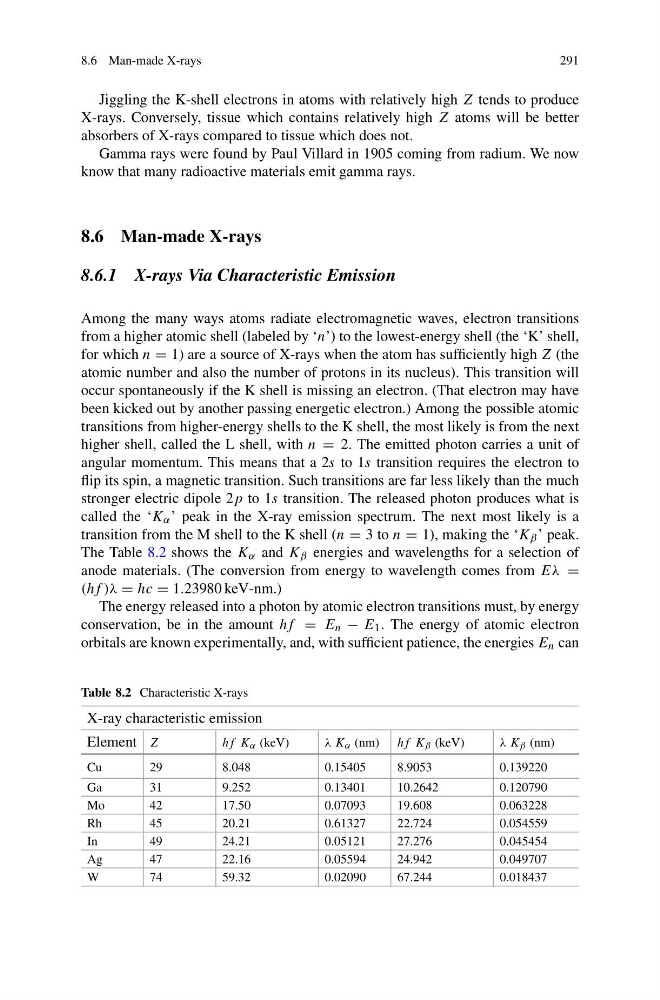
The Table 8.2 shows the K α and K β energies and wavelengths for a selection of
anode materials. (The conversion from energy to wavelength comes from Eλ =
(hf )λ = hc = 1.23980 keV-nm.)
The energy released into a photon by atomic electron transitions must, by energy
conservation, be in the amount hf = E n − E 1 . The energy of atomic electron
orbitals are known experimentally, and, with sufficient patience, the energies E n can
Table 8.2 Characteristic X-rays
X-ray characteristic emission
Element Z
h fK α (keV)
λ K α (nm) hf K β (keV)
λ K β (nm)
Cu
29
8.048
0.15405
8.9053
0.139220
Ga
31
9.252
0.13401
10.2642
0.120790
Mo
42
17.50
0.07093
19.608
0.063228
Rh
45
20.21
0.61327
22.724
0.054559
In
49
24.21
0.05121
27.276
0.045454
Ag
47
22.16
0.05594
24.942
0.049707
W
74
59.32
0.02090
67.244
0.018437
291
Jiggling the K-shell electrons in atoms with relatively high Z tends to produce
X-rays. Conversely, tissue which contains relatively high Z atoms will be better
absorbers of X-rays compared to tissue which does not.
Gamma rays were found by Paul Villard in 1905 coming from radium. We now
know that many radioactive materials emit gamma rays.
8.6 Man-made X-rays
8.6.1 X-rays Via Characteristic Emission
Among the many ways atoms radiate electromagnetic waves, electron transitions
from a higher atomic shell (labeled by ‘n’) to the lowest-energy shell (the ‘K’ shell,
for which n = 1) are a source of X-rays when the atom has sufficiently high Z (the
atomic number and also the number of protons in its nucleus). This transition will
occur spontaneously if the K shell is missing an electron. (That electron may have
been kicked out by another passing energetic electron.) Among the possible atomic
transitions from higher-energy shells to the K shell, the most likely is from the next
higher shell, called the L shell, with n = 2. The emitted photon carries a unit of
angular momentum. This means that a 2s to 1s transition requires the electron to
flip its spin, a magnetic transition. Such transitions are far less likely than the much
stronger electric dipole 2p to 1s transition. The released photon produces what is
called the ‘K α ’ peak in the X-ray emission spectrum. The next most likely is a
transition from the M shell to the K shell (n = 3 to n = 1), making the ‘K β ’ peak.
The Table 8.2 shows the K α and K β energies and wavelengths for a selection of
anode materials. (The conversion from energy to wavelength comes from Eλ =
(hf )λ = hc = 1.23980 keV-nm.)
The energy released into a photon by atomic electron transitions must, by energy
conservation, be in the amount hf = E n − E 1 . The energy of atomic electron
orbitals are known experimentally, and, with sufficient patience, the energies E n can
Table 8.2 Characteristic X-rays
X-ray characteristic emission
Element Z
h fK α (keV)
λ K α (nm) hf K β (keV)
λ K β (nm)
Cu
29
8.048
0.15405
8.9053
0.139220
Ga
31
9.252
0.13401
10.2642
0.120790
Mo
42
17.50
0.07093
19.608
0.063228
Rh
45
20.21
0.61327
22.724
0.054559
In
49
24.21
0.05121
27.276
0.045454
Ag
47
22.16
0.05594
24.942
0.049707
W
74
59.32
0.02090
67.244
0.018437