

294
8 Ionizing Radiation and Life
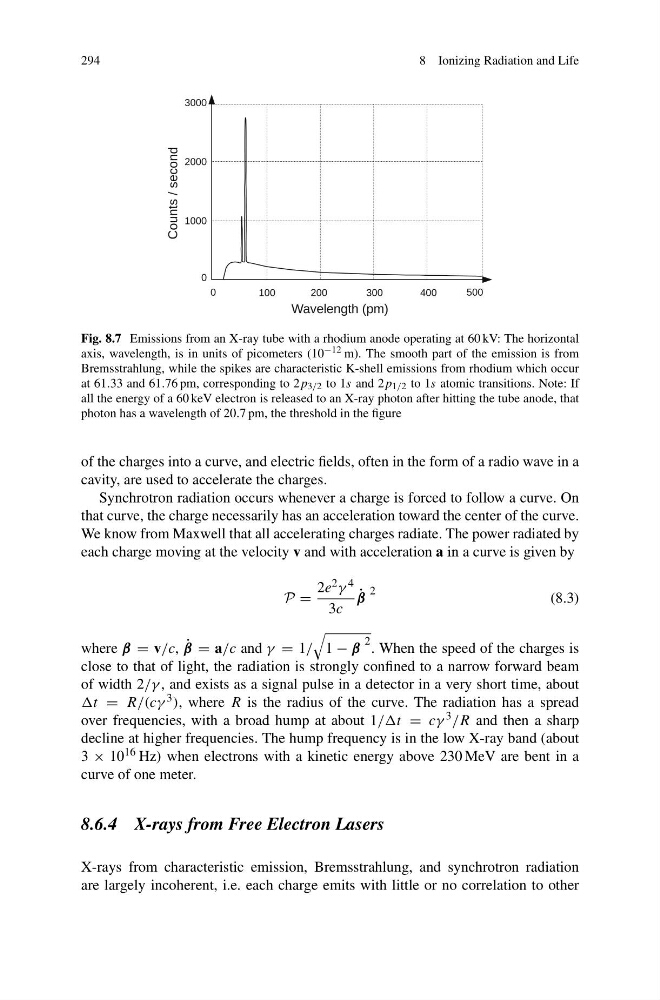
Fig. 8.7 Emissions from an X-ray tube with a rhodium anode operating at 60 kV: The horizontal
axis, wavelength, is in units of picometers (10 −12 m). The smooth part of the emission is from
Bremsstrahlung, while the spikes are characteristic K-shell emissions from rhodium which occur
at 61.33 and 61.76 pm, corresponding to 2p 3/2 to 1s and 2p 1/2 to 1s atomic transitions. Note: If
all the energy of a 60 keV electron is released to an X-ray photon after hitting the tube anode, that
photon has a wavelength of 20.7 pm, the threshold in the figure
of the charges into a curve, and electric fields, often in the form of a radio wave in a
cavity, are used to accelerate the charges.
Synchrotron radiation occurs whenever a charge is forced to follow a curve. On
that curve, the charge necessarily has an acceleration toward the center of the curve.
We know from Maxwell that all accelerating charges radiate. The power radiated by
each charge moving at the velocity v and with acceleration a in a curve is given by
P =
2e 2 γ 4
3c
˙
β
2
(8.3)
where β = v/c, ˙
β = a/c and γ = 1/
1 − β
2 . When the speed of the charges is
close to that of light, the radiation is strongly confined to a narrow forward beam
of width 2/γ , and exists as a signal pulse in a detector in a very short time, about
t = R/(cγ 3 ), where R is the radius of the curve. The radiation has a spread
over frequencies, with a broad hump at about 1//t = cγ 3 /R and then a sharp
decline at higher frequencies. The hump frequency is in the low X-ray band (about
3 × 10 16 Hz) when electrons with a kinetic energy above 230 MeV are bent in a
curve of one meter.
8.6.4 X-rays from Free Electron Lasers
X-rays from characteristic emission, Bremsstrahlung, and synchrotron radiation
are largely incoherent, i.e. each charge emits with little or no correlation to other
8 Ionizing Radiation and Life
Fig. 8.7 Emissions from an X-ray tube with a rhodium anode operating at 60 kV: The horizontal
axis, wavelength, is in units of picometers (10 −12 m). The smooth part of the emission is from
Bremsstrahlung, while the spikes are characteristic K-shell emissions from rhodium which occur
at 61.33 and 61.76 pm, corresponding to 2p 3/2 to 1s and 2p 1/2 to 1s atomic transitions. Note: If
all the energy of a 60 keV electron is released to an X-ray photon after hitting the tube anode, that
photon has a wavelength of 20.7 pm, the threshold in the figure
of the charges into a curve, and electric fields, often in the form of a radio wave in a
cavity, are used to accelerate the charges.
Synchrotron radiation occurs whenever a charge is forced to follow a curve. On
that curve, the charge necessarily has an acceleration toward the center of the curve.
We know from Maxwell that all accelerating charges radiate. The power radiated by
each charge moving at the velocity v and with acceleration a in a curve is given by
P =
2e 2 γ 4
3c
˙
β
2
(8.3)
where β = v/c, ˙
β = a/c and γ = 1/
1 − β
2 . When the speed of the charges is
close to that of light, the radiation is strongly confined to a narrow forward beam
of width 2/γ , and exists as a signal pulse in a detector in a very short time, about
t = R/(cγ 3 ), where R is the radius of the curve. The radiation has a spread
over frequencies, with a broad hump at about 1//t = cγ 3 /R and then a sharp
decline at higher frequencies. The hump frequency is in the low X-ray band (about
3 × 10 16 Hz) when electrons with a kinetic energy above 230 MeV are bent in a
curve of one meter.
8.6.4 X-rays from Free Electron Lasers
X-rays from characteristic emission, Bremsstrahlung, and synchrotron radiation
are largely incoherent, i.e. each charge emits with little or no correlation to other