

8.1 Detection of Ionizing Radiation
281
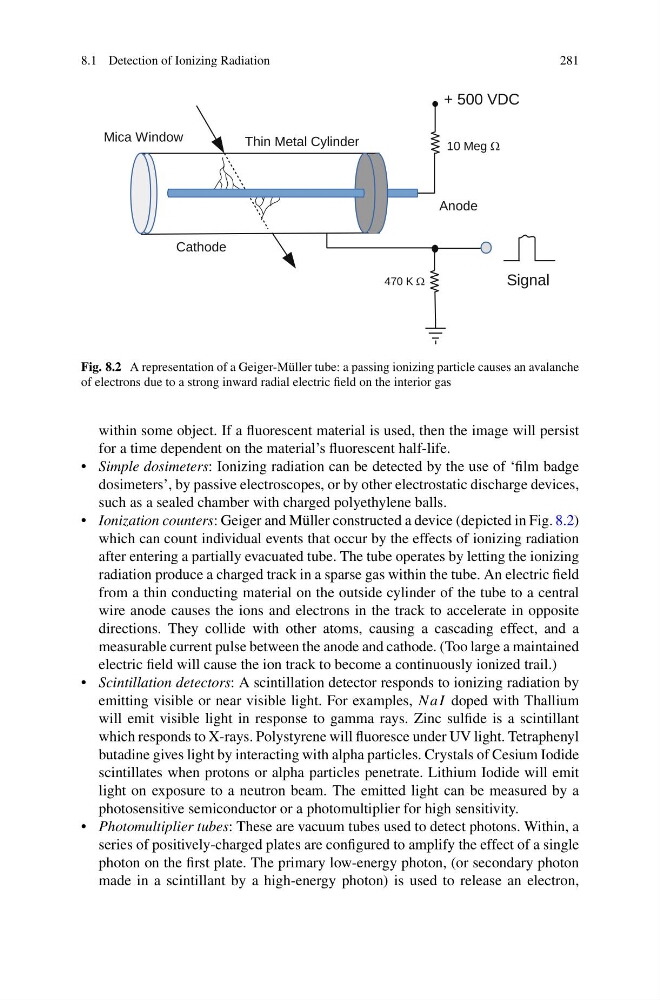
Fig. 8.2 A representation of a Geiger-Müller tube: a passing ionizing particle causes an avalanche
of electrons due to a strong inward radial electric field on the interior gas
within some object. If a fluorescent material is used, then the image will persist
for a time dependent on the material’s fluorescent half-life.
• Simple dosimeters: Ionizing radiation can be detected by the use of ‘film badge
dosimeters’, by passive electroscopes, or by other electrostatic discharge devices,
such as a sealed chamber with charged polyethylene balls.
• Ionization counters: Geiger and Müller constructed a device (depicted in Fig. 8.2)
which can count individual events that occur by the effects of ionizing radiation
after entering a partially evacuated tube. The tube operates by letting the ionizing
radiation produce a charged track in a sparse gas within the tube. An electric field
from a thin conducting material on the outside cylinder of the tube to a central
wire anode causes the ions and electrons in the track to accelerate in opposite
directions. They collide with other atoms, causing a cascading effect, and a
measurable current pulse between the anode and cathode. (Too large a maintained
electric field will cause the ion track to become a continuously ionized trail.)
• Scintillation detectors: A scintillation detector responds to ionizing radiation by
emitting visible or near visible light. For examples, NaI doped with Thallium
will emit visible light in response to gamma rays. Zinc sulfide is a scintillant
which responds to X-rays. Polystyrene will fluoresce under UV light. Tetraphenyl
butadine gives light by interacting with alpha particles. Crystals of Cesium Iodide
scintillates when protons or alpha particles penetrate. Lithium Iodide will emit
light on exposure to a neutron beam. The emitted light can be measured by a
photosensitive semiconductor or a photomultiplier for high sensitivity.
• Photomultiplier tubes: These are vacuum tubes used to detect photons. Within, a
series of positively-charged plates are configured to amplify the effect of a single
photon on the first plate. The primary low-energy photon, (or secondary photon
made in a scintillant by a high-energy photon) is used to release an electron,
281
Fig. 8.2 A representation of a Geiger-Müller tube: a passing ionizing particle causes an avalanche
of electrons due to a strong inward radial electric field on the interior gas
within some object. If a fluorescent material is used, then the image will persist
for a time dependent on the material’s fluorescent half-life.
• Simple dosimeters: Ionizing radiation can be detected by the use of ‘film badge
dosimeters’, by passive electroscopes, or by other electrostatic discharge devices,
such as a sealed chamber with charged polyethylene balls.
• Ionization counters: Geiger and Müller constructed a device (depicted in Fig. 8.2)
which can count individual events that occur by the effects of ionizing radiation
after entering a partially evacuated tube. The tube operates by letting the ionizing
radiation produce a charged track in a sparse gas within the tube. An electric field
from a thin conducting material on the outside cylinder of the tube to a central
wire anode causes the ions and electrons in the track to accelerate in opposite
directions. They collide with other atoms, causing a cascading effect, and a
measurable current pulse between the anode and cathode. (Too large a maintained
electric field will cause the ion track to become a continuously ionized trail.)
• Scintillation detectors: A scintillation detector responds to ionizing radiation by
emitting visible or near visible light. For examples, NaI doped with Thallium
will emit visible light in response to gamma rays. Zinc sulfide is a scintillant
which responds to X-rays. Polystyrene will fluoresce under UV light. Tetraphenyl
butadine gives light by interacting with alpha particles. Crystals of Cesium Iodide
scintillates when protons or alpha particles penetrate. Lithium Iodide will emit
light on exposure to a neutron beam. The emitted light can be measured by a
photosensitive semiconductor or a photomultiplier for high sensitivity.
• Photomultiplier tubes: These are vacuum tubes used to detect photons. Within, a
series of positively-charged plates are configured to amplify the effect of a single
photon on the first plate. The primary low-energy photon, (or secondary photon
made in a scintillant by a high-energy photon) is used to release an electron,