

282
8 Ionizing Radiation and Life
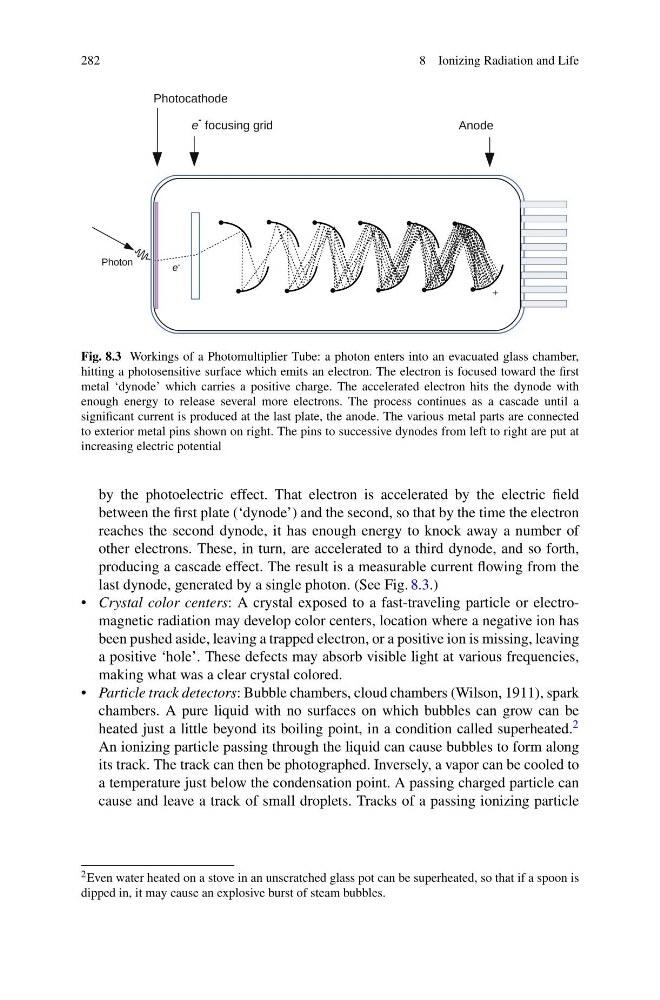
Fig. 8.3 Workings of a Photomultiplier Tube: a photon enters into an evacuated glass chamber,
hitting a photosensitive surface which emits an electron. The electron is focused toward the first
metal ‘dynode’ which carries a positive charge. The accelerated electron hits the dynode with
enough energy to release several more electrons. The process continues as a cascade until a
significant current is produced at the last plate, the anode. The various metal parts are connected
to exterior metal pins shown on right. The pins to successive dynodes from left to right are put at
increasing electric potential
by the photoelectric effect. That electron is accelerated by the electric field
between the first plate (‘dynode’) and the second, so that by the time the electron
reaches the second dynode, it has enough energy to knock away a number of
other electrons. These, in turn, are accelerated to a third dynode, and so forth,
producing a cascade effect. The result is a measurable current flowing from the
last dynode, generated by a single photon. (See Fig. 8.3.)
• Crystal color centers: A crystal exposed to a fast-traveling particle or electromagnetic radiation may develop color centers, location where a negative ion has
been pushed aside, leaving a trapped electron, or a positive ion is missing, leaving
a positive ‘hole’. These defects may absorb visible light at various frequencies,
making what was a clear crystal colored.
• Particle track detectors: Bubble chambers, cloud chambers (Wilson, 1911), spark
chambers. A pure liquid with no surfaces on which bubbles can grow can be
heated just a little beyond its boiling point, in a condition called superheated. 2
An ionizing particle passing through the liquid can cause bubbles to form along
its track. The track can then be photographed. Inversely, a vapor can be cooled to
a temperature just below the condensation point. A passing charged particle can
cause and leave a track of small droplets. Tracks of a passing ionizing particle
2 Even water heated on a stove in an unscratched glass pot can be superheated, so that if a spoon is
dipped in, it may cause an explosive burst of steam bubbles.
8 Ionizing Radiation and Life
Fig. 8.3 Workings of a Photomultiplier Tube: a photon enters into an evacuated glass chamber,
hitting a photosensitive surface which emits an electron. The electron is focused toward the first
metal ‘dynode’ which carries a positive charge. The accelerated electron hits the dynode with
enough energy to release several more electrons. The process continues as a cascade until a
significant current is produced at the last plate, the anode. The various metal parts are connected
to exterior metal pins shown on right. The pins to successive dynodes from left to right are put at
increasing electric potential
by the photoelectric effect. That electron is accelerated by the electric field
between the first plate (‘dynode’) and the second, so that by the time the electron
reaches the second dynode, it has enough energy to knock away a number of
other electrons. These, in turn, are accelerated to a third dynode, and so forth,
producing a cascade effect. The result is a measurable current flowing from the
last dynode, generated by a single photon. (See Fig. 8.3.)
• Crystal color centers: A crystal exposed to a fast-traveling particle or electromagnetic radiation may develop color centers, location where a negative ion has
been pushed aside, leaving a trapped electron, or a positive ion is missing, leaving
a positive ‘hole’. These defects may absorb visible light at various frequencies,
making what was a clear crystal colored.
• Particle track detectors: Bubble chambers, cloud chambers (Wilson, 1911), spark
chambers. A pure liquid with no surfaces on which bubbles can grow can be
heated just a little beyond its boiling point, in a condition called superheated. 2
An ionizing particle passing through the liquid can cause bubbles to form along
its track. The track can then be photographed. Inversely, a vapor can be cooled to
a temperature just below the condensation point. A passing charged particle can
cause and leave a track of small droplets. Tracks of a passing ionizing particle
2 Even water heated on a stove in an unscratched glass pot can be superheated, so that if a spoon is
dipped in, it may cause an explosive burst of steam bubbles.