

7.14 Microwave Spectroscopy
225
frequency of about 10 GHz, and has maximum absorption at even a higher frequency
as the water heats.
A lower frequency of 2.45 GHz is used in microwave ovens so that the wave can
penetrate the food, rather than just heating the outer layer. The part of the wave that
is reflected and transmitted is reflected back and forth a number of times in the oven
cavity, so that a higher fraction of the microwave energy is converted into heat in
the food. Moreover, a metal deflector fan is used to shift the nodes and antinodes of
the microwaves in the oven to heat the food more uniformly.
7.13.2 Absorption in Materials and Tissue
Because of absorption in materials and tissue, microwaves drop in intensity the
further they travel through uniform tissue, according to
I = I 0 exp (−2x/δ p ) ,
(7.14)
where δ p is called the ‘penetration depth’, giving the distance of travel in the tissue
which causes a drop of intensity by a factor e −2 0.135 . (Half this distance is
called the extinction length, introduced in our description of sound attenuation in
materials, Eq. (5.43).)
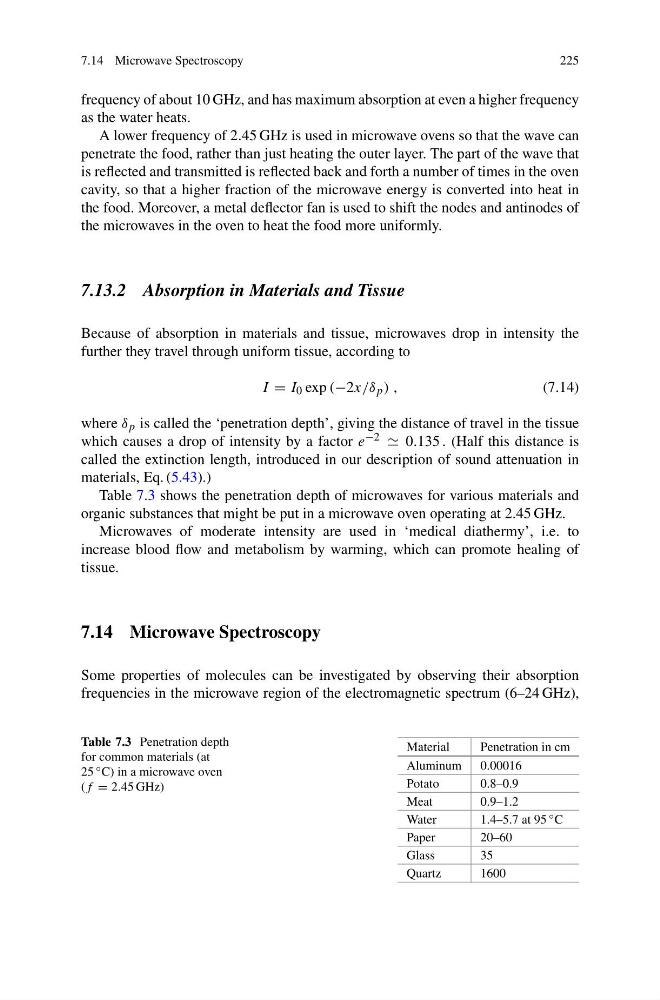
Table 7.3 shows the penetration depth of microwaves for various materials and
organic substances that might be put in a microwave oven operating at 2.45 GHz.
Microwaves of moderate intensity are used in ‘medical diathermy’, i.e. to
increase blood flow and metabolism by warming, which can promote healing of
tissue.
7.14 Microwave Spectroscopy
Some properties of molecules can be investigated by observing their absorption
frequencies in the microwave region of the electromagnetic spectrum (6–24 GHz),
Table 7.3 Penetration depth
for common materials (at
25 ◦ C) in a microwave oven
(f = 2.45 GHz)
Material
Penetration in cm
Aluminum 0.00016
Potato
0.8–0.9
Meat
0.9–1.2
Water
1.4–5.7 at 95 ◦ C
Paper
20–60
Glass
35
Quartz
1600
225
frequency of about 10 GHz, and has maximum absorption at even a higher frequency
as the water heats.
A lower frequency of 2.45 GHz is used in microwave ovens so that the wave can
penetrate the food, rather than just heating the outer layer. The part of the wave that
is reflected and transmitted is reflected back and forth a number of times in the oven
cavity, so that a higher fraction of the microwave energy is converted into heat in
the food. Moreover, a metal deflector fan is used to shift the nodes and antinodes of
the microwaves in the oven to heat the food more uniformly.
7.13.2 Absorption in Materials and Tissue
Because of absorption in materials and tissue, microwaves drop in intensity the
further they travel through uniform tissue, according to
I = I 0 exp (−2x/δ p ) ,
(7.14)
where δ p is called the ‘penetration depth’, giving the distance of travel in the tissue
which causes a drop of intensity by a factor e −2 0.135 . (Half this distance is
called the extinction length, introduced in our description of sound attenuation in
materials, Eq. (5.43).)
Table 7.3 shows the penetration depth of microwaves for various materials and
organic substances that might be put in a microwave oven operating at 2.45 GHz.
Microwaves of moderate intensity are used in ‘medical diathermy’, i.e. to
increase blood flow and metabolism by warming, which can promote healing of
tissue.
7.14 Microwave Spectroscopy
Some properties of molecules can be investigated by observing their absorption
frequencies in the microwave region of the electromagnetic spectrum (6–24 GHz),
Table 7.3 Penetration depth
for common materials (at
25 ◦ C) in a microwave oven
(f = 2.45 GHz)
Material
Penetration in cm
Aluminum 0.00016
Potato
0.8–0.9
Meat
0.9–1.2
Water
1.4–5.7 at 95 ◦ C
Paper
20–60
Glass
35
Quartz
1600