

226
7 Light in Biology and Medicine
because these absorptions are typically due to excitations of rotations of the
molecule. To allow free rotation, a gas cell is usually employed. The molecules
in the cell are excited by a short pulse of microwaves, and absorption measured
by receiving the microwave decay signals from the molecules. Thus, the molecular
moments of inertia can be determined, from which the inter-atomic spacing in the
molecule may be revealed, particularly when several atomic isotopes are employed
in separate measurements.
7.15 Radiation from Hot Bodies
Infrared light is produced by heating a body, using the thermal motion of the atoms
and molecules within to generate light. After all, atoms and molecules contain
charges. Jiggling them jiggles the charges, and such accelerated motion produces
radiation. Thermal radiation, also called blackbody radiation, 23 follows the theory
given by Max Planck 24 in 1901. His explanation required that light be emitted in
finite energy units (quanta, later called photons), with an energy proportional to the
light frequency given by Planck’s relation E = hf . Planck’s constant, h, has the
value 6.626 × 10 −34 Js = 4.13567 × 10 −15 eV/s. 25 The small size of h compared
to laboratory units suggests why quantum effects were not noticed in experiments
involving billions and billions of quanta typical of macroscopic interactions. But
without the quantization of light emission, a hot body would quickly release its
thermal energy by radiation at high frequencies. Quick release is impeded by
quantization of emission because thermal collisions do not have enough energy to
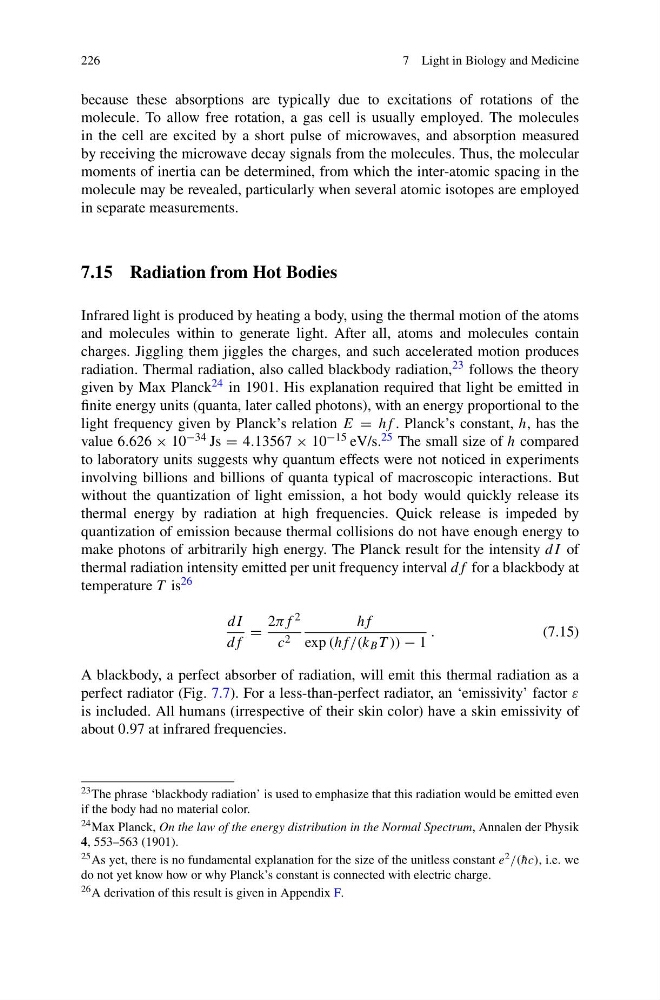
make photons of arbitrarily high energy. The Planck result for the intensity dI of
thermal radiation intensity emitted per unit frequency interval df for a blackbody at
temperature T is 26
dI
df
=
2πf 2
c 2
hf
exp (hf/(k B T )) − 1
.
(7.15)
A blackbody, a perfect absorber of radiation, will emit this thermal radiation as a
perfect radiator (Fig. 7.7). For a less-than-perfect radiator, an ‘emissivity’ factor ε
is included. All humans (irrespective of their skin color) have a skin emissivity of
about 0.97 at infrared frequencies.
23 The phrase ‘blackbody radiation’ is used to emphasize that this radiation would be emitted even
if the body had no material color.
24 Max Planck, On the law of the energy distribution in the Normal Spectrum, Annalen der Physik
4, 553–563 (1901).
25 As yet, there is no fundamental explanation for the size of the unitless constant e 2 /( ¯
hc), i.e. we
do not yet know how or why Planck’s constant is connected with electric charge.
26 A derivation of this result is given in Appendix F.
7 Light in Biology and Medicine
because these absorptions are typically due to excitations of rotations of the
molecule. To allow free rotation, a gas cell is usually employed. The molecules
in the cell are excited by a short pulse of microwaves, and absorption measured
by receiving the microwave decay signals from the molecules. Thus, the molecular
moments of inertia can be determined, from which the inter-atomic spacing in the
molecule may be revealed, particularly when several atomic isotopes are employed
in separate measurements.
7.15 Radiation from Hot Bodies
Infrared light is produced by heating a body, using the thermal motion of the atoms
and molecules within to generate light. After all, atoms and molecules contain
charges. Jiggling them jiggles the charges, and such accelerated motion produces
radiation. Thermal radiation, also called blackbody radiation, 23 follows the theory
given by Max Planck 24 in 1901. His explanation required that light be emitted in
finite energy units (quanta, later called photons), with an energy proportional to the
light frequency given by Planck’s relation E = hf . Planck’s constant, h, has the
value 6.626 × 10 −34 Js = 4.13567 × 10 −15 eV/s. 25 The small size of h compared
to laboratory units suggests why quantum effects were not noticed in experiments
involving billions and billions of quanta typical of macroscopic interactions. But
without the quantization of light emission, a hot body would quickly release its
thermal energy by radiation at high frequencies. Quick release is impeded by
quantization of emission because thermal collisions do not have enough energy to
make photons of arbitrarily high energy. The Planck result for the intensity dI of
thermal radiation intensity emitted per unit frequency interval df for a blackbody at
temperature T is 26
dI
df
=
2πf 2
c 2
hf
exp (hf/(k B T )) − 1
.
(7.15)
A blackbody, a perfect absorber of radiation, will emit this thermal radiation as a
perfect radiator (Fig. 7.7). For a less-than-perfect radiator, an ‘emissivity’ factor ε
is included. All humans (irrespective of their skin color) have a skin emissivity of
about 0.97 at infrared frequencies.
23 The phrase ‘blackbody radiation’ is used to emphasize that this radiation would be emitted even
if the body had no material color.
24 Max Planck, On the law of the energy distribution in the Normal Spectrum, Annalen der Physik
4, 553–563 (1901).
25 As yet, there is no fundamental explanation for the size of the unitless constant e 2 /( ¯
hc), i.e. we
do not yet know how or why Planck’s constant is connected with electric charge.
26 A derivation of this result is given in Appendix F.