

224
7 Light in Biology and Medicine
In common with radio waves,
• Microwaves can penetrate long distances through non-metallic materials, such as
air.
• Microwaves are non-ionizing radiation, and, at low intensities, will do little or no
harm to life forms.
7.13 Microwave Absorption
7.13.1 Absorption in Water
Biological tissue can strongly absorb microwaves principally because 10–75% of
this tissue is water (particularly muscle which has the highest fraction). When
microwaves pass through liquid water, the polar nature of the water molecule makes
the whole molecule rotate, tending to align and then anti-align with the passing
wave polarization direction. But the molecule is not free to rotate when in close
proximity to other water molecules. Hydrogen bonding tends to make liquid water
form quasi-bound nanostructures. The binding is not tight enough to hold under
thermal motion, so the structures are in dynamic fluctuation. When a microwave
forces a water molecule to twist, that molecules interacts with adjacent ones and
the added rotational energy will be partly converted to thermal energy. As seen in
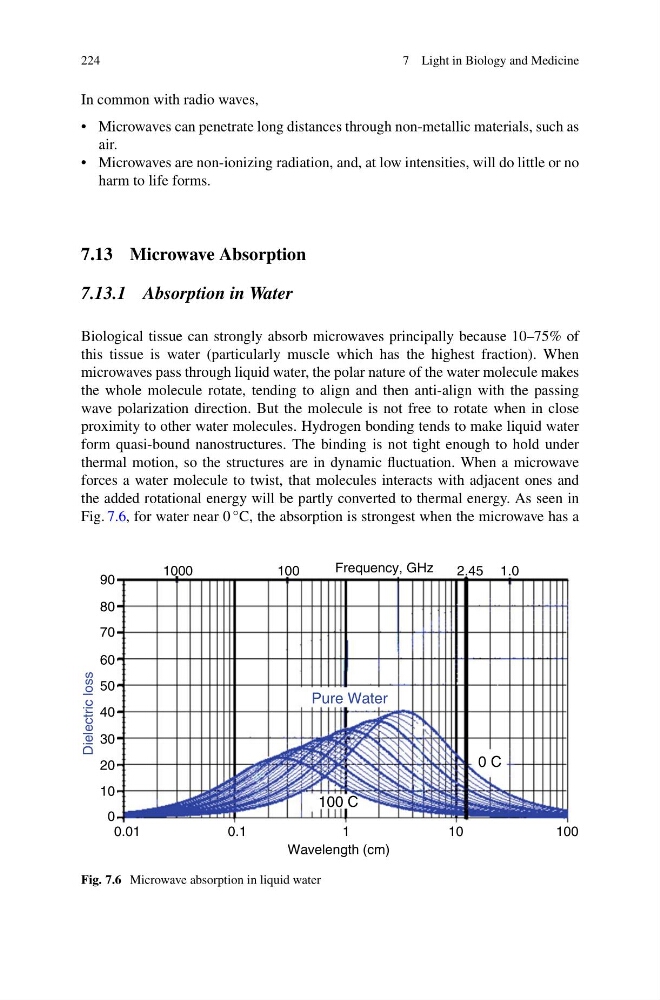
Fig. 7.6, for water near 0 ◦ C, the absorption is strongest when the microwave has a
90
1000
2.45
100
Frequency, GHz
1.0
80
70
60
50
40
30
20
10
0
0.01
0.1
1
10
100
0 C
100 C
Wavelength (cm)
Pure Water
Dielectric loss
Fig. 7.6 Microwave absorption in liquid water
7 Light in Biology and Medicine
In common with radio waves,
• Microwaves can penetrate long distances through non-metallic materials, such as
air.
• Microwaves are non-ionizing radiation, and, at low intensities, will do little or no
harm to life forms.
7.13 Microwave Absorption
7.13.1 Absorption in Water
Biological tissue can strongly absorb microwaves principally because 10–75% of
this tissue is water (particularly muscle which has the highest fraction). When
microwaves pass through liquid water, the polar nature of the water molecule makes
the whole molecule rotate, tending to align and then anti-align with the passing
wave polarization direction. But the molecule is not free to rotate when in close
proximity to other water molecules. Hydrogen bonding tends to make liquid water
form quasi-bound nanostructures. The binding is not tight enough to hold under
thermal motion, so the structures are in dynamic fluctuation. When a microwave
forces a water molecule to twist, that molecules interacts with adjacent ones and
the added rotational energy will be partly converted to thermal energy. As seen in
Fig. 7.6, for water near 0 ◦ C, the absorption is strongest when the microwave has a
90
1000
2.45
100
Frequency, GHz
1.0
80
70
60
50
40
30
20
10
0
0.01
0.1
1
10
100
0 C
100 C
Wavelength (cm)
Pure Water
Dielectric loss
Fig. 7.6 Microwave absorption in liquid water