

5.19 Human Hearing
155
5.19.1 General Properties of Human Hearing
The sensitivity of the human ear is quite remarkable. (Data on human hearing
can be found in Appendix J.) A good ear can hear sound whose intensity is only
10 −12 W/m
2 and a pressure variation of only 2 × 10 −5 Pa. Over the eardrum (of
area about 0.65 cm 2 ), this sound delivers 1.6 × 10 −15 J/s. With this power, it would
take 2.4 trillion years to make your morning toast (which takes 1000 W for 2 min).
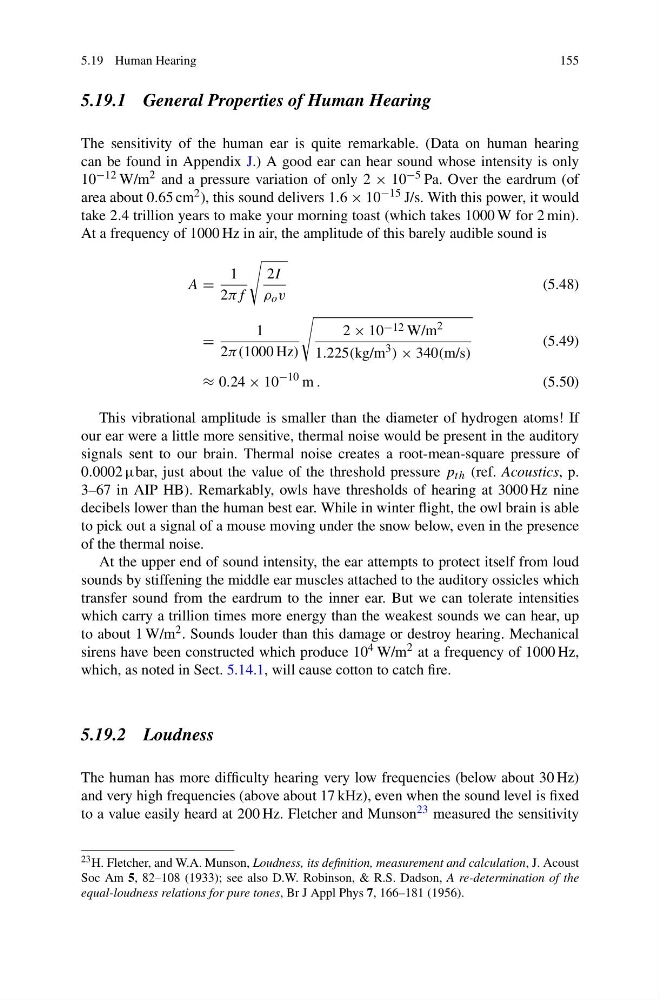
At a frequency of 1000 Hz in air, the amplitude of this barely audible sound is
A =
1
2πf
2I
ρ o v
(5.48)
=
1
2π(1000 Hz)
2 × 10 −12 W/m
2
1.225(kg/m
3 ) × 340(m/s)
(5.49)
≈ 0.24 × 10
−10 m .
(5.50)
This vibrational amplitude is smaller than the diameter of hydrogen atoms! If
our ear were a little more sensitive, thermal noise would be present in the auditory
signals sent to our brain. Thermal noise creates a root-mean-square pressure of
0.0002 μbar, just about the value of the threshold pressure p th (ref. Acoustics, p.
3–67 in AIP HB). Remarkably, owls have thresholds of hearing at 3000 Hz nine
decibels lower than the human best ear. While in winter flight, the owl brain is able
to pick out a signal of a mouse moving under the snow below, even in the presence
of the thermal noise.
At the upper end of sound intensity, the ear attempts to protect itself from loud
sounds by stiffening the middle ear muscles attached to the auditory ossicles which
transfer sound from the eardrum to the inner ear. But we can tolerate intensities
which carry a trillion times more energy than the weakest sounds we can hear, up
to about 1 W/m 2 . Sounds louder than this damage or destroy hearing. Mechanical
sirens have been constructed which produce 10 4 W/m
2 at a frequency of 1000 Hz,
which, as noted in Sect. 5.14.1, will cause cotton to catch fire.
5.19.2 Loudness
The human has more difficulty hearing very low frequencies (below about 30 Hz)
and very high frequencies (above about 17 kHz), even when the sound level is fixed
to a value easily heard at 200 Hz. Fletcher and Munson 23 measured the sensitivity
23 H. Fletcher, and W.A. Munson, Loudness, its definition, measurement and calculation, J. Acoust
Soc Am 5, 82–108 (1933); see also D.W. Robinson, & R.S. Dadson, A re-determination of the
equal-loudness relations for pure tones, Br J Appl Phys 7, 166–181 (1956).
155
5.19.1 General Properties of Human Hearing
The sensitivity of the human ear is quite remarkable. (Data on human hearing
can be found in Appendix J.) A good ear can hear sound whose intensity is only
10 −12 W/m
2 and a pressure variation of only 2 × 10 −5 Pa. Over the eardrum (of
area about 0.65 cm 2 ), this sound delivers 1.6 × 10 −15 J/s. With this power, it would
take 2.4 trillion years to make your morning toast (which takes 1000 W for 2 min).
At a frequency of 1000 Hz in air, the amplitude of this barely audible sound is
A =
1
2πf
2I
ρ o v
(5.48)
=
1
2π(1000 Hz)
2 × 10 −12 W/m
2
1.225(kg/m
3 ) × 340(m/s)
(5.49)
≈ 0.24 × 10
−10 m .
(5.50)
This vibrational amplitude is smaller than the diameter of hydrogen atoms! If
our ear were a little more sensitive, thermal noise would be present in the auditory
signals sent to our brain. Thermal noise creates a root-mean-square pressure of
0.0002 μbar, just about the value of the threshold pressure p th (ref. Acoustics, p.
3–67 in AIP HB). Remarkably, owls have thresholds of hearing at 3000 Hz nine
decibels lower than the human best ear. While in winter flight, the owl brain is able
to pick out a signal of a mouse moving under the snow below, even in the presence
of the thermal noise.
At the upper end of sound intensity, the ear attempts to protect itself from loud
sounds by stiffening the middle ear muscles attached to the auditory ossicles which
transfer sound from the eardrum to the inner ear. But we can tolerate intensities
which carry a trillion times more energy than the weakest sounds we can hear, up
to about 1 W/m 2 . Sounds louder than this damage or destroy hearing. Mechanical
sirens have been constructed which produce 10 4 W/m
2 at a frequency of 1000 Hz,
which, as noted in Sect. 5.14.1, will cause cotton to catch fire.
5.19.2 Loudness
The human has more difficulty hearing very low frequencies (below about 30 Hz)
and very high frequencies (above about 17 kHz), even when the sound level is fixed
to a value easily heard at 200 Hz. Fletcher and Munson 23 measured the sensitivity
23 H. Fletcher, and W.A. Munson, Loudness, its definition, measurement and calculation, J. Acoust
Soc Am 5, 82–108 (1933); see also D.W. Robinson, & R.S. Dadson, A re-determination of the
equal-loudness relations for pure tones, Br J Appl Phys 7, 166–181 (1956).