

156
5 Acoustics in Biology and Medicine
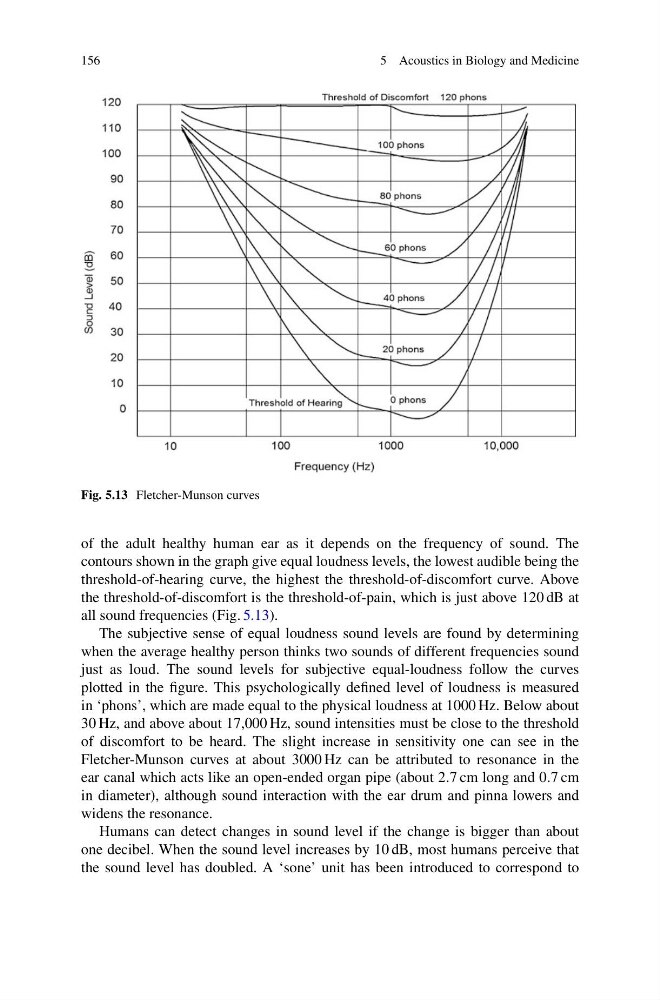
Fig. 5.13 Fletcher-Munson curves
of the adult healthy human ear as it depends on the frequency of sound. The
contours shown in the graph give equal loudness levels, the lowest audible being the
threshold-of-hearing curve, the highest the threshold-of-discomfort curve. Above
the threshold-of-discomfort is the threshold-of-pain, which is just above 120 dB at
all sound frequencies (Fig. 5.13).
The subjective sense of equal loudness sound levels are found by determining
when the average healthy person thinks two sounds of different frequencies sound
just as loud. The sound levels for subjective equal-loudness follow the curves
plotted in the figure. This psychologically defined level of loudness is measured
in ‘phons’, which are made equal to the physical loudness at 1000 Hz. Below about
30 Hz, and above about 17,000 Hz, sound intensities must be close to the threshold
of discomfort to be heard. The slight increase in sensitivity one can see in the
Fletcher-Munson curves at about 3000 Hz can be attributed to resonance in the
ear canal which acts like an open-ended organ pipe (about 2.7 cm long and 0.7 cm
in diameter), although sound interaction with the ear drum and pinna lowers and
widens the resonance.
Humans can detect changes in sound level if the change is bigger than about
one decibel. When the sound level increases by 10 dB, most humans perceive that
the sound level has doubled. A ‘sone’ unit has been introduced to correspond to
5 Acoustics in Biology and Medicine
Fig. 5.13 Fletcher-Munson curves
of the adult healthy human ear as it depends on the frequency of sound. The
contours shown in the graph give equal loudness levels, the lowest audible being the
threshold-of-hearing curve, the highest the threshold-of-discomfort curve. Above
the threshold-of-discomfort is the threshold-of-pain, which is just above 120 dB at
all sound frequencies (Fig. 5.13).
The subjective sense of equal loudness sound levels are found by determining
when the average healthy person thinks two sounds of different frequencies sound
just as loud. The sound levels for subjective equal-loudness follow the curves
plotted in the figure. This psychologically defined level of loudness is measured
in ‘phons’, which are made equal to the physical loudness at 1000 Hz. Below about
30 Hz, and above about 17,000 Hz, sound intensities must be close to the threshold
of discomfort to be heard. The slight increase in sensitivity one can see in the
Fletcher-Munson curves at about 3000 Hz can be attributed to resonance in the
ear canal which acts like an open-ended organ pipe (about 2.7 cm long and 0.7 cm
in diameter), although sound interaction with the ear drum and pinna lowers and
widens the resonance.
Humans can detect changes in sound level if the change is bigger than about
one decibel. When the sound level increases by 10 dB, most humans perceive that
the sound level has doubled. A ‘sone’ unit has been introduced to correspond to