

154
5 Acoustics in Biology and Medicine
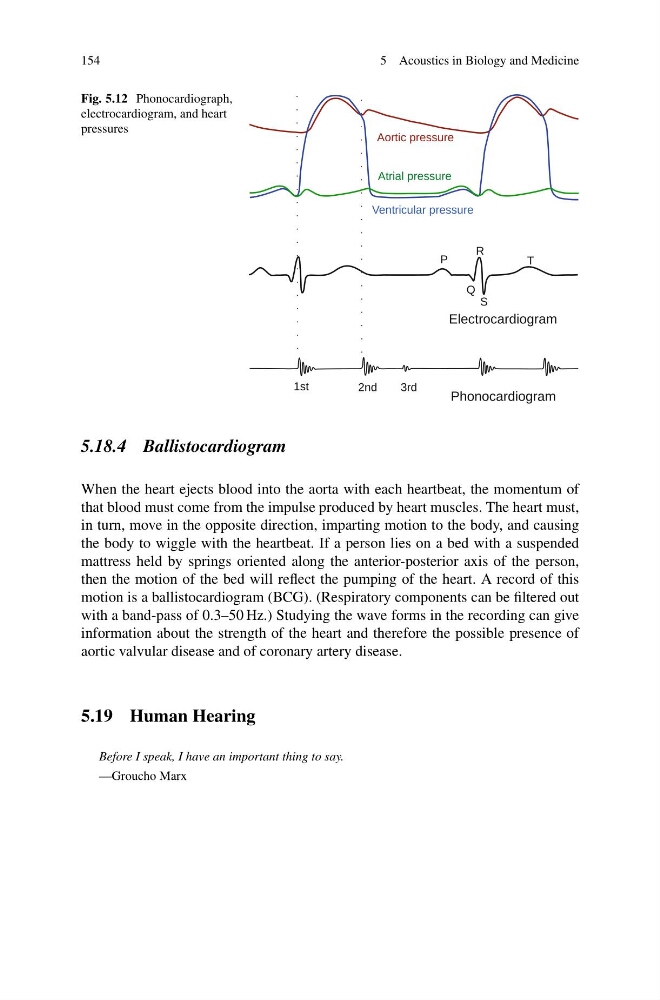
Fig. 5.12 Phonocardiograph,
electrocardiogram, and heart
pressures
5.18.4 Ballistocardiogram
When the heart ejects blood into the aorta with each heartbeat, the momentum of
that blood must come from the impulse produced by heart muscles. The heart must,
in turn, move in the opposite direction, imparting motion to the body, and causing
the body to wiggle with the heartbeat. If a person lies on a bed with a suspended
mattress held by springs oriented along the anterior-posterior axis of the person,
then the motion of the bed will reflect the pumping of the heart. A record of this
motion is a ballistocardiogram (BCG). (Respiratory components can be filtered out
with a band-pass of 0.3–50 Hz.) Studying the wave forms in the recording can give
information about the strength of the heart and therefore the possible presence of
aortic valvular disease and of coronary artery disease.
5.19 Human Hearing
Before I speak, I have an important thing to say.
—Groucho Marx
5 Acoustics in Biology and Medicine
Fig. 5.12 Phonocardiograph,
electrocardiogram, and heart
pressures
5.18.4 Ballistocardiogram
When the heart ejects blood into the aorta with each heartbeat, the momentum of
that blood must come from the impulse produced by heart muscles. The heart must,
in turn, move in the opposite direction, imparting motion to the body, and causing
the body to wiggle with the heartbeat. If a person lies on a bed with a suspended
mattress held by springs oriented along the anterior-posterior axis of the person,
then the motion of the bed will reflect the pumping of the heart. A record of this
motion is a ballistocardiogram (BCG). (Respiratory components can be filtered out
with a band-pass of 0.3–50 Hz.) Studying the wave forms in the recording can give
information about the strength of the heart and therefore the possible presence of
aortic valvular disease and of coronary artery disease.
5.19 Human Hearing
Before I speak, I have an important thing to say.
—Groucho Marx