

4.3 Fluid Dynamics
103
We see that the arterial inductance due to inertia is given by
L a =
ρL
A
.
(4.52)
The source of power for blood flow is an oscillating but rectified generator of
pressure, namely, the heart. Instead of a single set of passive elements: resistor,
capacitor, and inductor, the arterial system is better represented by a series of such
elements on small segments of the arteries, with resistors and inductors in series,
and capacitors in parallel. The heart can be represented in the electric analog by a
wave generator with diodes representing heart valves. The model leads to a set of
linear differential equations for the flow of blood in the arteries and veins.
4.3.10 Pulse Pressure Waves in Arteries
As arterial flow is non-uniform due to varying heart pressure, arteries undergo
elastic expansion and contraction. As a result, elastic waves along the walls of
arteries create a variation in the blood pressure. These pulse-pressure-waves travel
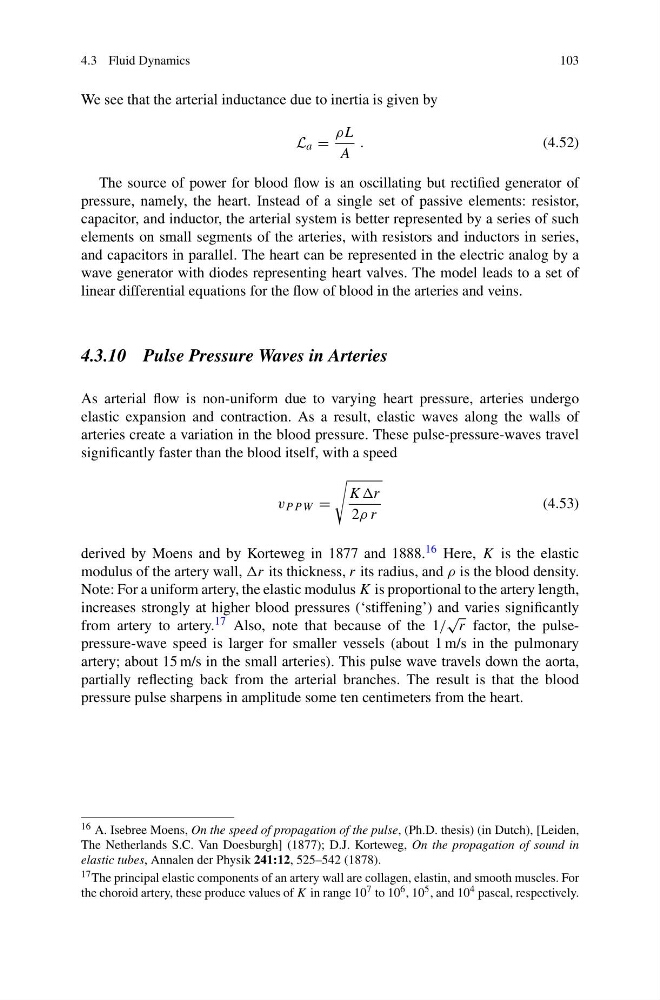
significantly faster than the blood itself, with a speed
v P P W =
KKr
2ρ r
(4.53)
derived by Moens and by Korteweg in 1877 and 1888. 16 Here, K is the elastic
modulus of the artery wall, r its thickness, r its radius, and ρ is the blood density.
Note: For a uniform artery, the elastic modulus K is proportional to the artery length,
increases strongly at higher blood pressures (‘stiffening’) and varies significantly
from artery to artery. 17 Also, note that because of the 1/
√
r factor, the pulsepressure-wave speed is larger for smaller vessels (about 1 m/s in the pulmonary
artery; about 15 m/s in the small arteries). This pulse wave travels down the aorta,
partially reflecting back from the arterial branches. The result is that the blood
pressure pulse sharpens in amplitude some ten centimeters from the heart.
16 A. Isebree Moens, On the speed of propagation of the pulse, (Ph.D. thesis) (in Dutch), [Leiden,
The Netherlands S.C. Van Doesburgh] (1877); D.J. Korteweg, On the propagation of sound in
elastic tubes, Annalen der Physik 241:12, 525–542 (1878).
17 The principal elastic components of an artery wall are collagen, elastin, and smooth muscles. For
the choroid artery, these produce values of K in range 10 7 to 10 6 , 10 5 , and 10 4 pascal, respectively.
103
We see that the arterial inductance due to inertia is given by
L a =
ρL
A
.
(4.52)
The source of power for blood flow is an oscillating but rectified generator of
pressure, namely, the heart. Instead of a single set of passive elements: resistor,
capacitor, and inductor, the arterial system is better represented by a series of such
elements on small segments of the arteries, with resistors and inductors in series,
and capacitors in parallel. The heart can be represented in the electric analog by a
wave generator with diodes representing heart valves. The model leads to a set of
linear differential equations for the flow of blood in the arteries and veins.
4.3.10 Pulse Pressure Waves in Arteries
As arterial flow is non-uniform due to varying heart pressure, arteries undergo
elastic expansion and contraction. As a result, elastic waves along the walls of
arteries create a variation in the blood pressure. These pulse-pressure-waves travel
significantly faster than the blood itself, with a speed
v P P W =
KKr
2ρ r
(4.53)
derived by Moens and by Korteweg in 1877 and 1888. 16 Here, K is the elastic
modulus of the artery wall, r its thickness, r its radius, and ρ is the blood density.
Note: For a uniform artery, the elastic modulus K is proportional to the artery length,
increases strongly at higher blood pressures (‘stiffening’) and varies significantly
from artery to artery. 17 Also, note that because of the 1/
√
r factor, the pulsepressure-wave speed is larger for smaller vessels (about 1 m/s in the pulmonary
artery; about 15 m/s in the small arteries). This pulse wave travels down the aorta,
partially reflecting back from the arterial branches. The result is that the blood
pressure pulse sharpens in amplitude some ten centimeters from the heart.
16 A. Isebree Moens, On the speed of propagation of the pulse, (Ph.D. thesis) (in Dutch), [Leiden,
The Netherlands S.C. Van Doesburgh] (1877); D.J. Korteweg, On the propagation of sound in
elastic tubes, Annalen der Physik 241:12, 525–542 (1878).
17 The principal elastic components of an artery wall are collagen, elastin, and smooth muscles. For
the choroid artery, these produce values of K in range 10 7 to 10 6 , 10 5 , and 10 4 pascal, respectively.