

102
4 Fluid Mechanics Applied to Biosystems
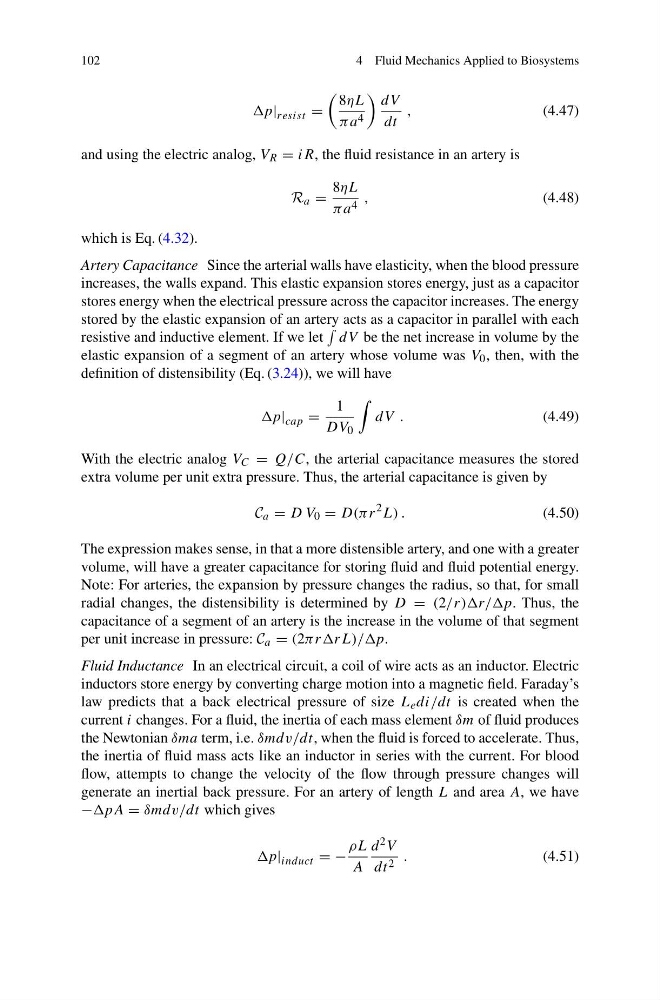
p| resist =
8ηL
πa 4
dV
dt
,
(4.47)
and using the electric analog, V R = iR, the fluid resistance in an artery is
R a =
8ηL
πa 4 ,
(4.48)
which is Eq. (4.32).
Artery Capacitance Since the arterial walls have elasticity, when the blood pressure
increases, the walls expand. This elastic expansion stores energy, just as a capacitor
stores energy when the electrical pressure across the capacitor increases. The energy
stored by the elastic expansion of an artery acts as a capacitor in parallel with each
resistive and inductive element. If we let
dV be the net increase in volume by the
elastic expansion of a segment of an artery whose volume was V 0 , then, with the
definition of distensibility (Eq. (3.24)), we will have
p| cap =
1
DV 0
dV .
(4.49)
With the electric analog V C = Q/C, the arterial capacitance measures the stored
extra volume per unit extra pressure. Thus, the arterial capacitance is given by
C a = D V 0 = D(πr
2 L) .
(4.50)
The expression makes sense, in that a more distensible artery, and one with a greater
volume, will have a greater capacitance for storing fluid and fluid potential energy.
Note: For arteries, the expansion by pressure changes the radius, so that, for small
radial changes, the distensibility is determined by D = (2/r))r//p. Thus, the
capacitance of a segment of an artery is the increase in the volume of that segment
per unit increase in pressure: C a = (2π rrrL)//p.
Fluid Inductance In an electrical circuit, a coil of wire acts as an inductor. Electric
inductors store energy by converting charge motion into a magnetic field. Faraday’s
law predicts that a back electrical pressure of size L e di/dt is created when the
current i changes. For a fluid, the inertia of each mass element δm of fluid produces
the Newtonian δma term, i.e. δmdv/dt, when the fluid is forced to accelerate. Thus,
the inertia of fluid mass acts like an inductor in series with the current. For blood
flow, attempts to change the velocity of the flow through pressure changes will
generate an inertial back pressure. For an artery of length L and area A, we have
−pA = δmdv/dt which gives
p| induct = −
ρL
A
d 2 V
dt 2 .
(4.51)
4 Fluid Mechanics Applied to Biosystems
p| resist =
8ηL
πa 4
dV
dt
,
(4.47)
and using the electric analog, V R = iR, the fluid resistance in an artery is
R a =
8ηL
πa 4 ,
(4.48)
which is Eq. (4.32).
Artery Capacitance Since the arterial walls have elasticity, when the blood pressure
increases, the walls expand. This elastic expansion stores energy, just as a capacitor
stores energy when the electrical pressure across the capacitor increases. The energy
stored by the elastic expansion of an artery acts as a capacitor in parallel with each
resistive and inductive element. If we let
dV be the net increase in volume by the
elastic expansion of a segment of an artery whose volume was V 0 , then, with the
definition of distensibility (Eq. (3.24)), we will have
p| cap =
1
DV 0
dV .
(4.49)
With the electric analog V C = Q/C, the arterial capacitance measures the stored
extra volume per unit extra pressure. Thus, the arterial capacitance is given by
C a = D V 0 = D(πr
2 L) .
(4.50)
The expression makes sense, in that a more distensible artery, and one with a greater
volume, will have a greater capacitance for storing fluid and fluid potential energy.
Note: For arteries, the expansion by pressure changes the radius, so that, for small
radial changes, the distensibility is determined by D = (2/r))r//p. Thus, the
capacitance of a segment of an artery is the increase in the volume of that segment
per unit increase in pressure: C a = (2π rrrL)//p.
Fluid Inductance In an electrical circuit, a coil of wire acts as an inductor. Electric
inductors store energy by converting charge motion into a magnetic field. Faraday’s
law predicts that a back electrical pressure of size L e di/dt is created when the
current i changes. For a fluid, the inertia of each mass element δm of fluid produces
the Newtonian δma term, i.e. δmdv/dt, when the fluid is forced to accelerate. Thus,
the inertia of fluid mass acts like an inductor in series with the current. For blood
flow, attempts to change the velocity of the flow through pressure changes will
generate an inertial back pressure. For an artery of length L and area A, we have
−pA = δmdv/dt which gives
p| induct = −
ρL
A
d 2 V
dt 2 .
(4.51)