

104
4 Fluid Mechanics Applied to Biosystems
4.3.11 Living in Fluids with Low Reynolds Number
The flagella of bacteria have a low mass, and the flagella move in viscous water.
This is an example of a situation where the conditions allow for the inertia term in
the Navier–Stokes equation to be neglected.
As artfully described by E.M. Purcell, 18 microscopic marine life take advantage
of the viscous properties of water. To move through water, an animal must be able to
generate a net forward force on itself over a cycle of its locomotive organs. However,
if the animal is microscopic and living in water, it cannot use its own inertia to carry
it forward with each stroke of locomotive parts, as you or a fish might do. Viscous
forces on the micro-organism dominate over inertia. As soon as the propelling force
vanishes, the organism almost immediately stops.
To estimate the relative sizes of protozoan inertia versus viscous forces acting on
them, take a spherical animal of radius a = 1 micron, density about that of water,
and moving at a typical speed of 30 μ/s. Then the viscous force acting will be given
by Stokes’ law, f = 6πηav. Acting alone, this viscous force will just about stop
the animal in a time given approximately by (4/9)ρa 2 /η = 50 μs. The stopping
distance is only about 14 times the diameter of the hydrogen atom! Clearly, viscous
forces dominate over inertia for these critters.
As we have noted, the unitless Reynolds number R e for fluid flow is often used
to give a threshold for the onset of turbulence under given boundaries for the fluid.
But the Reynolds number, as a ratio of fluid inertial effects to viscous effects, also
characterizes when viscous forces dominate over convective fluid inertial forces for
bodies moving through a fluid. For a fish swimming in water, R e is in the hundreds.
For an ambulating protozoa, R e can be as small as one ten thousandth. For a
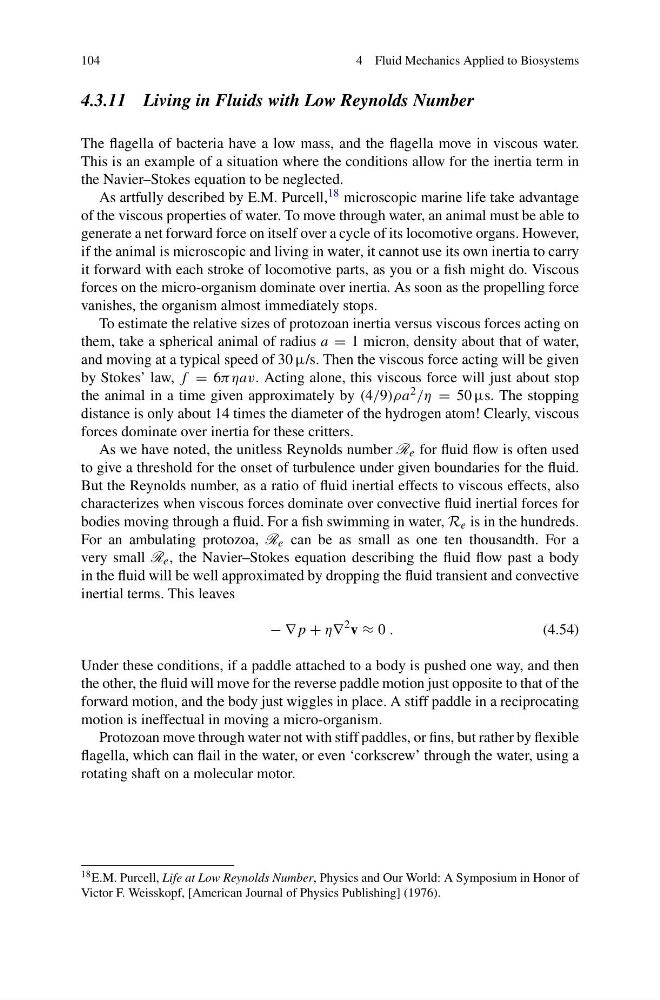
very small R e , the Navier–Stokes equation describing the fluid flow past a body
in the fluid will be well approximated by dropping the fluid transient and convective
inertial terms. This leaves
− ∇p + η∇
2 v ≈ 0 .
(4.54)
Under these conditions, if a paddle attached to a body is pushed one way, and then
the other, the fluid will move for the reverse paddle motion just opposite to that of the
forward motion, and the body just wiggles in place. A stiff paddle in a reciprocating
motion is ineffectual in moving a micro-organism.
Protozoan move through water not with stiff paddles, or fins, but rather by flexible
flagella, which can flail in the water, or even ‘corkscrew’ through the water, using a
rotating shaft on a molecular motor.
18 E.M. Purcell, Life at Low Reynolds Number, Physics and Our World: A Symposium in Honor of
Victor F. Weisskopf, [American Journal of Physics Publishing] (1976).
4 Fluid Mechanics Applied to Biosystems
4.3.11 Living in Fluids with Low Reynolds Number
The flagella of bacteria have a low mass, and the flagella move in viscous water.
This is an example of a situation where the conditions allow for the inertia term in
the Navier–Stokes equation to be neglected.
As artfully described by E.M. Purcell, 18 microscopic marine life take advantage
of the viscous properties of water. To move through water, an animal must be able to
generate a net forward force on itself over a cycle of its locomotive organs. However,
if the animal is microscopic and living in water, it cannot use its own inertia to carry
it forward with each stroke of locomotive parts, as you or a fish might do. Viscous
forces on the micro-organism dominate over inertia. As soon as the propelling force
vanishes, the organism almost immediately stops.
To estimate the relative sizes of protozoan inertia versus viscous forces acting on
them, take a spherical animal of radius a = 1 micron, density about that of water,
and moving at a typical speed of 30 μ/s. Then the viscous force acting will be given
by Stokes’ law, f = 6πηav. Acting alone, this viscous force will just about stop
the animal in a time given approximately by (4/9)ρa 2 /η = 50 μs. The stopping
distance is only about 14 times the diameter of the hydrogen atom! Clearly, viscous
forces dominate over inertia for these critters.
As we have noted, the unitless Reynolds number R e for fluid flow is often used
to give a threshold for the onset of turbulence under given boundaries for the fluid.
But the Reynolds number, as a ratio of fluid inertial effects to viscous effects, also
characterizes when viscous forces dominate over convective fluid inertial forces for
bodies moving through a fluid. For a fish swimming in water, R e is in the hundreds.
For an ambulating protozoa, R e can be as small as one ten thousandth. For a
very small R e , the Navier–Stokes equation describing the fluid flow past a body
in the fluid will be well approximated by dropping the fluid transient and convective
inertial terms. This leaves
− ∇p + η∇
2 v ≈ 0 .
(4.54)
Under these conditions, if a paddle attached to a body is pushed one way, and then
the other, the fluid will move for the reverse paddle motion just opposite to that of the
forward motion, and the body just wiggles in place. A stiff paddle in a reciprocating
motion is ineffectual in moving a micro-organism.
Protozoan move through water not with stiff paddles, or fins, but rather by flexible
flagella, which can flail in the water, or even ‘corkscrew’ through the water, using a
rotating shaft on a molecular motor.
18 E.M. Purcell, Life at Low Reynolds Number, Physics and Our World: A Symposium in Honor of
Victor F. Weisskopf, [American Journal of Physics Publishing] (1976).