

94
M. H. Mahyuddin
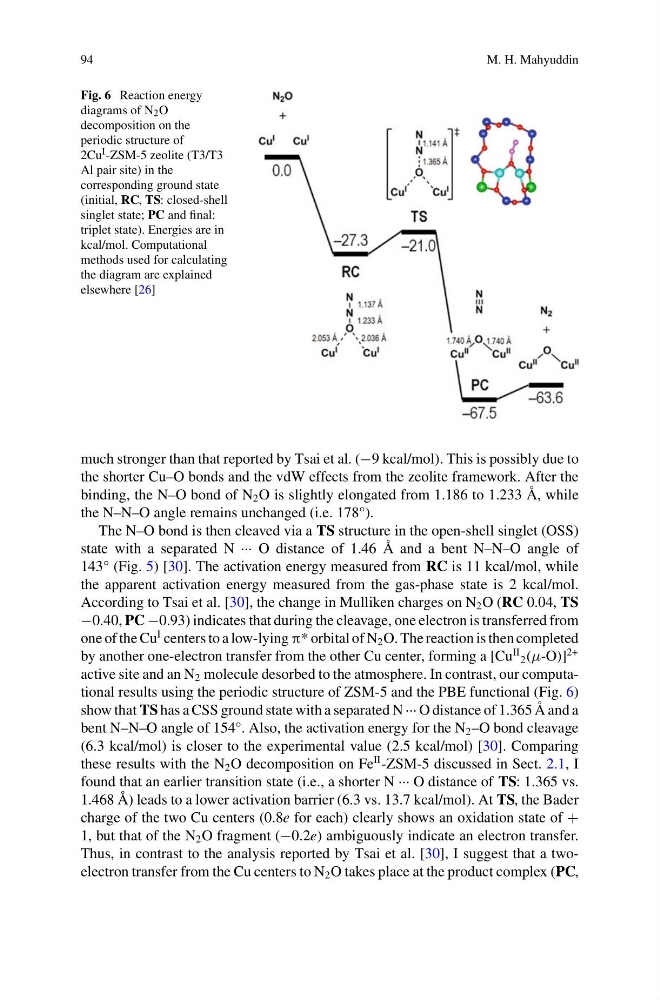
Fig. 6 Reaction energy
diagrams of N 2 O
decomposition on the
periodic structure of
2Cu I -ZSM-5 zeolite (T3/T3
Al pair site) in the
corresponding ground state
(initial, RC, TS: closed-shell
singlet state; PC and final:
triplet state). Energies are in
kcal/mol. Computational
methods used for calculating
the diagram are explained
elsewhere [26]
much stronger than that reported by Tsai et al. (−9 kcal/mol). This is possibly due to
the shorter Cu–O bonds and the vdW effects from the zeolite framework. After the
binding, the N–O bond of N 2 O is slightly elongated from 1.186 to 1.233 Å, while
the N–N–O angle remains unchanged (i.e. 178°).
The N–O bond is then cleaved via a TS structure in the open-shell singlet (OSS)
state with a separated N ··· O distance of 1.46 Å and a bent N–N–O angle of
143° (Fig. 5) [30]. The activation energy measured from RC is 11 kcal/mol, while
the apparent activation energy measured from the gas-phase state is 2 kcal/mol.
According to Tsai et al. [30], the change in Mulliken charges on N 2 O (RC 0.04, TS
−0.40, PC −0.93) indicates that during the cleavage, one electron is transferred from
one of the Cu
I centers to a low-lying π* orbital of N 2 O. The reaction is then completed
by another one-electron transfer from the other Cu center, forming a [Cu
II
2 (μ-O)]
2+
active site and an N 2 molecule desorbed to the atmosphere. In contrast, our computational results using the periodic structure of ZSM-5 and the PBE functional (Fig. 6)
show that TS has a CSS ground state with a separated N ··· O distance of 1.365 Å and a
bent N–N–O angle of 154°. Also, the activation energy for the N 2 –O bond cleavage
(6.3 kcal/mol) is closer to the experimental value (2.5 kcal/mol) [30]. Comparing
these results with the N 2 O decomposition on Fe
II -ZSM-5 discussed in Sect. 2.1, I
found that an earlier transition state (i.e., a shorter N ··· O distance of TS: 1.365 vs.
1.468 Å) leads to a lower activation barrier (6.3 vs. 13.7 kcal/mol). At TS, the Bader
charge of the two Cu centers (0.8e for each) clearly shows an oxidation state of +
1, but that of the N 2 O fragment (−0.2e) ambiguously indicate an electron transfer.
Thus, in contrast to the analysis reported by Tsai et al. [30], I suggest that a twoelectron transfer from the Cu centers to N 2 O takes place at the product complex (PC,
M. H. Mahyuddin
Fig. 6 Reaction energy
diagrams of N 2 O
decomposition on the
periodic structure of
2Cu I -ZSM-5 zeolite (T3/T3
Al pair site) in the
corresponding ground state
(initial, RC, TS: closed-shell
singlet state; PC and final:
triplet state). Energies are in
kcal/mol. Computational
methods used for calculating
the diagram are explained
elsewhere [26]
much stronger than that reported by Tsai et al. (−9 kcal/mol). This is possibly due to
the shorter Cu–O bonds and the vdW effects from the zeolite framework. After the
binding, the N–O bond of N 2 O is slightly elongated from 1.186 to 1.233 Å, while
the N–N–O angle remains unchanged (i.e. 178°).
The N–O bond is then cleaved via a TS structure in the open-shell singlet (OSS)
state with a separated N ··· O distance of 1.46 Å and a bent N–N–O angle of
143° (Fig. 5) [30]. The activation energy measured from RC is 11 kcal/mol, while
the apparent activation energy measured from the gas-phase state is 2 kcal/mol.
According to Tsai et al. [30], the change in Mulliken charges on N 2 O (RC 0.04, TS
−0.40, PC −0.93) indicates that during the cleavage, one electron is transferred from
one of the Cu
I centers to a low-lying π* orbital of N 2 O. The reaction is then completed
by another one-electron transfer from the other Cu center, forming a [Cu
II
2 (μ-O)]
2+
active site and an N 2 molecule desorbed to the atmosphere. In contrast, our computational results using the periodic structure of ZSM-5 and the PBE functional (Fig. 6)
show that TS has a CSS ground state with a separated N ··· O distance of 1.365 Å and a
bent N–N–O angle of 154°. Also, the activation energy for the N 2 –O bond cleavage
(6.3 kcal/mol) is closer to the experimental value (2.5 kcal/mol) [30]. Comparing
these results with the N 2 O decomposition on Fe
II -ZSM-5 discussed in Sect. 2.1, I
found that an earlier transition state (i.e., a shorter N ··· O distance of TS: 1.365 vs.
1.468 Å) leads to a lower activation barrier (6.3 vs. 13.7 kcal/mol). At TS, the Bader
charge of the two Cu centers (0.8e for each) clearly shows an oxidation state of +
1, but that of the N 2 O fragment (−0.2e) ambiguously indicate an electron transfer.
Thus, in contrast to the analysis reported by Tsai et al. [30], I suggest that a twoelectron transfer from the Cu centers to N 2 O takes place at the product complex (PC,