

Oxidative Activation of Metal-Exchanged Zeolite …
95
triplet ground state), where the N–O bond is completely cleaved and an N 2 molecule
is formed and readily desorbed with a desorption energy of only 3.9 kcal/mol.
3.2 O 2 Activation on 2[Cu I 2 ]-MOR
and [Cu III 2 Cu I (MO)]-MOR
In contrast to the N 2 O decomposition, O 2 activation requires four electrons to break
the O=O bond. Unfortunately, the reduced Cu
I ··· Cu
I centers in Cu-zeolites can
provide only two electrons. Thus, two additional electrons from two spectator Cu
I
sites are required. Detailed mechanism of this reaction was reported by Smeets et al.
[31], who experimentally found a μ-η
2 :η
2 -peroxo-Cu
II
2 species as a precursor for
the formation of mono(μ-O)Cu
II
2 active species. The main issue associated with
this mechanism, however, is the fate of the second O atom after the peroxo bond of
the precursor is cleaved. Smeets et al. suggested that the second O atom, instead of
forming a second [Cu 2 (μ-O)]
2+ active species, interacts with the zeolite lattice that
acts as a reservoir for mobile O atoms [31]. However, a recent DFT study by the
Yoshizawa’s group showed that when the second O atom interacts with the lattice
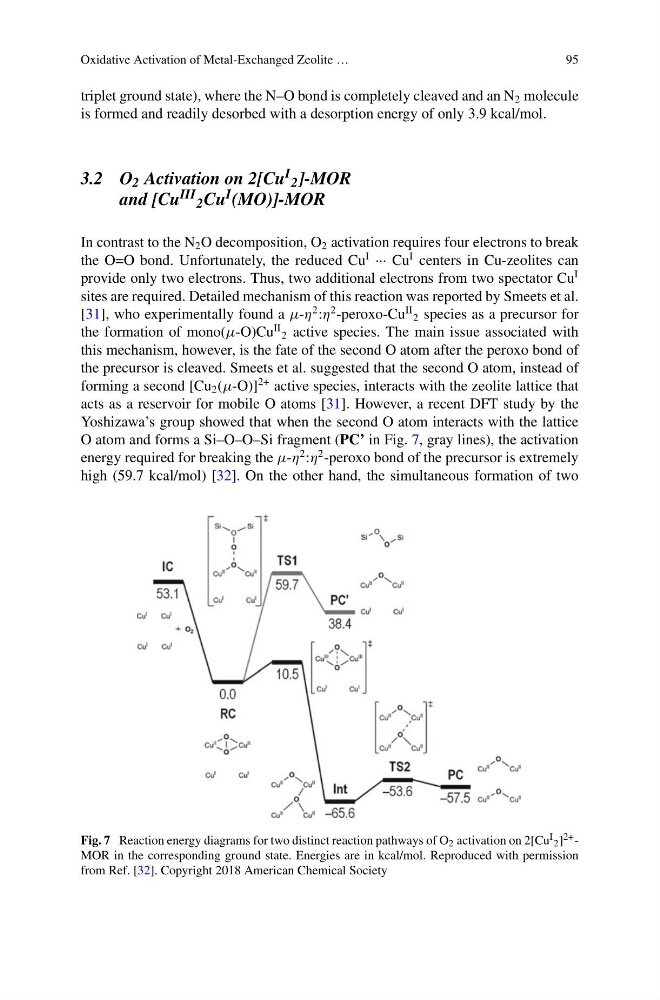
O atom and forms a Si–O–O–Si fragment (PC’ in Fig. 7, gray lines), the activation
energy required for breaking the μ-η
2 :η
2 -peroxo bond of the precursor is extremely
high (59.7 kcal/mol) [32]. On the other hand, the simultaneous formation of two
Fig. 7 Reaction energy diagrams for two distinct reaction pathways of O 2 activation on 2[Cu I 2 ] 2+ -
MOR in the corresponding ground state. Energies are in kcal/mol. Reproduced with permission
from Ref. [32]. Copyright 2018 American Chemical Society
95
triplet ground state), where the N–O bond is completely cleaved and an N 2 molecule
is formed and readily desorbed with a desorption energy of only 3.9 kcal/mol.
3.2 O 2 Activation on 2[Cu I 2 ]-MOR
and [Cu III 2 Cu I (MO)]-MOR
In contrast to the N 2 O decomposition, O 2 activation requires four electrons to break
the O=O bond. Unfortunately, the reduced Cu
I ··· Cu
I centers in Cu-zeolites can
provide only two electrons. Thus, two additional electrons from two spectator Cu
I
sites are required. Detailed mechanism of this reaction was reported by Smeets et al.
[31], who experimentally found a μ-η
2 :η
2 -peroxo-Cu
II
2 species as a precursor for
the formation of mono(μ-O)Cu
II
2 active species. The main issue associated with
this mechanism, however, is the fate of the second O atom after the peroxo bond of
the precursor is cleaved. Smeets et al. suggested that the second O atom, instead of
forming a second [Cu 2 (μ-O)]
2+ active species, interacts with the zeolite lattice that
acts as a reservoir for mobile O atoms [31]. However, a recent DFT study by the
Yoshizawa’s group showed that when the second O atom interacts with the lattice
O atom and forms a Si–O–O–Si fragment (PC’ in Fig. 7, gray lines), the activation
energy required for breaking the μ-η
2 :η
2 -peroxo bond of the precursor is extremely
high (59.7 kcal/mol) [32]. On the other hand, the simultaneous formation of two
Fig. 7 Reaction energy diagrams for two distinct reaction pathways of O 2 activation on 2[Cu I 2 ] 2+ -
MOR in the corresponding ground state. Energies are in kcal/mol. Reproduced with permission
from Ref. [32]. Copyright 2018 American Chemical Society