

Oxidative Activation of Metal-Exchanged Zeolite …
93
3 Oxidative Activation of Cu-Exchanged Zeolites
3.1 N 2 O Decomposition on 2Cu I -ZSM-5
Following the previous work by Woertink et al. suggesting that the [Cu 2 (μ-O)]
2+
formation from N 2 O decomposition is already observed at 100 °C [14], Tsai et al.
carried out kinetics experiments to determine the activation energy of N 2 O activation
on Cu-ZSM-5 by measuring the reaction rate at six different temperatures ranging
from 25 to 100 °C [30]. The measured activation energy from the Arrhenius plot was
reported to be E a = 2.5 kcal/mol, which agree very well with the DFT-calculated
apparent activation barrier (2.0 kcal/mol) [30].
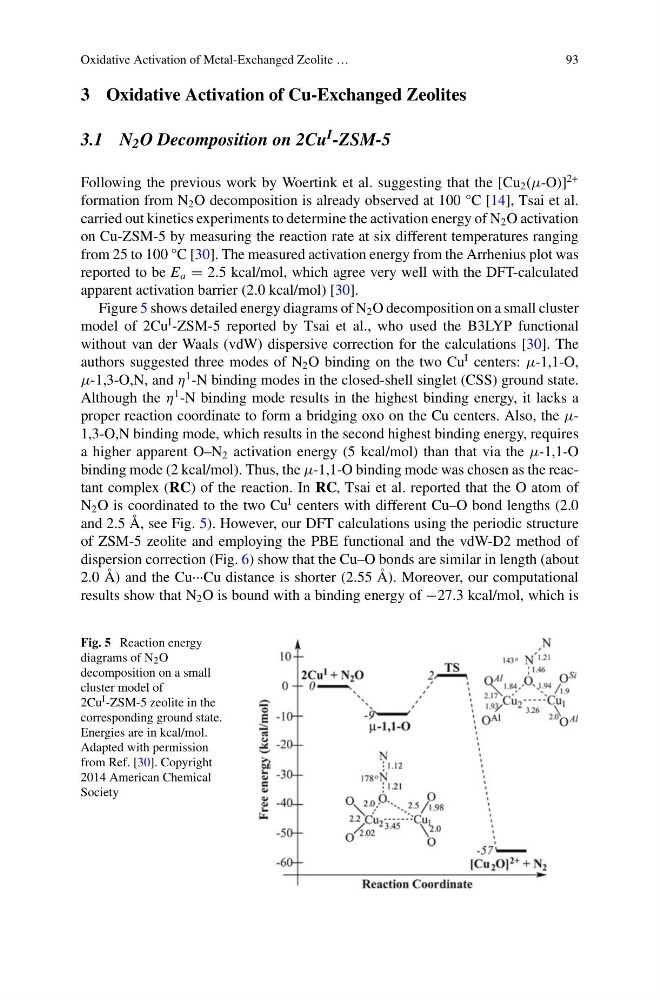
Figure 5 shows detailed energy diagrams of N 2 O decomposition on a small cluster
model of 2Cu
I -ZSM-5 reported by Tsai et al., who used the B3LYP functional
without van der Waals (vdW) dispersive correction for the calculations [30]. The
authors suggested three modes of N 2 O binding on the two Cu
I centers: μ-1,1-O,
μ-1,3-O,N, and η
1 -N binding modes in the closed-shell singlet (CSS) ground state.
Although the η
1 -N binding mode results in the highest binding energy, it lacks a
proper reaction coordinate to form a bridging oxo on the Cu centers. Also, the μ1,3-O,N binding mode, which results in the second highest binding energy, requires
a higher apparent O–N 2 activation energy (5 kcal/mol) than that via the μ-1,1-O
binding mode (2 kcal/mol). Thus, the μ-1,1-O binding mode was chosen as the reactant complex (RC) of the reaction. In RC, Tsai et al. reported that the O atom of
N 2 O is coordinated to the two Cu
I centers with different Cu–O bond lengths (2.0
and 2.5 Å, see Fig. 5). However, our DFT calculations using the periodic structure
of ZSM-5 zeolite and employing the PBE functional and the vdW-D2 method of
dispersion correction (Fig. 6) show that the Cu–O bonds are similar in length (about
2.0 Å) and the Cu···Cu distance is shorter (2.55 Å). Moreover, our computational
results show that N 2 O is bound with a binding energy of −27.3 kcal/mol, which is
Fig. 5 Reaction energy
diagrams of N 2 O
decomposition on a small
cluster model of
2Cu I -ZSM-5 zeolite in the
corresponding ground state.
Energies are in kcal/mol.
Adapted with permission
from Ref. [30]. Copyright
2014 American Chemical
Society
93
3 Oxidative Activation of Cu-Exchanged Zeolites
3.1 N 2 O Decomposition on 2Cu I -ZSM-5
Following the previous work by Woertink et al. suggesting that the [Cu 2 (μ-O)]
2+
formation from N 2 O decomposition is already observed at 100 °C [14], Tsai et al.
carried out kinetics experiments to determine the activation energy of N 2 O activation
on Cu-ZSM-5 by measuring the reaction rate at six different temperatures ranging
from 25 to 100 °C [30]. The measured activation energy from the Arrhenius plot was
reported to be E a = 2.5 kcal/mol, which agree very well with the DFT-calculated
apparent activation barrier (2.0 kcal/mol) [30].
Figure 5 shows detailed energy diagrams of N 2 O decomposition on a small cluster
model of 2Cu
I -ZSM-5 reported by Tsai et al., who used the B3LYP functional
without van der Waals (vdW) dispersive correction for the calculations [30]. The
authors suggested three modes of N 2 O binding on the two Cu
I centers: μ-1,1-O,
μ-1,3-O,N, and η
1 -N binding modes in the closed-shell singlet (CSS) ground state.
Although the η
1 -N binding mode results in the highest binding energy, it lacks a
proper reaction coordinate to form a bridging oxo on the Cu centers. Also, the μ1,3-O,N binding mode, which results in the second highest binding energy, requires
a higher apparent O–N 2 activation energy (5 kcal/mol) than that via the μ-1,1-O
binding mode (2 kcal/mol). Thus, the μ-1,1-O binding mode was chosen as the reactant complex (RC) of the reaction. In RC, Tsai et al. reported that the O atom of
N 2 O is coordinated to the two Cu
I centers with different Cu–O bond lengths (2.0
and 2.5 Å, see Fig. 5). However, our DFT calculations using the periodic structure
of ZSM-5 zeolite and employing the PBE functional and the vdW-D2 method of
dispersion correction (Fig. 6) show that the Cu–O bonds are similar in length (about
2.0 Å) and the Cu···Cu distance is shorter (2.55 Å). Moreover, our computational
results show that N 2 O is bound with a binding energy of −27.3 kcal/mol, which is
Fig. 5 Reaction energy
diagrams of N 2 O
decomposition on a small
cluster model of
2Cu I -ZSM-5 zeolite in the
corresponding ground state.
Energies are in kcal/mol.
Adapted with permission
from Ref. [30]. Copyright
2014 American Chemical
Society